
Knowledge – Fish
Pumpkinseed: Identification, invasiveness and rules
The pumpkinseed (Lepomis gibbosus) is a colourful, deep-bodied perch-like fish from North America that has lived in Europe since the late 19th century. In warm, weedy waters in summer it forms dense stocks and feeds on spawn and juvenile fish. It is on the EU list of invasive alien species and must not be spread further.
In short: An invasive species on the EU Union list, from North America: recognise it and keep it, do not release it again and never transport it alive. What to do with a bycatch: pumpkinseed as bycatch.
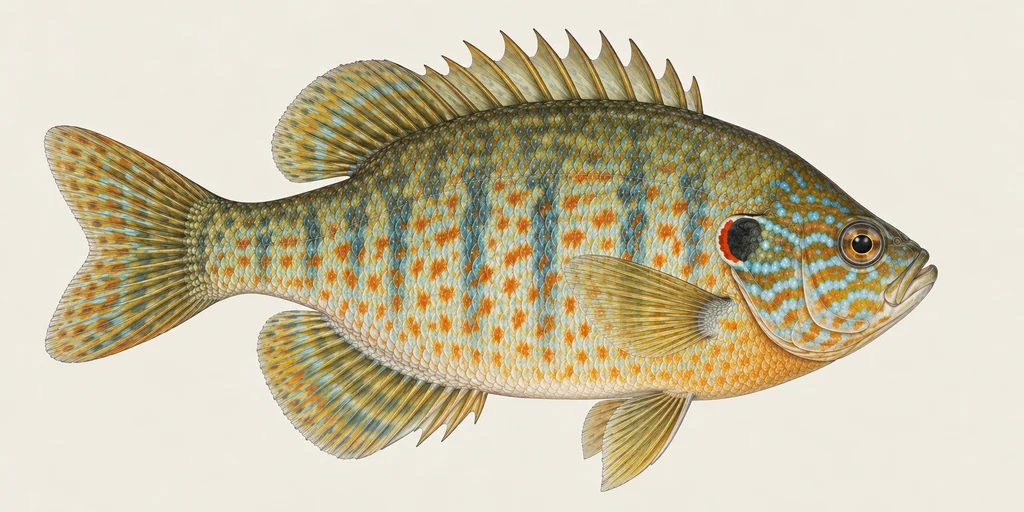
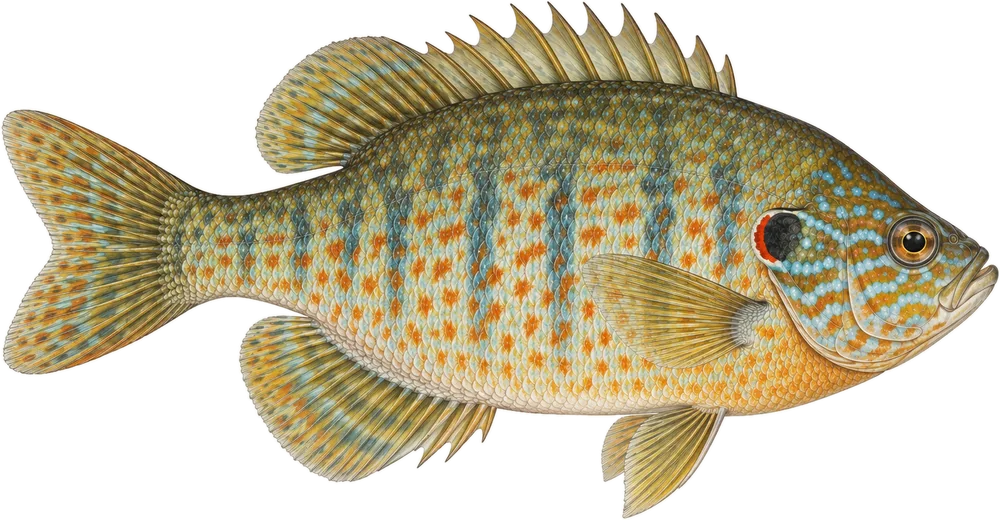
- Skin flap on the gill cover with a black and usually red spot
- Continuous dorsal fin with a spiny front part
- Deep, laterally flattened body with bluish cross bars and colourful spots
Catch chances through the year
- Hardly any chance
- Possible
- Good
- Peak season
- Spawning (observe the closed season)
Editorial assessment for waters in Germany, not a measured value and no guarantee. Spawning time is not the same as the legal closed season.
Species profile and sources in the catch calendarAll species compared month by monthThe rules of your federal state
How to recognise it
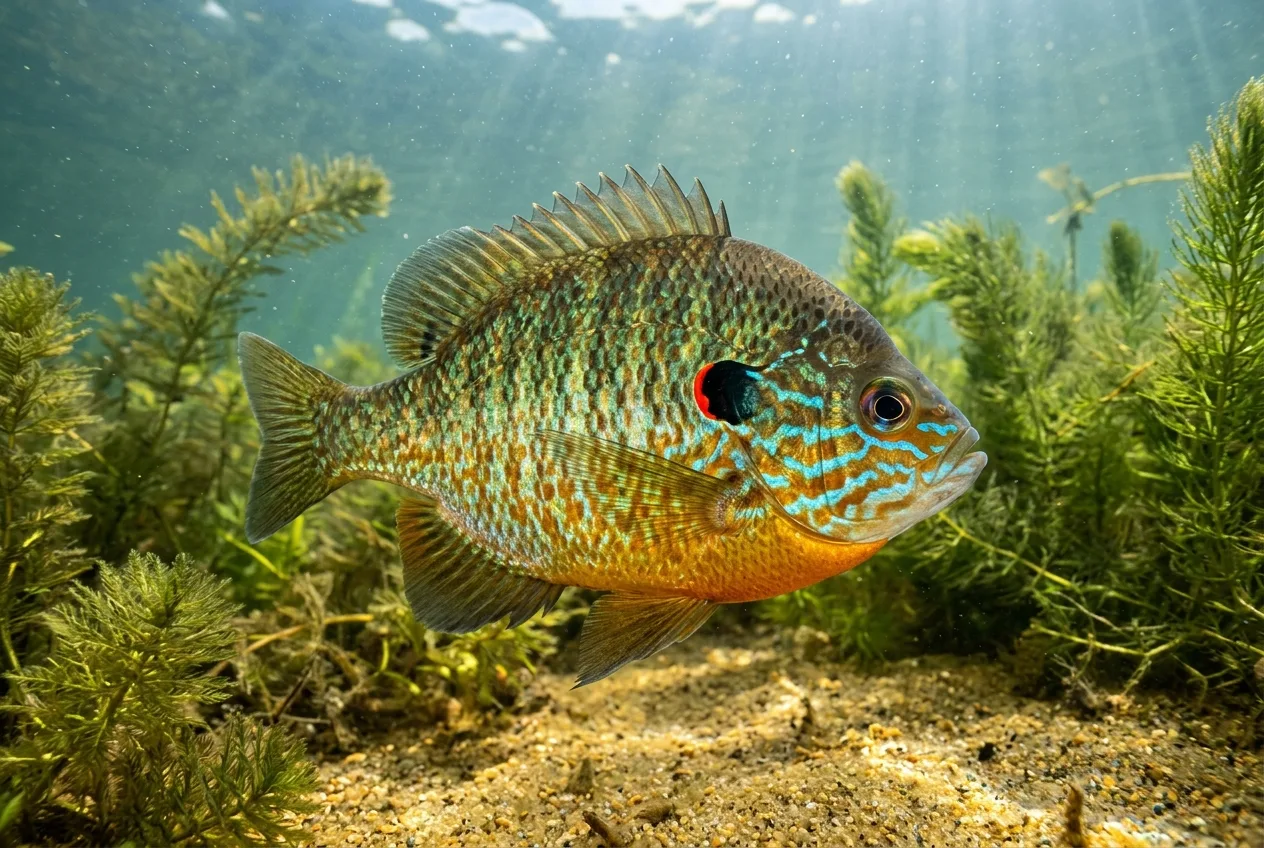
The pumpkinseed is flat from the sides but very deep-bodied and therefore looks stocky, almost disc-shaped. The mouth is slightly upturned. The two dorsal fins are fused into one, the front part of which has 10 to 12 sharp spiny rays.
Hardly any fish in German waters is so colourful. The base colour is orange to brownish, with bluish cross bands on top, and the scales are speckled with red, yellow, blue and emerald-green dots. Typical is the skin-like flap at the end of the gill cover with a black and usually a red spot. Females are less conspicuously coloured overall.
In Europe the pumpkinseed stays small. The Landesamt für Umwelt Brandenburg gives up to 15 centimetres and 250 grams, a Luxembourg leaflet up to 20 centimetres. For its native range FishBase lists up to 40 centimetres, 630 grams and an age of 12 years. Life expectancy is given as 8 to 10 years.
Young perch also have cross bands and spiny rays. But they have two clearly separate dorsal fins, a black spot at the end of the first dorsal fin and no dark gill-cover flap. The pumpkinseed is also much deeper-bodied and more colourful.
According to the Landesamt für Umwelt Brandenburg, the pumpkinseed cannot be confused with native species. Only other non-native sunfish species look similar, such as the green sunfish. You recognise the largemouth bass, also from North America, by its elongated body.
Side by side
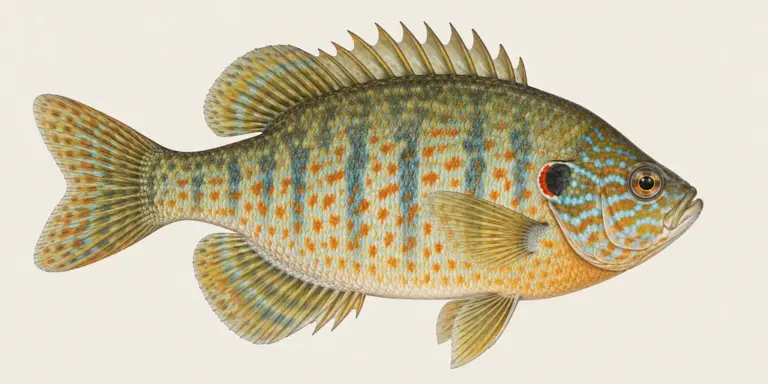
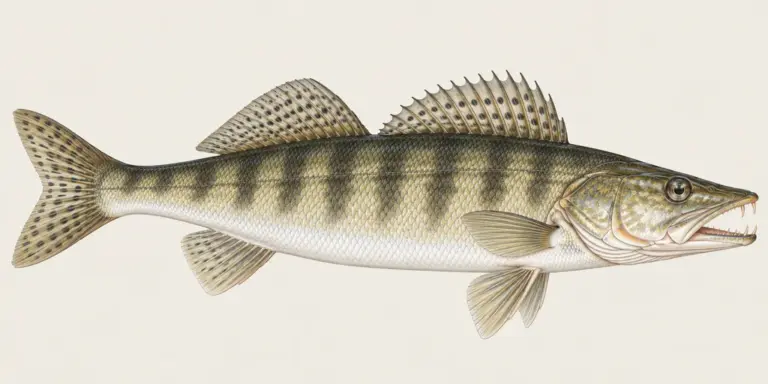
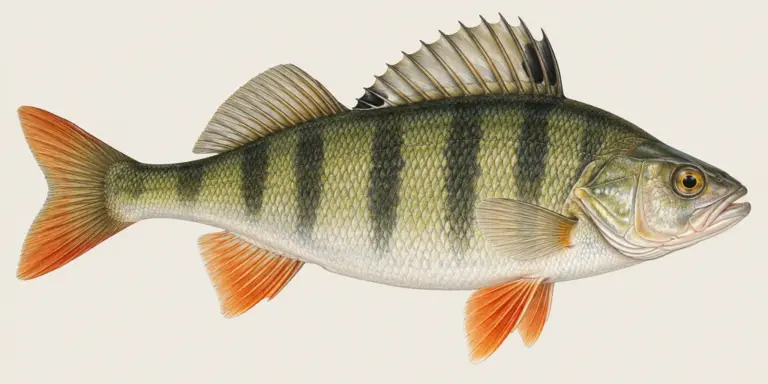
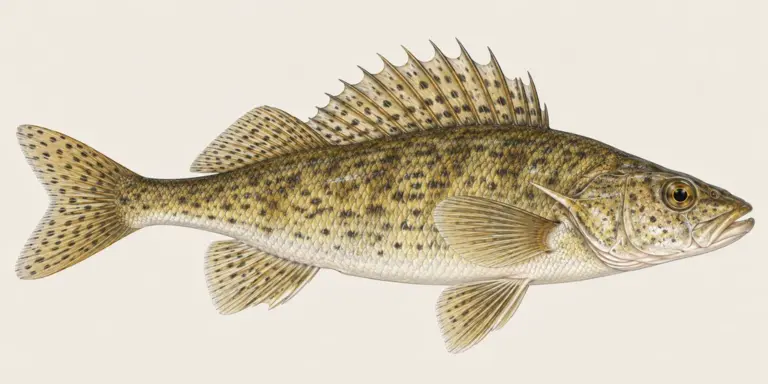
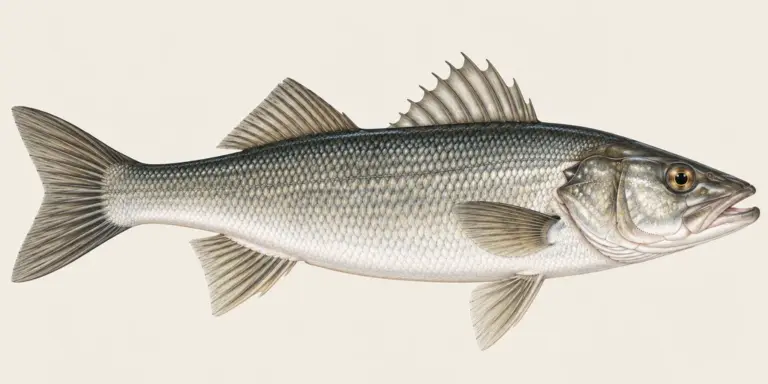
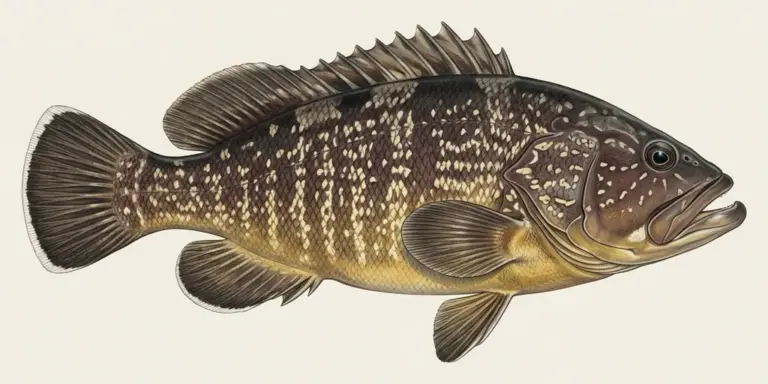
AI-generated illustrations.
Where it comes from and where it lives
The pumpkinseed originally lives in the east of North America, from New Brunswick in Canada to Georgia, in the Great Lakes region and on the upper Mississippi. It came to Germany at the end of the 19th century, mainly as an aquarium fish. Records in the wild existed as early as the beginning of the 20th century.
Today it is regarded as established in most federal states. There is a focus in the south-west; elsewhere the colonisation is often patchy. It prefers shallow stillwaters that are warm in summer and sluggish stretches with plenty of weed. It avoids fast-flowing water. The increasing spread in the North German Plain is linked to the dry summers of recent years.
It was spread by the release of aquarium fish and by stocking, also because it was sold as a pond or biotope fish. Today it spreads on its own along rivers and canals and is carried further by people.
Holding spots in the picture
Choose a season and time of day: the picture shows where the species sits then. Tap a fish or a spot in the list to bring it closer. The picture is schematic and AI-generated, every water is different.
In the lake
reed edge
The pumpkinseed is found here all year round.
Water lilies and weed bed
The pumpkinseed is found here all year round.
The pumpkinseed lives in shallow still waters that heat up strongly in summer. It stays among dense aquatic plants and in the shallow bank zone.
Spring: At spawning time from May the males dig nest hollows in very shallow water at the bank and guard them.
In the river
Calm bay with aquatic plants
The pumpkinseed is found here all year round.
In a river you will find it only in slow-flowing, weedy stretches. It avoids fast water.
Size comparison: AI-generated drawing, schematic.
Nest building and effects on native species
Adult pumpkinseeds live in pairs or small groups, while juveniles roam in larger shoals. They eat worms, insects and their larvae, small crustaceans, small fish, spawn and amphibian larvae.
At spawning time the male builds a nest in very shallow water near the bank and defends it. In Europe a male often spawns with several females in the same nest. He guards the eggs for about a week and then the hatched young as well. Because a female can spawn several times a year, stocks in warm waters grow quickly.
At high density the pumpkinseed competes with native fish for food and eats their spawn and fry. It behaves aggressively towards other species. It is also a host for introduced gill flukes and, as an intermediate host, can transmit the pike tapeworm.
When it spawns
Spawning takes place from May to June, when the water is between 13 and 28 °C. During this time the colourful males can be seen clearly above their nest hollows in the shallows.
There is no angling season, because the pumpkinseed is not a target fish.
You will find the monthly overview of all species and the water temperature check in the catch calendar.
What to do if you catch one
As bycatch: Fishing for pumpkinseed? – how to recognise the species and why a catch must not go back into the water.
The pumpkinseed is not fished for deliberately. Anglers report, however, that in waters where it occurs it often takes small natural baits when you are fishing from a stationary spot. Handle it carefully, the spiny rays of the dorsal fin are sharp.
You do not return a pumpkinseed you have caught, you keep it. The federal states‘ management sheet (Bundesländer) requires this for bycatch from fisheries management. In Bavaria, fish of species not listed in the fisheries regulation (Fischereiverordnung) may not be released again anyway. A fish you keep is stunned and killed humanely straight away. The management sheet considers using the fish better than disposing of it.
Never transport it alive: Bans on possession, trade and transport apply to the pumpkinseed. Do not take it away alive, not even as bait, and never put it into another water.
Check your gear: Before you move to another water, check your landing net, bucket and keepnet. That way you spread neither young fish nor spawn.
Suitable lures
We deliberately show no baits for this species.
Invasive species on the EU Union list: do not transport bycatch alive or use it as bait; whether it has to be kept is regulated by the federal state (Bundesland).
How to cook a pumpkinseed in the pan
In its North American homeland the pumpkinseed counts as a classic pan fish. Its taste is rated just as highly there as that of the bluegill. Its flesh is lean and rich in protein.
The simplest way is to prepare it whole, as is usual with small fish. After stunning and killing, it is scaled and gutted. Watch out for more than the dorsal fin: the anal fin also carries three sharp spines. Then you dust it lightly in flour, the classic meunière way, and fry it in the pan. Pat it dry first: if the skin is wet, the flour will not stick and the fat spits.
What the law says
The pumpkinseed has been on the list of invasive alien species of Union concern since 2019 (Implementing Regulation (EU) 2016/1141, supplemented by Implementing Regulation (EU) 2019/1262). Under Article 7 of Regulation (EU) No 1143/2014 it may not, among other things, be kept, transported, traded or released into the environment. For you at the water that means: recognise it, keep it and do not release it again. This is exactly what the management and action sheet (Management- und Maßnahmenblatt) of the federal states (Bundesländer) demands for bycatch from fisheries management. The German Red List does not assess it, as it is an alien species.
In Bavaria, caught fish of species that are not in the annex to the fisheries regulation (Fischereiverordnung) may not be released again. The pumpkinseed is one of them.
What happens to the fish you keep can be regulated in more detail by the states. The fisheries regulation (Fischereiverordnung) of your federal state (Bundesland) and your fishing permit (Erlaubnisschein) are always binding. You will find a list of links to the official sources in the catch calendar.
What closed season, minimum size and harvest slot mean and where to find them is explained on the page Closed season and minimum size explained.
Frequently asked questions (FAQ)
May I release a pumpkinseed?
No. As a species on the EU Union list it must not be released back into the environment, and the federal states‘ management sheet (Bundesländer) requires bycatch to be kept. In Bavaria the fisheries regulation (Fischereiverordnung) also bans releasing fish of unlisted species. You stun and kill a fish you keep straight away.
May I use pumpkinseeds as bait fish?
Not alive under any circumstances. Bans on possession, trade and transport apply to species on the EU Union list. Whether a dead pumpkinseed is allowed as bait, check with the fisheries authority (Fischereibehörde) of your state.
How do I recognise a pumpkinseed?
By its deep, colourful body with bluish cross bars, the continuous dorsal fin and the gill-cover flap with a black and usually red spot.
Sources
The rating of catch chances is an editorial assessment. The facts come from these sources, and the text is worded in our own words. The illustration is an original design by Angel Momente in the style of a natural history plate (AI-generated, see the AI notice).
- FishBase: Lepomis gibbosus (Größe, Alter, Lebensraum, Nestbau, Brutpflege, Verbreitung)
- Rote-Liste-Zentrum: Sonnenbarsch (Rote Liste 2023: nicht bewertet; Unionsliste nach VO (EU) 2016/1141)
- LANA/NLWKN Niedersachsen: Sonnenbarsch, Management- und Maßnahmenblatt zu VO (EU) Nr. 1143/2014 (Stand 2021)
- Umweltministerium Luxemburg: Merkblatt invasive gebietsfremde Arten, Gemeiner Sonnenbarsch (Merkmale, Fortpflanzung, Lebensraum)
- Landesamt für Umwelt Brandenburg: Steckbrief invasive Arten, Sonnenbarsch (Merkmale, Größe, Verwechslung; nach BfN-Schriften 654)
- Bayerische Staatskanzlei: Verordnung zur Ausführung des Bayerischen Fischereigesetzes (AVBayFiG), Aussetzverbot für nicht gelistete Arten
- Landesfischereiverband Bayern: Fischlexikon, Flussbarsch (Abgrenzung)
- Durchführungsverordnung (EU) 2019/1262 (Aufnahme von Lepomis gibbosus in die Unionsliste)
- Management- und Maßnahmenblatt Sonnenbarsch (Fassung Sachsen, Stand Februar 2021), Maßnahme M 6: Beifänge müssen entnommen werden
- Wisconsin Department of Natural Resources: Pumpkinseed (Lepomis gibbosus), Artenporträt PUB-FH-714
- Landesfischereiverband Bayern: Lernportal der Fischerjugend, Fische aufbewahren, zerteilen und filetieren
- Landesfischereiverband Bayern: Lernportal der Fischerjugend, Fische vorbereiten für die Zubereitung
Created with AI support from the sources listed. Figures only appear in the text if a source gives them. Last updated: 27 October 2026. Found a mistake? Write to us. Who is behind this site: About me.
More in the lexicon
- All fish species at a glance
- Catch calendar – month, water temperature and profile for 93 species
- Line calculator – breaking strain after the knot, drag guideline, backing
- Angling methods