
Knowledge · Tackle
Pin bone pliers and pin bone tweezers
Pin bone pliers pull out the fine pin bones that stay in the flesh after filleting. They are worthwhile for salmon, trout and char; for pike, coarse fish and carp a knife is more help. This page covers how to find the bones, which line to pull along and when the pliers can stay in the drawer.
Which bones stay in the fillet
When filleting you run the knife along the central bone and then cut off the belly bones with the fatty edge. How these cuts run is covered under Filleting and boning fish. What is still in the flesh afterwards, in trout, are cross-wise pin bones in the back part of the fillet. With a salmon trout you check the fillets along the centre line for protruding bones.
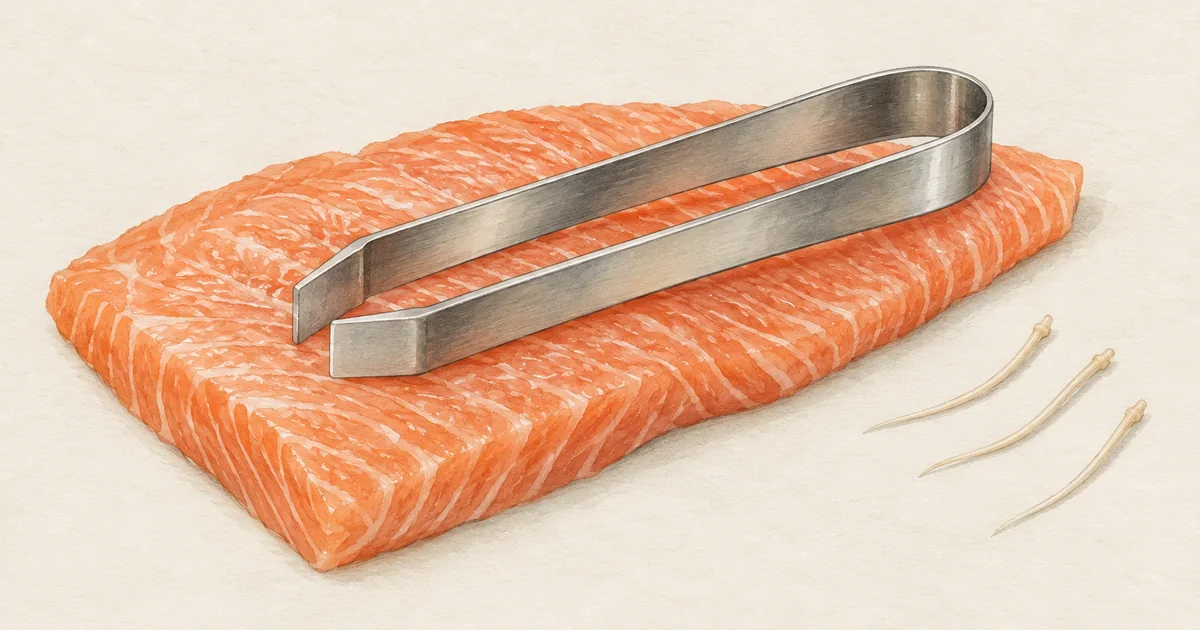
These bones have nothing to do with the ribs. They are ossifications in the connective tissue between the muscle segments, angled backwards and not touching the spine. The Bavarian exam questions for the angling exam (Fischerprüfung) likewise place the Y-shaped bones of the carp family between the segments of the trunk muscles. There they are called intermuscular bones (Zwischenmuskelgräten) or flesh bones (Fleischgräten). Because they sit freely in the flesh, they stay in the fillet when you cut along the backbone.
Check shop-bought fillets too: According to the Bundeszentrum für Ernährung (BZfE), the claim “practically boneless” allows up to one bone per kilogram of raw product. Running a finger over the fillet is therefore worthwhile even with fish from the counter.
Pin bone pliers and pin bone tweezers
In both cases it means a small gripping tool with which you take hold of a single bone by its end and pull it out. The names are not kept strictly apart: one guide to filleting trout calls the tool pin bone tweezers in one place and pin bone pliers in the step that goes with it. In the salmon trout recipe small pliers are enough, in the char recipe tweezers.
Why a separate tool at all: according to BLINKER, professional kitchens work with pin bone tweezers because picking the bones out with your fingers is unhygienic. For cured salmon (gravlax) a special pin bone tweezers from a catering supplier is mentioned. You do not need a knife for pulling bones. The filleting knife only comes back into play when the bones are branched, as in pike.
Feeling for and pulling the bones
- Lay the fillet flat. The flesh side faces up and the skin lies on the board.
- Feel with a finger. Run your index finger over the flesh, with salmon and trout mainly over the back part and the centre line. That is how the recipe instructions describe it. A bone feels like a small, hard peg sticking out of the flesh.
- Grip the end. Set the pliers on the part that sticks out of the flesh.
- Pull along the line of the bone. The bones sit at an angle in the flesh, sloping backwards. So pull them out at the angle at which they sit, not vertically upwards. The angle is shown by the cross-section in Fig. 1.
- Check again by touch. Work through the row bone by bone, then run a finger over it once more.
The recipes set the timing differently. With trout the bones are pulled straight after the belly bones have been cut off, with char before the fillets are rolled up in savoy cabbage, with salmon trout before it goes into the pan. How to deal with a bone you cannot catch is covered under Filleting and boning fish.
Which fish the pliers help with
The pliers grip only one bone at a time. Where the bones branch or are especially numerous, the experts name other methods.
| Fish | Bones in the fillet | What with |
|---|---|---|
| Salmon, trout, char | individual thin bones | Pin bone pliers |
| Pike | Y-bones and a second row | Filleting knife |
| Coarse fish, carp | numerous flesh bones | scoring with the knife |
| Eel | no intermuscular bones | nothing to pull |
Salmon, trout and char
For salmon, trout and char the recipe instructions provide for pulling with pliers or tweezers. Only with cured salmon is it optional; more on that in the next section.
Pike
With pike the pliers are not enough. The leaflet of the Bayerische Landesanstalt für Landwirtschaft (LfL) on boneless pike fillets lists only a soft and a hard filleting knife and a beekeeper’s fork as equipment. The Y-bones come out there together with a wedge-shaped strip of flesh. According to the leaflet, in the middle part and towards the tail there is a second row of intermuscular bones without the Y shape, and these too are released with the knife. The sequence of cuts is covered under Filleting and boning fish.
Coarse fish and carp
The question catalogue for the angling exam (Fischerprüfung) in Saxony-Anhalt names coarse fish as the group with especially many intermuscular bones, the Bavarian exam questions name carp. For coarse fish such as bream or roach the Bavarian questions give scoring instead of the pliers: the muscle is cut through to the skin at intervals of 2 to 3 mm, after which the bones hardly matter after frying or deep-frying. As further methods the catalogue lists a vinegar poaching liquor and scoring combined with fierce frying.
Eel and garfish
According to the Saxony-Anhalt question catalogue, the eel has no intermuscular bones, so the pliers stay in the drawer. Anyone filleting a garfish will be surprised by the colour: the same catalogue names it as a species with green bones.
Cured, fried, raw
For cured salmon it is said that many experts skip pulling the bones. The cure softens the thinner bones, and the thin, diagonally cut slices do the rest. If you want to be quite sure, pull the bones with tweezers before curing.
Gravlax and tartare are not heated. Fish that is to be eaten raw is subject to its own freezing rules, covered under Parasites in fish. For smoked fillets you will find the procedure under Smoking fish.
Working cleanly
The pliers touch raw fish and so count as kitchen utensils. The Bundesamt für Verbraucherschutz und Lebensmittelsicherheit (BVL) recommends cleaning hands, kitchen utensils and work surfaces thoroughly with hot water during and after working with fish. According to the BVL you keep raw fish apart from food that will not be heated again, such as salad. How to chill and store fillets afterwards is covered under Storage and hygiene. For questions about food safety, the food inspection service (Lebensmittelüberwachung) in your district is the right place; this text does not replace its advice.
Common mistakes
- Picking them out with your fingers. That counts as unhygienic; that is what the pliers are for.
- Pulling vertically upwards. The bone sits at an angle in the flesh. Follow its angle, as in Fig. 1.
- Plucking bones from pike. The Y-bones branch. The LfL leaflet cuts them out with the knife in a strip of flesh.
- Working through coarse-fish fillets bone by bone. With so many flesh bones, the Bavarian exam questions give scoring at intervals of 2 to 3 mm.
- Just wiping the pliers after the fish. The BVL advises cleaning utensils thoroughly with hot water after working with fish.
Frequently asked questions
Are pin bone pliers the same as pin bone tweezers?
In use, yes. Both names stand for a small gripping tool with which you pull individual bones out of the fillet. A trout guide uses both words for the same step.
Do I have to pull the bones before curing?
Not necessarily. Many experts do without, because the cure softens the thinner bones and slicing thinly does the rest. If you do not want a bone in your mouth, pull them beforehand with tweezers, which is quite easy.
Why don’t the pliers help with pike?
Its Y-bones are branched and sit in a row between the muscle strands. The LfL leaflet therefore cuts them out together with a wedge-shaped strip of flesh and gets by with filleting knives.
Does an eel fillet have bones?
According to the Saxony-Anhalt question catalogue, the eel has no intermuscular bones. When filleting, the central bone stays on the carcass, so there is nothing left for the pliers.
Related
- Filleting and boning fish: the three cuts and the way to a boneless pike fillet
- Filleting knife: the blade for the cut along the central bone
- Filleting glove: cut protection for the hand that holds the fish
- Atlantic salmon: life cycle, migration and catching
- Pike: the predator with the Y-bones
- Storage and hygiene: chilling, freezing and time limits for fish
- Line calculator: breaking strain and backing for the line, before salmon or trout end up on the board
Sources
- BLINKER: Forelle filetieren, in 10 Schritten zum Filet (Quergräten im Rücken des Filets, Ertasten mit dem Zeigefinger, Grätenzange und Grätenpinzette, Pulen mit den Fingern unhygienisch, Zeitpunkt nach dem Abtrennen der Bauchgräten)
- BLINKER: Lachs beizen leicht gemacht (spezielle Gräten-Pinzette, Beize macht dünnere Gräten weich, dünne Scheiben schräg schneiden)
- BLINKER: Saibling-Rezept, Edelfisch in Wirsingkohl (mit dem Finger über das Fleisch streichen, abstehende Gräten mit der Pinzette entfernen) und BLINKER: Lachsforellen-Rezept (Prüfen entlang der Mittellinie, kleine Zange, Ziehen vor dem Braten)
- Bayerische Landesanstalt für Landwirtschaft: Anleitung zur Herstellung grätenfreier Hechtfilets (PDF) (Ausrüstung, keilförmiger Streifen mit den Y-Gräten, zweite Grätenreihe im mittleren und hinteren Filet)
- LfL Bayern: Staatliche Fischerprüfung, Prüfungsfragen 2023/2024 (PDF) (Lage der Y-Gräten, Karpfen mit vielen Fleischgräten, Schröpfen im Abstand von 2 bis 3 mm, Essigsud, Einschneiden und scharfes Braten)
- Land Sachsen-Anhalt: Fragenkatalog zur Fischerprüfung (PDF) (Weißfische mit besonders vielen Zwischenmuskelgräten, Aal ohne Zwischenmuskelgräten, grüne Gräten beim Hornhecht)
- BZfE: Fisch und Meeresfrüchte, vom Einkauf in die Küche (Bedeutung von „praktisch grätenfrei“)
- BVL: Hygienischer Umgang mit Fisch (Reinigen von Händen, Geräten und Flächen mit heißem Wasser, Trennung von nicht erhitzten Speisen)
- Wikipedia: Gräte (Gräten als Verknöcherungen zwischen den Muskelsegmenten, schräg nach hinten geneigt, ohne Verbindung zur Wirbelsäule; nur ergänzend)
Text AI-assisted, drawing AI-generated. Sources opened and checked in October 2026; no graphics taken from the sources.
All figures are guide values without guarantee. How thoroughly you bone a fish depends on the species, size and preparation; for questions about food safety, the advice of the food inspection service (Lebensmittelüberwachung) applies.