
Knowledge · Tackle
Sharpening knives: Keeping a filleting knife sharp at the water
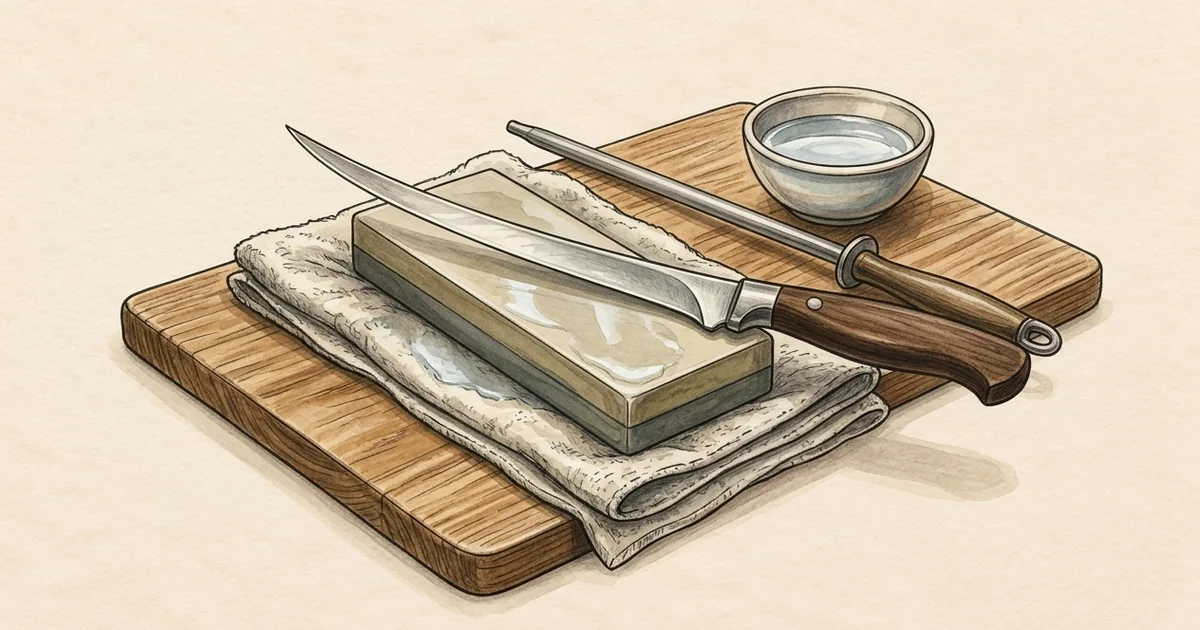
Sharpening a knife means removing steel at the edge until both sides meet again in a fine edge. Honing on a steel is something else: it only straightens the edge that has rolled over during cutting. For the filleting knife at the water, a rod is therefore often enough; the stone only comes out when honing no longer helps.
What happens at the edge
Every blade goes blunt over time. According to the Berufsgenossenschaft Nahrungsmittel und Gastgewerbe (BGN), it wears on the food being cut and on the surface underneath. A second process adds to this: the outermost part of the edge, known in German as the Wate, is gradually pushed to the side during cutting. The knife then glides less well, even though hardly any steel is missing (Fig. 1, centre). According to the BGN, hard surfaces made of glass, ceramic or metal blunt a blade quickly.
The angle
When sharpening, what counts is the angle between blade and stone or rod, measured per side. The sources give guide values that are close together: Blinker holds the angling knife at about 15 degrees on the stone, the BGN gives 15 to 20 degrees for the honing steel, and Stiftung Warentest, in a reply to a reader from 2010, about 20 degrees for the honing rod. Because both sides are ground, the values add up. At 15 degrees per side you get an edge of about 30 degrees.
Hardly anyone takes a protractor to the water. It is easier to judge how high the spine of the blade sits above the stone. A rule of thumb: blade width times 0,26 gives the height for 15 degrees, blade width times 0,34 the height for 20 degrees. With a blade 2,5 centimetres wide, the spine therefore sits about 6,5 millimetres high (15 degrees) to about 8,5 millimetres (20 degrees). With narrow filleting blades the gap is correspondingly smaller. The calculation is rough: it ignores the thickness of the spine, so the real angle comes out slightly larger.
The burr
When the stone grinds right up to the edge, it pushes fine steel over the edge to the other side. This burr shows that the edge has been ground through. Blinker shows it during rough grinding on the grinding wheel as a fine bright line along the edge; from then on the rough grinding is done. At the end the burr must come off again, and that is what the finest stone and the honing steel are for.
Which tool does what
Honing steel. Strictly speaking it does not sharpen; it straightens the rolled-over edge again. The BGN calls this honing. Because the honing steel removes hardly any steel in the process (as the Wikipedia entry on the honing steel also says), it only helps as long as the grind underneath is still good. For commercial kitchens, the BGN requires a hand guard between handle and rod on the honing steel.
Sharpening stone. It removes steel and reshapes the edge. Stones come in different grits: coarse stones grind out nicks and visible scratches, finer ones smooth the edge, and the finest gives the final polish. Water and oil stones are wetted with water or honing oil before and during work. According to Blinker, a little oil makes grinding easier and keeps the blade cooler. According to Stiftung Warentest, water stones break easily and call for patience. For a long filleting knife, its advice not to buy too small a stone applies.
Diamond and ceramic rod. Blinker counts diamond-coated pocket rods among the accessories for sharpening an angling knife. They are small enough for your fishing bag. Ceramic honing rods exist too; how much they remove is not documented by any of the specialist sources used here.
Pull-through sharpener. On these devices the angle is preset and the blade is simply pulled through. The BGN presents such honing devices as an easy-to-use alternative to the honing steel, which takes practice. According to an information sheet from the Deutsche Gesetzliche Unfallversicherung (DGUV) from 2004, special honing systems make it less likely that the blade slips. However, a comparison by the Swiss consumer magazine K-Tipp, reported on by Stiftung Warentest, found big differences: some devices damaged the edge, others posed a risk of cutting your fingers. According to the report, knives with serrated edges and ceramic blades do not belong in the sharpeners tested.
| Tool | Removes steel | What for | What to watch for |
|---|---|---|---|
| Honing steel | hardly | straighten a rolled edge | hand guard, grind must still be good |
| Sharpening stone, coarse | plenty | remove nicks and scratches | wet it, wait for the burr |
| Sharpening stone, fine | little | smooth the edge, final polish | only switch after the burr |
| Diamond pocket rod | yes | touching up on the go | Hold the angle as on the stone |
| Pull-through sharpener | depends on the device | quick, no practice needed | no serrated edges, no ceramic blades |
On the stone, step by step
The short version is under Filleting knife. In more detail, with the techniques from the sources below, the process looks like this:
- Prepare the stone. Depending on the type of stone, wet it with water or a few drops of honing oil and set it down firmly so that it does not move while you sharpen.
- Set the angle. Lay the blade flat on the coarse stone and raise the spine until you reach about 15 to 20 degrees (rule of thumb above).
- Draw in an arc. With light pressure, guide the edge over the stone from the heel to the tip. Your hand follows the curve towards the tip, and the angle stays the same along the whole length (Fig. 2).
- Wait for the burr. Keep grinding until a burr has formed along the whole length on the other side. Only then work the other side in the same way.
- Go finer. Move to the finer stones one after the other, both sides as before. The finest stone gives the final polish.
- Remove the burr. Take off whatever is left of the burr with a few strokes on the honing steel.
- Measure the tip. For hand knives in the meat industry, the BGN considers this safe: 20 millimetres behind the tip, the blade is still at least 8 millimetres wide. Blades ground to a sharper point can pierce protective equipment against stabs; more on this under Filleting glove.
- Rinse and dry. Wash the grinding sludge off blade and stone. Stiftung Warentest also advises rinsing knife and rod after honing and rubbing them dry.
With a machine: if you use a grinding machine, the BGN says to wear safety glasses and follow the operating instructions. Blinker warns that the blade must not get too hot on the grinding wheel. The reason: reheating lowers the hardness of hardened steel, the more so the hotter and longer it is. That is how the Spektrum-Lexikon der Chemie describes it for tempering. According to the Wikipedia entry on sharpening stones, the thin edge is particularly vulnerable to this. So cool it and press the blade on only briefly.
Honing and checking sharpness
Between two sessions on the stone, the honing steel keeps the edge in shape. In a reply to a reader from 2010, Stiftung Warentest describes the process for right-handers like this: the left hand holds the rod, the right hand the knife. The heel of the blade is placed lightly at the tip of the rod and drawn down the rod in a shallow arc to the tip of the knife, at about 20 degrees. After five to ten strokes, the other side of the blade goes against the back of the rod. Left-handers swap hands.
A tomato shows whether the edge bites again: according to the BGN, a sharp knife cuts it without much effort. If that no longer works even after honing, the grind itself is worn and only the stone will help. If the primary grind is completely worn, Stiftung Warentest recommends a professional. The cuts where sharpness matters are shown in Filleting fish.
After salt water and fish slime
Sea water brings chloride onto the blade. The Spektrum-Lexikon der Chemie counts chloride ions among the substances that promote corrosion and names removing them, along with dryness, as protection. After a day on the coast, rinse the knife with fresh water and dry it thoroughly before it goes into the sheath. More on stainless steel and chloride is under Angling knife.
The BGN gives clear rules for cleaning. Wash by hand under running water with a brush or sponge, from the handle towards the tip and with the edge facing away from your body. Knives do not belong in the dishwasher; detergents and high temperatures damage the edge. Nor should they be left soaking in the sink: anyone reaching in easily cuts themselves on the edge, and according to the BGN this happens again and again.
Sharpening and carrying safely
A blunt knife needs more force and slips off the food more easily; according to the BGN, both increase the risk of injury. Sharpening has its own dangers. The BGN advises keeping the edge away from your body while sharpening too, and never grabbing at a falling knife. According to the BGN, damaged knives go into puncture-proof containers and never unsecured into the general waste.
If it happens anyway
For a heavily bleeding cut, the Deutsche Rote Kreuz (DRK) advises pressing material that is as germ-free as possible firmly onto the wound or applying a pressure bandage, raising the injured limb and calling 112 in a life-threatening situation. According to the DGUV first-aid handbook, smaller wounds are covered with dressing material that is as sterile as possible. Because of the risk of lockjaw (tetanus), the same handbook says that in the workplace every wound should be seen by a doctor within six hours. What belongs in the first-aid kit is under First-aid kit, wound care and tetanus protection under Hook injuries and first aid. This text is no substitute for medical advice.
Taking it to the water
The freshly sharpened blade goes dry into a blade guard that covers the whole edge. If you carry a knife loose in your hand, according to the BGN the blade always points downwards and backwards.
For carrying knives, § 42a of the Waffengesetz (German Weapons Act) applies (wording retrieved in November 2026). It prohibits carrying one-handed knives, as well as fixed-blade knives with a blade longer than 12 centimetres. Under paragraph 2, the ban does not apply, among other things, to transport in a locked container or where there is a legitimate interest. As examples, paragraph 3 names professional activity, the cultivation of customs and traditions, sport or a generally recognised purpose. Angling is not listed there.
A pointer, not legal advice: how this is to be assessed in an individual case is left open by the text of the law. The current version is binding; the responsible public order office (Ordnungsbehörde) can give you information. Prohibited zones and other rules on knives at the water are under Angling knife.
Common mistakes
- Trying to rescue a blunt blade with the honing steel. The steel only straightens the edge. If the grind is worn, even long honing will not bring back the sharpness.
- Switching sides before a burr has formed. Then the stone has not yet reached the edge, and the fine stone smooths an edge that is still rounded at the front.
- Grinding the tip too narrow. If the blade is narrower than 8 millimetres 20 millimetres behind the tip, according to the BGN it can pierce stab protection.
- Pulling a serrated edge through the pull-through sharpener. According to Stiftung Warentest, serrated and ceramic blades belong in professional hands.
- Putting the knife in its sheath salty and wet. Chloride and moisture then stay on the blade. Rinse with fresh water first, then dry.
Frequently asked questions
How often do I need to sharpen?
There is no fixed number. According to the BGN, the intervals depend on what and how much is cut. For kitchen knives, Stiftung Warentest recommends honing before every use. You only need the stone when honing no longer helps.
Which angle suits a filleting knife?
The sources used here do not give a separate value for filleting knives. The guide value is 15 to 20 degrees per side; Blinker sharpens the angling knife at about 15 degrees.
Can I have the knife sharpened?
Yes, the BGN generally considers sharpening by a specialist a good choice. In 2014 Stiftung Warentest warned about grinders who ring at the door: the work was often poor and the bill excessive. Reputable businesses state their price in advance.
What should I take to the water for touching up?
A small honing steel for honing the edge, or a diamond-coated pocket rod, as Blinker mentions. The stone stays at home: it needs water, space and time, and according to Stiftung Warentest a water stone breaks easily.
Related
- Filleting knife: flexible and stiff blades, length to suit the fish
- Angling knife: blade shapes, steel and the Weapons Act in detail
- Filleting glove: chain mail and cut protection for the holding hand
- Filleting and boning fish: the cuts for which the knife must be sharp
- Hook sharpener: the small counterpart for blunt hook points
- Multitool and fishing pliers: which other tools belong in your bag
- First-aid kit for angling: dressings for cuts and puncture wounds
- Line calculator: breaking strain and backing, before the fish lands on the board
Sources
- BGN: ASI 7.10, Sicherer Umgang mit Messern in Küchen (PDF) (Wate, Abziehen, 15 bis 20 Grad am Wetzstahl, Handschutz, Tomatenprobe, Fachbetrieb, Abziehgeräte, harte Unterlagen, Reinigen, Transport)
- BGN Akzente: Scharf und spitz, Handmesser in der Fleischwirtschaft (Mindestbreite der Spitze, Schutzbrille an der Maschine, Entsorgung) und BGN Branchenwissen: Messerunfälle verhindern (Schneide abwenden beim Schärfen, fallende Messer)
- DGUV Information 212-864: Schnitt- und Stichschutz bei Handmessern (PDF) (Stand Juli 2004, Abziehsysteme gegen Abrutschen)
- Blinker: Messer schärfen (15 Grad am Stein, grobe und feine Steine, Schleiföl, Grat, Hitze an der Scheibe, Wetzstahl, diamantbesetzte Taschenstäbe)
- Stiftung Warentest: Leserfrage Messer schärfen (2010; Wetzen bei 20 Grad, fünf bis zehn Züge, abspülen), Messerschärfer im Test (Durchziehschärfer, Wellenschliff und Keramik, Wassersteine), Kochmesser, Tipps (Grundschliff vom Fachmann) und test warnt: Messerschleifer (2014; Schleifer an der Haustür)
- Spektrum Lexikon der Chemie: Korrosionsschutz (Chlorid, Trocknung) und Vergüten (Härteverlust beim Erwärmen)
- Deutsches Rotes Kreuz: Blutungen und Blutstillung (Druck, Druckverband, hochhalten, 112) und DGUV Information 204-007: Handbuch zur Ersten Hilfe, Wundversorgung (keimfreie Wundauflage, Tetanus, sechs Stunden)
- Bundesministerium der Justiz: § 42a Waffengesetz (12-cm-Grenze, Ausnahmen)
- Wikipedia: Wetzstahl (Wetzstahl nimmt kaum Stahl ab, Stäbe aus Keramik, nur ergänzend) und Wikipedia: Schleifstein (Klinge auflegen und Rücken anheben, Bogen, Grat, dünne Schneide und Hitze, nur ergänzend)
Text AI-assisted, drawings AI-generated. Sources opened and checked in November 2026, no graphics taken from the sources.
All information is a guide only and without guarantee. Which angle and which tool suit you depends on blade and steel; this page is no substitute for medical or legal advice.