
Knowledge · Tackle
Fly tying: Tools and accessories
When tying flies you wind feathers, hair and synthetic fibres onto a hook with fine thread until they become an insect or a small fish. This page explains which tools you need, in what order a simple fly takes shape and what species protection law says about feathers and fur.
Tools at the tying station
According to the equipment guide of the Fischereiverein Löningen, an artificial fly is an imitation of an insect made from materials such as plastic, wool, feathers or hair, tied onto a hook. The tools for the job can be sorted by task.
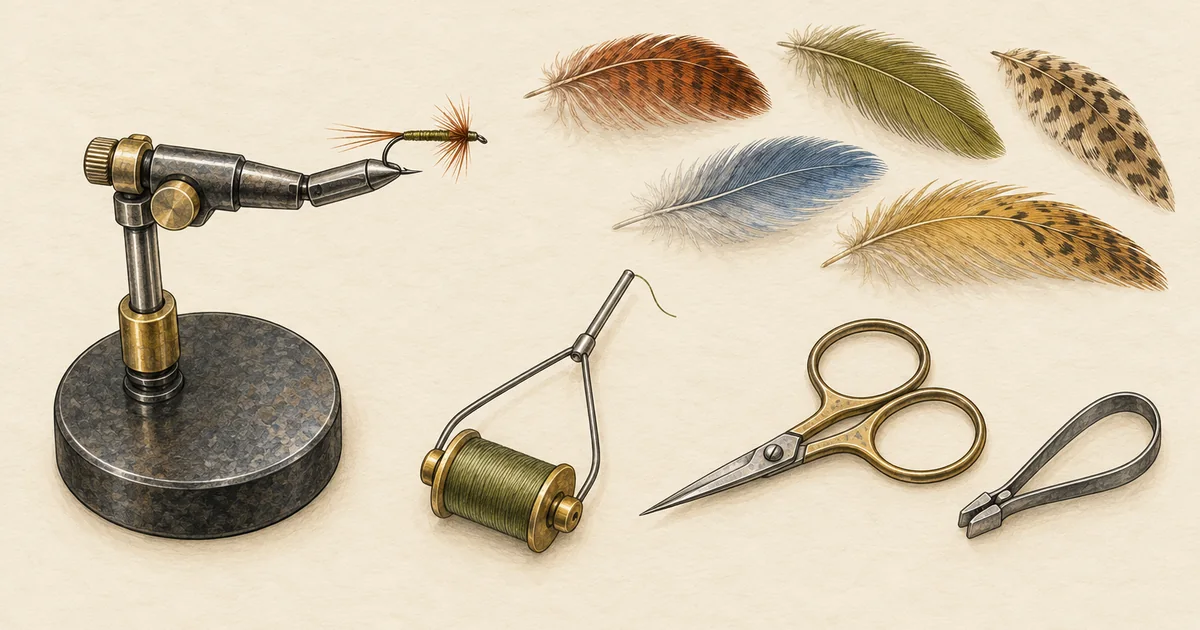
Holding: vice and hackle pliers
The fly-tying vice stands on its own base or is clamped to the edge of the table. Its jaws hold the hook so that both hands are free. There are fixed and rotary vices; with a rotary one you can turn the hook and see the fly from all sides. Before buying, check, as Blinker advises, that the jaws also hold small hooks in sizes 14 to 18 securely.
The hackle pliers are a small clamp. They grip the tip of the hackle feather, that is the feather whose projecting fibres later form the collar around the head of the fly, and hold it while you wind the feather around the hook. One set of instructions even uses them to hold two hackles at once (Fisch & Fang).
Guiding the thread: bobbin and whip finisher
The bobbin, in German Fadenhalter (thread holder), takes the spool of tying thread. The thread runs to the hook through its tube, and the bobbin keeps it under tension. That way you can let the bobbin hang while you wind the hackle, for instance. A model with a ceramic insert and no sharp edges is a good choice. The whip finisher makes the final knot at the head. Because the designs are used in different ways, it is best to try one before you buy.
Cutting and teasing: scissors and dubbing needle
The scissors must be pointed and cut cleanly. Blinker recommends two pairs, a fine one for feathers and thread and a second for wire, because wire and coarse materials dull the fine blade. The dubbing needle is a needle with a handle. You use it to part hair, and in a twisted strand of rabbit fur, for example for the head of a streamer, it loosens the hairs and picks them out. Dubbing is the name for the loose fur or synthetic fibre that is twisted onto the thread.
The hook as the framework
The shape of the hook sets the shape of the fly’s body. Hook sizes are not standardised and vary from maker to maker, so the number is only a rough guide. Labels such as 2X long or 2X strong describe a longer shank or thicker wire. Thick wire makes the hook heavier and suits a nymph better, thin wire a dry fly. The abbreviation BL stands for barbless, a hook without a barb that is gentler on fish. You can flatten the barb of an ordinary hook between the jaws of the vice. Whether barbless hooks are required on your water is set out in the water rules (Gewässerordnung).
How a simple fly is tied
You tie from back to front, one material at a time. The steps follow tying instructions from the angling press.
- Clamp the hook. Set the bend of the hook in the jaws so that the shank lies free.
- Start the thread. Hold the loose end of the thread taut, lay a few turns over it with the bobbin, then wind close turns towards the bend. After about a third of the shank the thread holds without a knot and you cut off the end. This base layer gives the smooth wire a grip so that no material slips. All turns run in the same direction.
- Tie in the tail. Wind a small bump in front of the bend so that the fibres splay later. Strip the fluff from the quill of a feather, pull off five to ten fibres, lay them on top of the hook, hold them with two or three loose turns, align them, then pull tight. For dry flies you use stiff fibres, for nymphs and wet flies soft ones that move in the water.
- Prepare the ribbing. Lay wire, tinsel or thin monofilament against the hook and wrap over it. This is done before the body and is easily forgotten.
- Form the body. Twist a little dubbing between thumb and forefinger around the thread, always in the same direction, and lay the strand forward turn by turn.
- Rib the body. Take the wire diagonally across the body, against the previous direction of winding, with the gaps getting wider towards the eye. Tie it in at the front and cut off the rest. The ribbing protects the body from fish teeth and segments it like an insect.
- Wind the hackle. Tie in the hackle feather at the front, take its tip in the hackle pliers and lay a few close turns just in front of the body so that a collar of fibres forms. Catch the end with the thread and cut it off.
- Whip finish. Use the whip finisher to lay a few turns over the thread and pull tight, cut the thread and secure the knot with a drop of tying varnish.
Length of the tail: As a rule of thumb for nymphs, Blinker gives about a third of the shank length; on dry flies the tail may be as long as the body.
From pattern to type of fly
The equipment guide of the Fischereiverein Löningen distinguishes four groups:
- Dry fly: upright wings and hackles. In the Saxony-Anhalt question catalogue it is the fly with the most hackles, and according to the LfL Bayern question catalogue the hackles increase its buoyancy.
- Wet fly: wings and hackles lie backwards; it is fished in the water.
- Nymph: represents an insect rising to hatch.
- Streamer: imitates small fish or beetles.
Feathers, hair and synthetic fibres
Hackle feathers come from the cock. The cock cape, the skin with its feathers, is one of the basic materials. According to Fisch & Fang, cock capes from American breeding came onto the European market in the early 1980s. The fibres of the peacock feather, peacock herl, are also used for bodies. Hair and fur supply dubbing and streamer wings, for example rabbit as fur strips or as dubbing. Add synthetic fibres, foam, chenille, tinsel and wire. Plastics now also replace rare or endangered feathers and furs. Weight comes from bead heads, gold or tungsten, and from lead wire or lead-free wire.
Species protection and feathers and fur
§ 44 para. 2 no. 1 BNatSchG prohibits „taking into possession or custody, having in possession or custody, or working or processing animals and plants of specially protected species“. Under § 7 para. 2 no. 1, animals also include „readily recognisable parts of animals of wild species“. Under § 7 para. 2 no. 13, the European bird species, among others, are specially protected; the Bundesamt für Naturschutz (BfN) writes that all native bird species in Germany are specially protected.
Exceptions are listed in § 45 para. 1, for example for animals lawfully bred in the EU. § 46 regulates when you must prove your entitlement on request of the nature conservation authority (Naturschutzbehörde). What applies to a particular skin, a bought feather or a find on the bank is answered by the nature conservation authority of your federal state (Bundesland): according to the BfN, the state authorities are responsible for possession and marketing, and the BfN itself for import and export. The protection status of a species is shown by the BfN’s WISIA database; in case of doubt the texts of the law are binding.
Common mistakes
- Bought a vice without thinking of small hooks. Whether the jaws also hold sizes 14 to 18 securely only shows in a test.
- Too much dubbing. Beginners often take too much. It is better to take little and add more if needed.
- Forgotten ribbing. It is tied in before the body, and this is exactly the step that tends to get dropped.
- Cutting wire with the fine scissors. The fine blade gets dull.
- Fraying the thread on the hook point. When winding close to the bend the thread easily brushes the point and gets damaged. If you prick yourself on the point: hook injuries and first aid.
Frequently asked questions
Can you tie flies without a vice?
Yes, but it is harder and takes more dexterity. Simple patterns such as the dry Behm fly, which consists only of a hook, thread and a cock hackle, can, according to Fisch & Fang, be tied in the hand at the water with a little practice.
Which fly should I tie first?
A simple pattern with few materials. A nymph with a bead head, a little lead wire, rabbit dubbing, gold wire as ribbing and a whip finish makes a good first fly. This pattern needs neither a tail nor a hackle.
May I use feathers I find at the water?
The Federal Nature Conservation Act (Bundesnaturschutzgesetz) applies to parts of animals of wild species, and whether an exception applies is decided by the nature conservation authority of your federal state (Bundesland). You can check the protection status of the species beforehand in WISIA.
Related
- Fly fishing: how the line carries the light fly
- Flies, fur and feather lures: all types of fly at a glance
- Dry fly: construction and presentation on the surface
- Nymph and streamer: flies for deeper water and predators
- Fly rod and fly line: the tackle that gets the fly to the water
- Line calculator: estimating the strength of the tippet and knots
Sources
- Blinker: Fliegenbinden für Anfänger: So einfach gelingt der Einstieg (Werkzeug, Haken, Bindeschritte, erste Nymphe)
- Blinker: Bindeanleitung Crazy Rabbit (Dubbingnadel)
- Fisch & Fang: Das Hexerl (Hechel, Kopfknoten, Zuchtbälge) und Fisch & Fang: Die trockene Behmfliege (Binden auf der Hand) und Fisch & Fang: 3. Fly Swap (Hecheln mit der Hechelklemme winden)
- Fischereiverein Löningen: Gerätekunde (PDF) (Fliegengruppen und Materialien), LfL Bayern: Prüfungsfragen 2023/2024 (PDF) (Hecheln und Schwimmfähigkeit) und Land Sachsen-Anhalt: Fragenkatalog Fischerprüfung (PDF) (Trockenfliege mit den meisten Hecheln)
- Bundesnaturschutzgesetz § 44 (Besitzverbote), § 7 (Begriffe), § 45 (Ausnahmen) und § 46 (Nachweispflicht)
- Bundesamt für Naturschutz: Zuständigkeiten im Artenschutzvollzug (Zuständigkeit), BfN: Artenschutz der Vogelschutzrichtlinie (einheimische Vogelarten besonders geschützt) und BfN: WISIA online (Schutzstatus nachschlagen)
- Wikipedia: Fliegenbinden (Bindestock, Fadenhalter, ergänzend) und Wikipedia (en): Fly tying (Hechelklemme, Schere, Kunstfasern, ergänzend)
Text AI-assisted, drawing AI-generated. Sources opened and checked in October 2026; no graphics taken from the sources.
All information is a rough guide without guarantee. Which feathers and furs you may own and process is clarified in each individual case by the nature conservation authority of your federal state (Bundesland).