
Knowledge · Tackle
Gaffs and landing hooks: What is allowed and what is not
A gaff is a pole with a large hook, used to grab a heavy fish and lift it ashore or on board. Because the hook injures the fish, the study materials for the angling exam say it must then be stunned and killed immediately. The gaff is therefore out of the question for any fish that is to go back into the water, and some water rules ban it altogether.
Design: pole, hook and rope
The study materials for the angling exam describe the tool briefly. The Fischereiverein Löningen calls it a pole with a hook, the question catalogue of Saxony-Anhalt a tool for landing particularly large fish. In the worksheets of the Landesfischereiverband Baden-Württemberg, the hook is pushed under the gill cover and the fish lifted out of the water with it. Blinker also speaks of a gaff hook; it means the same landing hook.
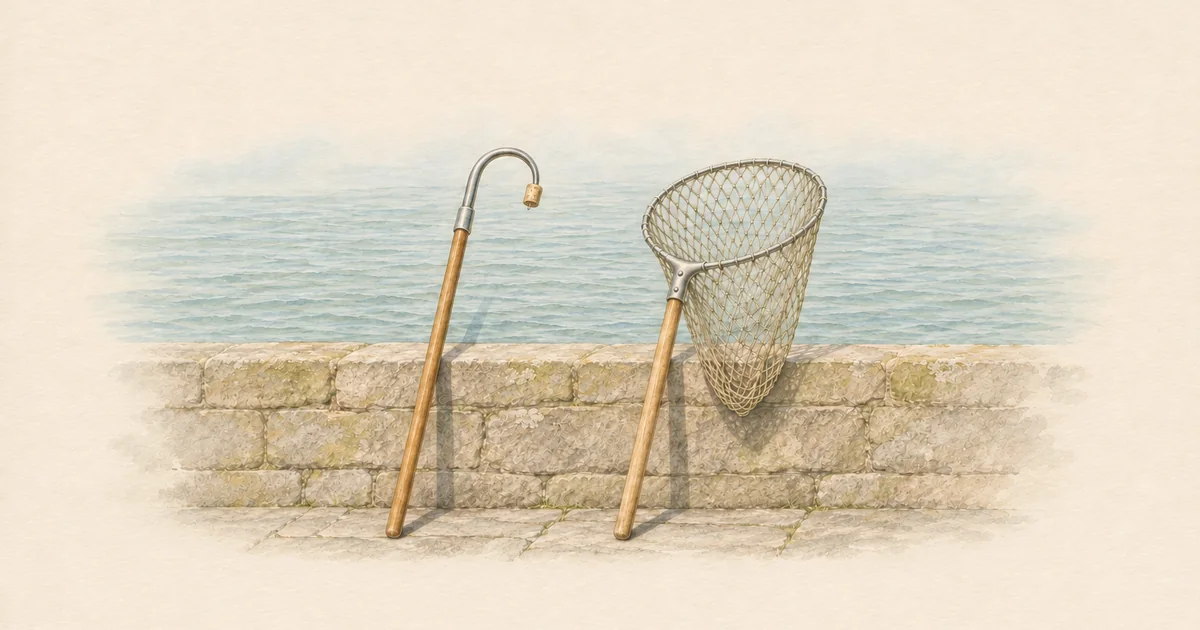
On a fixed gaff, the hook is permanently attached to the pole. There is also the gaff with a rope, known in English as a flying gaff: under strong pull its head detaches from the pole and then hangs on a strong rope or cable attached to the boat. A Blinker packing list for Norway includes a gaff hook with rope for landing halibut. The IGFA, the international association that keeps records of catches in sport fishing, allows gaffs up to 2,44 m overall length for records, and for a gaff with a detachable head a rope of no more than 9,14 m, measured from the point where it is attached to the head.
The tool has little to do with freshwater angling. In the question catalogue of Saxony-Anhalt, a large carp is normally landed with a landing net, and the gaff is listed there as a wrong answer. Which landing nets are available for large fish is under Landing net.
Animal welfare: a gaffed fish is killed
In § 1, the Animal Welfare Act (Tierschutzgesetz) requires a reasonable cause before pain, suffering or harm is inflicted on an animal. For the gaff, the exam materials draw a clear line. The worksheets of the Landesfischereiverband Baden-Württemberg require the fish to be stunned and killed humanely and without delay after gaffing. In the Saxony-Anhalt catalogue the correct answer is the same: stun and kill properly at once. Putting the gaffed fish in a keepnet or unhooking and releasing it are wrong answers there.
A review of gentle angling methods in the journal Fisheries Research (2016) advises against gaffs and lip grippers if the fish is to swim again, because both often leave injuries. The IGFA prohibits the gaff for its length records, for which the fish is released alive after measuring.
It follows that you decide about the gaff before landing, not afterwards. It is only used on a fish that is certain to be of legal size, not protected and allowed to be kept. How stunning and killing work is under Stunning and killing fish, the tool for it under Fish priest.
What state law and water rules say
Fishing law is state law. In the state fisheries acts and fisheries regulations we reviewed in November 2026, we did not find the word gaff. Special rules such as those for Lake Constance were not part of this review. The texts reviewed contain general bans and requirements on landing, for example:
- Saxony, § 24 Abs. 1 Nr. 3 Sächsisches Fischereigesetz: the use of injuring tools, except fish hooks, is prohibited, and so is merely carrying such tools at the water.
- Schleswig-Holstein, § 31 Abs. 1 Landesfischereigesetz: when fishing, injuring tools may not be used, among other things, except fish hooks.
- Bremen, § 7 Abs. 3 Binnenfischereiverordnung: fish are landed with a landing net where the location allows.
- Hamburg, § 4 Abs. 3 Durchführungsverordnung zum Fischerei- und Angelgesetz: a landing net suited to the spot and the expected catch must be used.
Whether a gaff counts as an injuring tool or may still be used alongside the landing net is left open by the wording. The fisheries authority of your state gives a binding answer. The exam catalogue of the Saxon Landesamt für Umwelt, Landwirtschaft und Geologie (as revised 06/2025) calls the gaff a landing tool that is not permitted in Saxony. That is exam material, not legal text. Which equipment the states actually prescribe is under Mandatory equipment at the water.
Associations and fishing permits
The water rules are clearer. The Landesverband Sächsischer Angler prohibits grippers and gaffs in its water rules (2024 edition, no. 1.17). The Landesanglerverband Thüringen requires fish on the Saalekaskade in 2026 to be landed gently with a landing net and bans the gaff. Both apply only to the waters of the association concerned. What applies at your water is in the water rules and the fishing permit; see Fishing permit and water map.
Rule for practice: a gaff should only be used on a fish that will definitely be kept, and at a water where the tool is not prohibited. If either is uncertain, land with a net or by hand, or unhook in the water.
Sea, charter boats and Norway
For charter boats on the German coast, we have found no official requirement governing the gaff on board. Whether gaffs are used on board and which landing aid the crew keeps ready is best asked when booking. What else belongs in your bag is in the Packing list for a charter boat trip; the routine on board is described in Fishing from a boat and a charter boat.
In Norway, the Fiskeridirektoratet gives no rule on the gaff for recreational anglers on its halibut page. But it does give rules that affect every landing (as of November 2026):
- The minimum size is 84 cm.
- Every halibut over 2 m, or over 1,6 m without the head, must go back into the sea. This applies in all Norwegian waters and expressly also to fish that are dying or already dead. The reason is high levels of potentially hazardous contaminants.
- North of Stad (62° N), halibut are protected from 20 December to 20 April; south of it, they may not be fished for at all, all year round. In these cases, fish that are still viable go back.
A halibut whose length is not yet clear when you land it therefore has no place on the gaff: if it turns out to be too big, it still has to go back, only injured. For fishing in the fjords, Blinker often considers a large landing net a better landing aid than a gaff. More on the target fish under Halibut fishing, and on the waters under Fishing holiday in Norway.
Sweden shows how differently neighbouring countries handle this. For the fishing area of the Torneälv, the Swedish fisheries regulation (Förordning 1994:1716, chapter 2 a, § 4 b) bans, until 31 May 2027, the hook on a shaft used to lift a fish caught by other means. The area is described on the region page Lapland.
Alternatives to the gaff
Big landing net
The landing net takes up the fish without injuring it and leaves you the choice of whether it stays or goes back. Frame size, mesh and handle length for big fish are covered under Landing net.
Landing by hand
According to Blinker, landing by hand is fairly gentle. The magazine distinguishes between the gill grip, neck grip, perch grip and tail-wrist grip. Your hands must be wet beforehand so that the slime layer and scales are not damaged. With the gill grip, the fish should not hang vertically out of the water, because then its whole weight pulls on the neck vertebrae; it is better to lift it horizontally with both hands. You can practise the grips on a food fish that has already been killed. According to Blinker, many landing gloves have a rough surface that grips well but damages the mucous membrane. More on hands, mat and disgorger under Landing and unhooking fish.
Fish grip
A fish grip clamps the fish by its lower jaw. The review mentioned above also advises against it if the fish is to go back, and the Saxon state association bans it together with the gaff. When it still helps is covered under Fish grip.
Unhooking in the water
According to Blinker, you should always unhook undersized fish and fish caught in the closed season (Schonzeit) in the water. A long disgorger makes this quick. How the fish then swims off again is shown in Returning fish.
| If … | then … | because … |
|---|---|---|
| the fish should or must go back | landing net, hand landing or unhooking in the water | a gaffed fish is killed |
| the length is still unclear, e.g. with halibut | check the length first, if in doubt release it in the water | even a fish that is too big has to go back |
| the water regulations ban the gaff | Landing net | the association’s rule applies on its waters |
| a big carp is on the hook | Landing net | the correct exam answer in Saxony-Anhalt |
| the fish is definitely being kept and the gaff is allowed | gaff possible, priest within reach | then stun and kill immediately |
Before a gaff goes on the boat
- Read the water regulations, the fishing permit (Erlaubnisschein) or the host country’s rules and check whether the gaff is banned there.
- Check the minimum size (Mindestmaß), closed season (Schonzeit) and fishing bans for the target species, including any maximum size, as for halibut in Norway. The terms are explained in Closed season and minimum size explained.
- Pack a large landing net as well, for any fish that should go back or whose length is uncertain.
- Stow the priest and knife so that they are in your hand without searching.
- Only reach for the gaff once it is certain the fish is staying. If in doubt, use the landing net.
Common mistakes
- Gaffing before the length is known. In Norway, a halibut over 2 m has to go back into the sea even if it is injured or dead.
- Releasing the gaffed fish or keeping it alive. Both are wrong answers in the Saxony-Anhalt question catalogue; the right one is to stun and kill it immediately.
- Taking the gaff to a water where it is banned. The Landesverband Sächsischer Angler and the Thüringer Landesanglerverband on the Saalekaskade expressly prohibit it.
- Only a gaff with you, no large landing net. Then there is no gentle landing aid for a fish that has to go back.
- Rough landing gloves for fish that are to go back. According to Blinker they damage the mucous membrane; wet hands are gentler.
Frequently asked questions
Is a gaff banned in Germany?
It is not mentioned explicitly in any state fisheries act (Landesfischereigesetz) or state fisheries regulation (Landesfischereiverordnung) that we have looked through. Some states ban injurious devices other than fish hooks; whether a gaff counts as one is for the fisheries authority (Fischereibehörde) to answer. Some associations regulate it in their water regulations; the Landesverband Sächsischer Angler, for example, bans it.
Can I release a gaffed fish?
Not according to the exam materials from Baden-Württemberg and Saxony-Anhalt: there, a gaffed fish is stunned and killed immediately, and releasing it counts as a wrong answer. A review on releasing fish advises against the gaff because it often causes injury.
Do I need a gaff in Norway?
We have not found any requirement to carry one. Blinker often considers a large landing net the better landing aid in the fjord. With halibut, the obligation to return fish over 2 m is a reason to check the length first and only gaff it if it may be kept.
What is a flying gaff?
A gaff with a rope whose hook head comes away from the pole under heavy pull. The head then stays connected to the boat by a strong rope, while the pole stays in your hand. It is intended for very large sea fish that are being kept.
Related
- Landing net: frame, mesh and handle for big fish
- Fish grip: design, jaw injuries and what it is good for
- Stunning and killing fish: blow to the head, checking and the cut to the heart
- Fish priest: weight, blow and stowing it within reach
- Mandatory equipment at the water: what the federal states really require
- Fishing from a charter boat and a boat: routine on board and rules on the coast
- Halibut fishing: playing and landing the largest flatfish
- Line calculator: breaking strain to match heavy sea fish
Sources
- Landesfischereiverband Baden-Württemberg: Gerätekunde, Arbeitsblätter zur Fischerprüfung (PDF) (Gaff unter den Kiemendeckel, danach unverzüglich betäuben und töten)
- Land Sachsen-Anhalt: Fragenkatalog zur Fischerprüfung, Stand 28.04.2022 (PDF) (Gaff für besonders große Fische, Behandlung nach dem Gaffen, großer Karpfen mit Kescher)
- Saxony, LfULG: Prüfungsfragen Gerätekunde, Bearbeitungsstand 06/2025 (PDF) (Gaff in Sachsen nicht zugelassen, Prüfungsstoff) und Fischereiverein Löningen: Gerätekunde (PDF) (Gaff als Stab mit Haken)
- Bundesministerium der Justiz: Tierschutzgesetz, § 1 (Grundsatz) und Fisheries Research: Best practices for catch-and-release recreational fisheries, 2016 (PDF) (Gaffs und Lippengreifer beim Zurücksetzen)
- Freistaat Sachsen: Sächsisches Fischereigesetz (§ 24 Abs. 1 Nr. 3) und Land Schleswig-Holstein: Landesfischereigesetz (§ 31 Abs. 1, verletzende Geräte)
- Freie Hansestadt Bremen: Bremische Binnenfischereiverordnung vom 30. September 2011 (§ 7 Abs. 3) und Freie und Hansestadt Hamburg: Verordnung zur Durchführung des Hamburgischen Fischerei- und Angelgesetzes (§ 4 Abs. 3, Unterfangkescher)
- Landesverband Sächsischer Angler: Gewässerordnung, Ausgabe 2024 (PDF) (Nr. 1.17, Greifer und Gaff) und Landesanglerverband Thüringen: Anlage zur Jahreskarte Saalekaskade 2026 (PDF) (Landen mit dem Unterfangkescher, Gaff verboten)
- Fiskeridirektoratet: Kveite for fritidsfiskarar (Mindestmaß, Rückwurfpflicht über 2 m, Schonzeit und Fangverbot) und Sveriges riksdag: Förordning (1994:1716) om fisket, vattenbruket och fiskerinäringen (Kapitel 2 a § 4 b, Torneälv)
- Blinker: Norwegen, Angeln im Fjord (großer Kescher statt Gaff), Blinker: Angelausrüstung für Norwegen (Gaffhaken mit Seil für Heilbutt) und Blinker: Fische landen mit Kescher, Greifer oder Hand (Handlandung, Griffe, Landehandschuhe, im Wasser abhaken)
- International Game Fish Association: International Angling Rules (Länge von Gaff und Seil bei Rekorden, Gaff-Verbot bei Längenrekorden) und Wikipedia: Gaff (fishing) (Aufbau des Flying Gaff, nur ergänzend)
Text AI-assisted, drawings AI-generated. Sources opened and checked in November 2026, no graphics taken from the sources.
All information is a guide only and given without guarantee. Whether a gaff is allowed on your water is stated in the water regulations and fishing permit; if in doubt, ask the fisheries authority.