
Knowledge – Fish
Payara (vampire fish): Features, way of life, catching
The payara (Hydrolycus scomberoides), also called the vampire fish because of its long fangs, is a predatory characin from the Amazon basin. It hunts fish in open water and seizes them with two large teeth in the lower jaw. In the angling world several species of the genus Hydrolycus go under the name payara.
In short: According to the catch calendar, the best time is the whole year. Good spots on a lake: open water and surface; on a river: main current. Proven baits: baitfish that resembles an open-water fish, on a steel trace. Payara is a collective name for the genus Hydrolycus. Hydrolycus scomberoides lives only in the Amazon basin, and the payara of the Orinoco is usually Hydrolycus armatus. Step by step: Payara fishing.
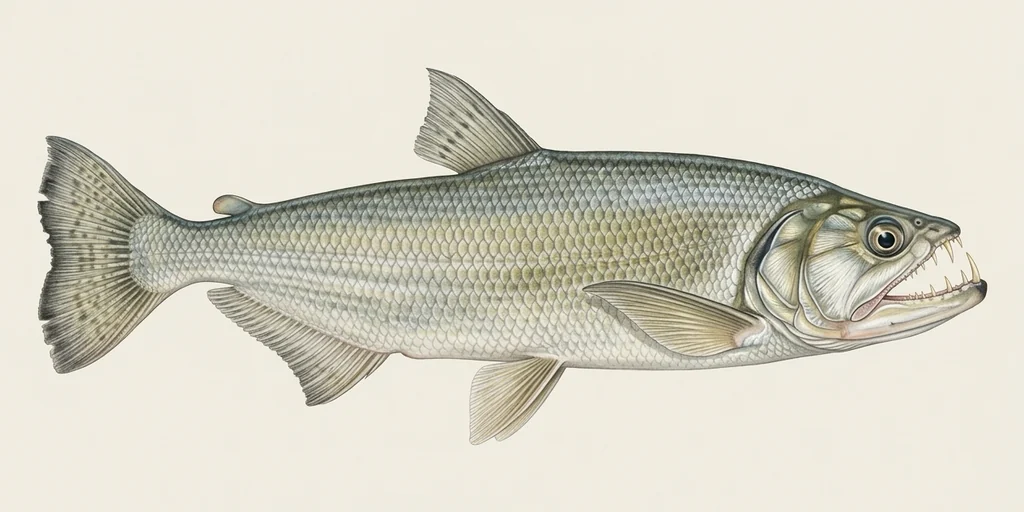
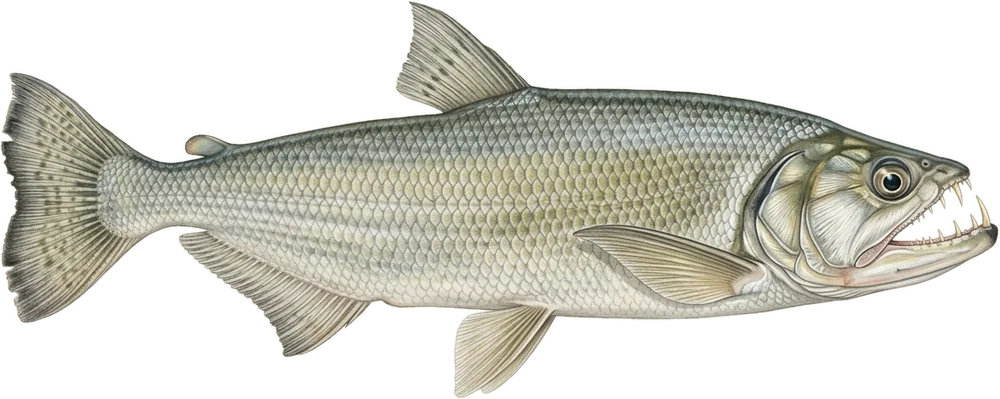
- Long fangs in an upward-pointing mouth with a projecting lower jaw
- Large pectoral fins set far forward
- Elongated body with a narrow head
Catch chances through the year
- Hardly any chance
- Possible
- Good
- Peak season
- Spawning (observe the closed season)
Editorial assessment for the home water (Amazon basin (Brazil)), not a measured value and not a guarantee. The rules of the country you travel to are binding.
How to recognise it
The payara is long and has a narrow head with a large, upward-pointing mouth. The lower jaw projects. The long canine teeth in the lower jaw are striking, and they gave the fish the names vampire fish and dogtooth characin.
The pectoral fins are greatly enlarged. Researchers suspect that the payara uses them to accelerate from below upwards to seize prey.
FishBase gives contradictory values for size: 117 cm and 17,8 kg as the greatest listed length, but only 40 cm in the text on biology. Reliable series of measurements on the final size of this species are rare.
Side by side: two payara species (external differences are not documented in freely accessible sources)
| Feature | Hydrolycus scomberoides | Hydrolycus armatus |
|---|---|---|
| Distribution according to FishBase | Amazon basin only | Amazon and Orinoco basins, rivers of Guyana |
| Size according to FishBase | contradictory, the high value comes from an angling record list | up to 89 cm and 8,5 kg, from series of measurements in Brazil |
Several species go under the name payara. Besides H. scomberoides the genus Hydrolycus includes H. armatus and H. tatauaia, among others. The angling organisation IGFA therefore lists the payara as Hydrolycus spp.
According to FishBase, H. scomberoides occurs only in the Amazon basin. Hydrolycus armatus, by contrast, lives in the Amazon and Orinoco basins and in rivers of Guyana. So anyone who catches a payara in Venezuela usually has this species on the hook. In Brazil the species are called Cachorra.
Where it hunts
The payara is widespread throughout the Amazon basin and hunts in the open water of rivers and lakes. In the Rio Machado in Rondônia it was common in a two-year study.
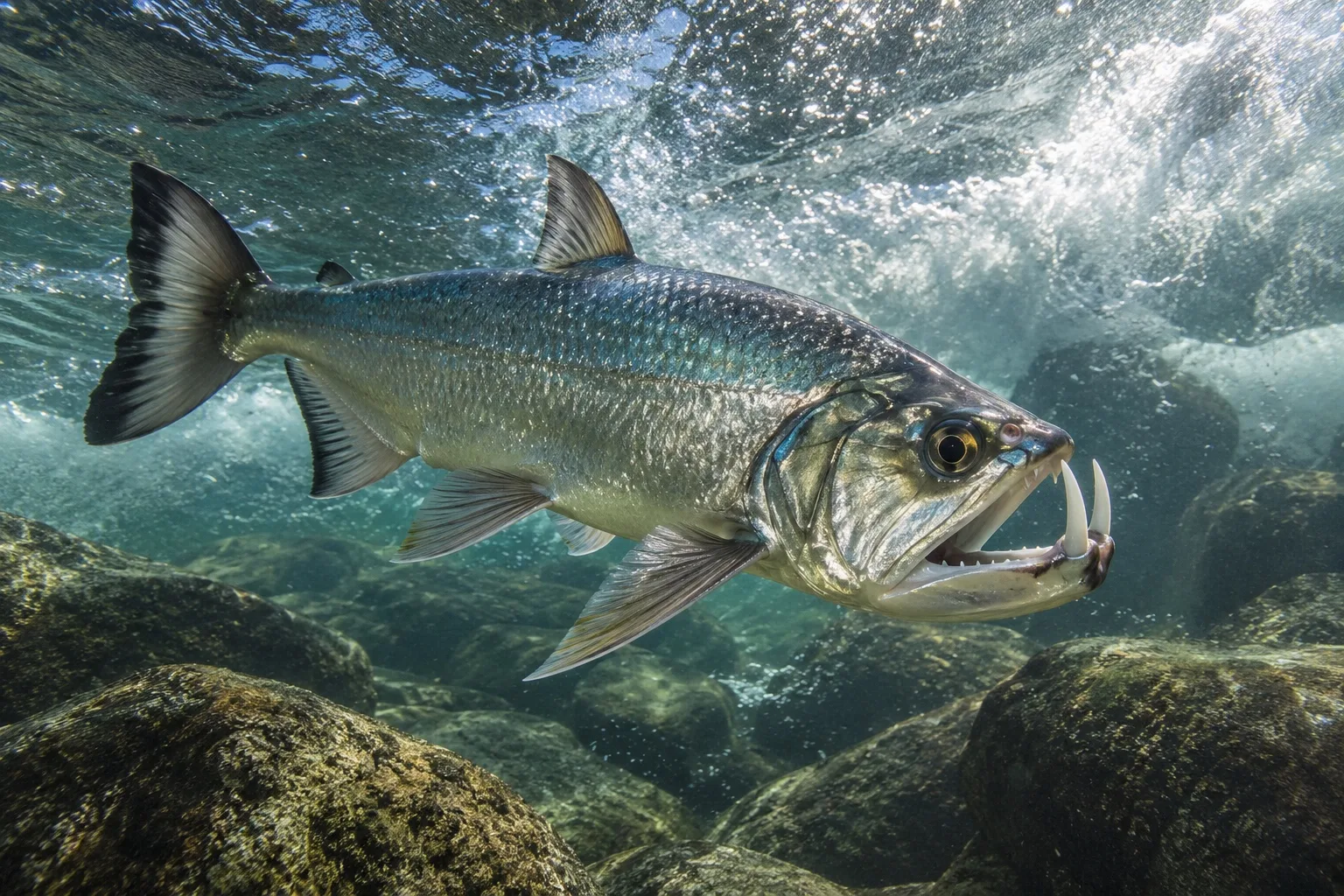
The whole family of dogtooth characins hunts by sight. A study in the Bananal floodplain in Mato Grosso found more of these fish the clearer the water was. If a water becomes cloudier from sediments from land use, this can harm their stocks.
Holding spots in the picture
Choose the time of day: the picture shows where the species holds. We do not show German seasons for travel fish; the bars give the chance of a catch for each month. Tap a fish or a spot in the list to bring it closer. The picture is schematic and AI-generated, and every water is different.
Chance of a catch per month according to the catch calendar
- J
- F
- M
- A
- M
- J
- J
- A
- S
- O
- N
- D
In the lake
Open water
Payara (vampire fish) are found here all year.
Just below the surface
Payara (vampire fish) are found here all year.
In lakes of the Amazon basin the payara hunts in open water and often just below the surface. Because it hunts by sight, it is more common in clear water than in murky water.
In the river
Free current in mid-river
Payara (vampire fish) are found here all year.
In the river the payara stands in free water and catches characins and other shoaling fish there. It stays higher up than the corvina, which feeds on the bottom. Clear stretches are more promising than murky ones.
Depth: With its gaze directed upwards it hunts in the upper layers of water and just below the surface.
Size comparison: AI-generated drawing, schematic.
How it gets its prey
The payara is a specialised fish eater. In the Rio Machado researchers examined the stomachs of 134 payaras: they had eaten mainly open-water fish, including characins and curimbatás. The prey is usually swallowed whole or speared on the fangs. Its gaze is directed upwards, and it hunts near the surface and in open water.
In the same river lives the corvina (Plagioscion squamosissimus), also a predator. It eats mainly fish on the bottom, and the diets of the two species hardly overlap. For anglers this means: the payara hunts rather in mid-water and above. You should not rule out the bottom all the same, because FishBase lists the species as living near the bottom (benthopelagic), and in the Guri reservoir in Venezuela it ate mainly catfish and corvinas.
Its diet changed only little between high and low water. The related species H. armatus is regarded on the Xingu as a slow-growing predator with low fecundity and a long generation time.
When and where the season is
For the payara itself there are no reliable data on the spawning period and main season. Its diet changes little between high and low water, so there is no fixed season calendar.
When a trip makes sense depends above all on the water level in the river concerned, which differs greatly between the Amazon and Orinoco basins. Ask locally when the water is clear, because the payara hunts by sight. Clear stretches and phases with little suspended matter are the better choice.
How to fish for it
Step by step: Payara fishing: how to catch it, step by step – season, spots, baits, tackle and rules on one page.
Because the payara eats almost only fish and hunts near the surface, the bait belongs in mid-water or above and should resemble a prey fish. A baitfish is a good natural bait, and Florida State University names live piranhas as a proven bait.
The long fangs call for a steel trace. Also plan on a large landing net or lip grip, and never put your hand in the fish’s mouth.
Look for clear water: Dogtooth characins are more common where the water is clear. In cloudy stretches the search is hardly worthwhile.
Hands away from the mouth: The fangs are long and sharp. Unhook with long pliers.
Suitable lures
Baitfish that resembles an open-water fish, on a steel trace.
AI-generated illustrations. A click opens the lure’s page.
Long fangs: steel trace and unhooking pliers.
Which rules apply
According to the IUCN Red List the payara is not globally threatened. There is no international trade protection under CITES.
Licences and catch rules are set by the authorities in the country you travel to: in Brazil IBAMA and the environmental authorities of the states, in Venezuela and Colombia the national fisheries authorities. Information from the competent local authority is the one that counts, including on closed seasons and protected areas.
Frequently asked questions (FAQ)
Why is the payara called the vampire fish?
Because of the two long canine teeth in the lower jaw. It spears prey fish with them.
Is every payara a Hydrolycus scomberoides?
No. Payara is a collective name for the genus Hydrolycus. H. scomberoides lives only in the Amazon basin, and in the Orinoco and Guyana it is Hydrolycus armatus.
What does the payara eat?
Almost only fish. A study in the Rio Machado found mainly characins and other open-water fish in the stomachs, and they are usually swallowed whole.
Sources
The rating of catch chances is an editorial assessment. The facts come from these sources, and the text is worded in our own words. The illustration is an original design by Angel Momente in the style of a natural history plate (AI-generated, see the AI notice).
- FishBase: Hydrolycus scomberoides
- FishBase: Hydrolycus armatus
- Costa & Nunes (2022), Iheringia Série Zoologia: Niche partitioning of two piscivorous fish species in a river in the western Brazilian Amazon
- de Melo et al. (2009), Neotropical Ichthyology: Relationships between water transparency and abundance of Cynodontidae species in the Bananal floodplain
- Camargo, Giarrizzo & Isaac (2015), Brazilian Journal of Biology: Population and biological parameters of selected fish species from the middle Xingu River
- Brazilian Journal of Biology (2015): Artisanal fisheries of the Xingu River basin in Brazilian Amazon
- International Game Fish Association: Game Fish Database
- Williams, Winemiller u. a. (1998), North American Journal of Fisheries Management 18: Ecology and Status of Piscivores in Guri, an Oligotrophic Tropical Reservoir
- Florida State University, Molecular Expressions – The Silicon Zoo: Hydrolycus
Created with AI support from the sources listed. Figures only appear in the text if a source gives them. Last updated: 27 October 2026. Found a mistake? Write to us. Who is behind this site: About me.
More in the lexicon
- All fish species at a glance
- Catch calendar – month, water temperature and profile for 93 species
- Line calculator – breaking strain after the knot, drag guideline, backing
- Angling methods