
Knowledge · Knots
How to tie a Bimini twist
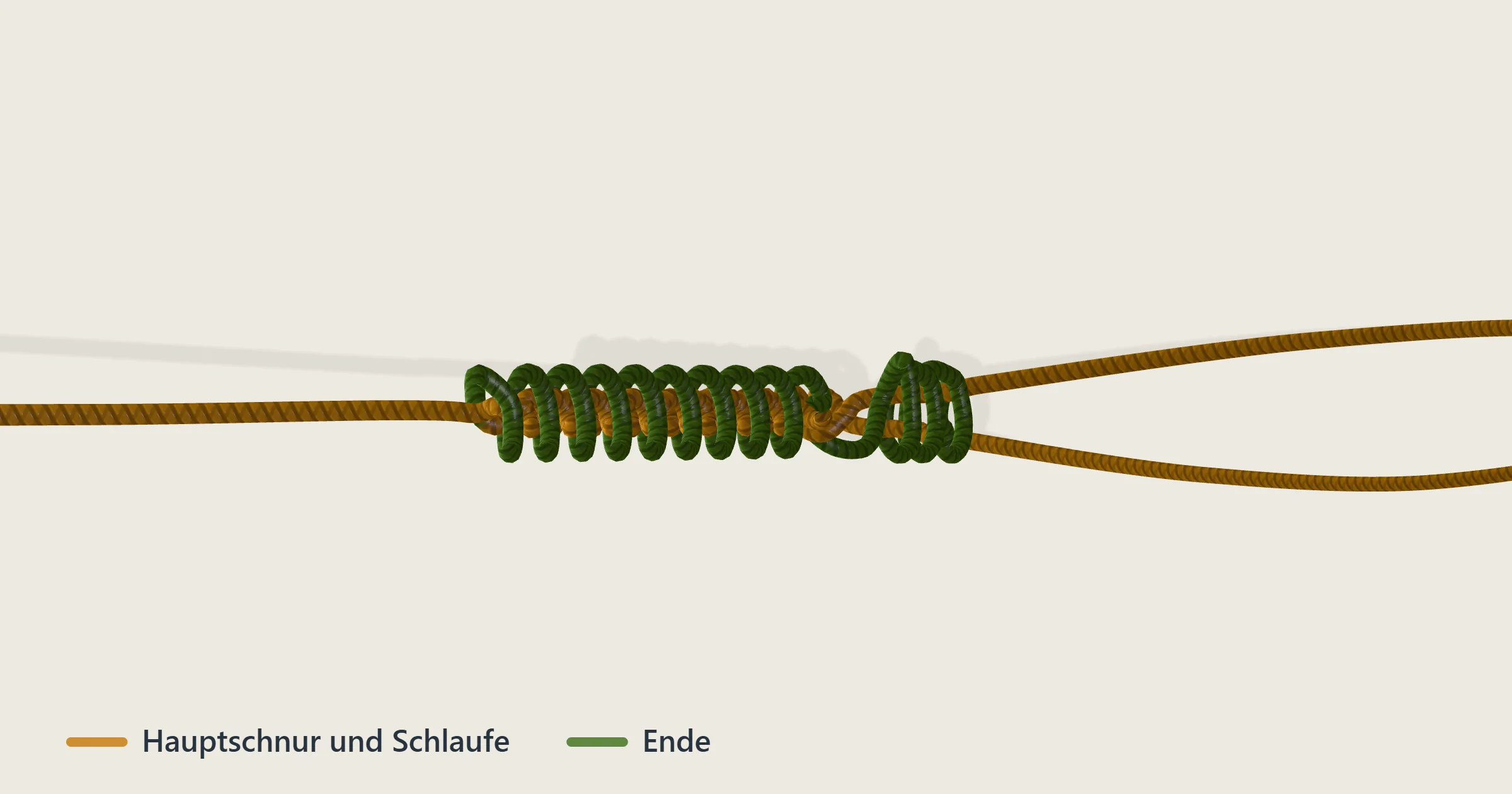
The Bimini twist forms a long, doubled loop at the end of the line. The two strands are twisted together many times, then the end wraps back over the twists. It is used mainly in heavy sea fishing.
What is the Bimini twist good for?
The loop serves as a double line against abrasion or as the starting point for a loop-to-loop connection to the leader. Blinker calls the knot a classic of big-game fishing: very strong, but laborious to tie.
The Bimini twist is regarded as a knot with full strength. Animated Knots qualifies that: under jerky load and when dry it can fail much sooner. Wikipedia lists the claim about its strength as unsupported.
Tying the Bimini twist step by step
- Laying and twisting the loop. Double the line into a long loop and twist it. NetKnots gives 20 twists, Blinker about 30, Animated Knots about 30 for monofilament and more for braid.
- Tensioning the loop. Put the open end of the loop over a knee or a foot and keep both strands under tension throughout.
- Spreading the loop. Open the angle of the loop so that the twists slide together.
- Wrapping the end back. Guide the short end so that it jumps over the first twists and wraps itself over them all the way to their end.
- Securing. Make a half hitch around one strand of the loop and then several half hitches around both strands. NetKnots gives three to five.
- Tightening and trimming. Moisten the knot, draw the half hitches up to the knot and trim the end.
Common mistakes
- Too few twists: According to Animated Knots, about twelve have proved inadequate; smooth braid needs clearly more.
- Tension lost: While twisting and wrapping back, all strands must stay under tension.
- Tightened dry: Without moistening, friction heat builds up that can weaken the line.
- With just two hands: The knot is awkward. A knee, a foot or a fixed hook as a hold are part of the job.
Pull test and knot strength
First check that the knot sits neatly and the line is undamaged. Hang the loop over a blunt hook or ring and pull steadily on the main line. Do not wrap thin line round bare fingers. If the end slips or the knot distorts, tie it again. A pull test does not measure breaking strength, it only shows gross tying faults.
Material, diameter and tying technique affect every connection. The line calculator gives you a rough guide using cautious knot factors of our own.
Related knots
For short end loops the surgeon’s loop or the figure-of-eight loop will do.
Used in sea fishing.
Note: The sources differ on the number of twists and on the finish. The sketch shows the principle, not every single twist.
Sources
- Animated Knots – Bimini Twist Knot
- NetKnots – Bimini Twist
- Wikipedia (englisch) – Bimini twist
- Blinker – Der Bimini-Twist-Knoten
Sources opened and checked on 2 October 2026. Texts in our own words, sketch drawn independently; no graphics taken from the sources. You will find all knots in the overview of fishing knots.
All figures are guide values without guarantee. Follow the line manufacturer’s instructions.