
Knowledge – Fish
Great barracuda: Features, haunts, catching and ciguatera
The great barracuda (Sphyraena barracuda) is a slender predator of warm seas with a set of knife-sharp teeth. It hunts by sight during the day, stands at reefs, over seagrass and at mangroves, and in Florida and the Caribbean it is a common catch when spinning and trolling.
In brief: According to the catch calendar the best time is all year round. Good spots on the coast: wrecks, reefs, edges and seagrass. Proven baits: fast-retrieved, shiny lures or baitfish on a wire hooklength. It can carry ciguatera toxin, according to the Bundesinstitut für Risikobewertung mainly fish that live close to the coast. In Florida regional size and bag limits apply. Step by step: Great barracuda fishing.
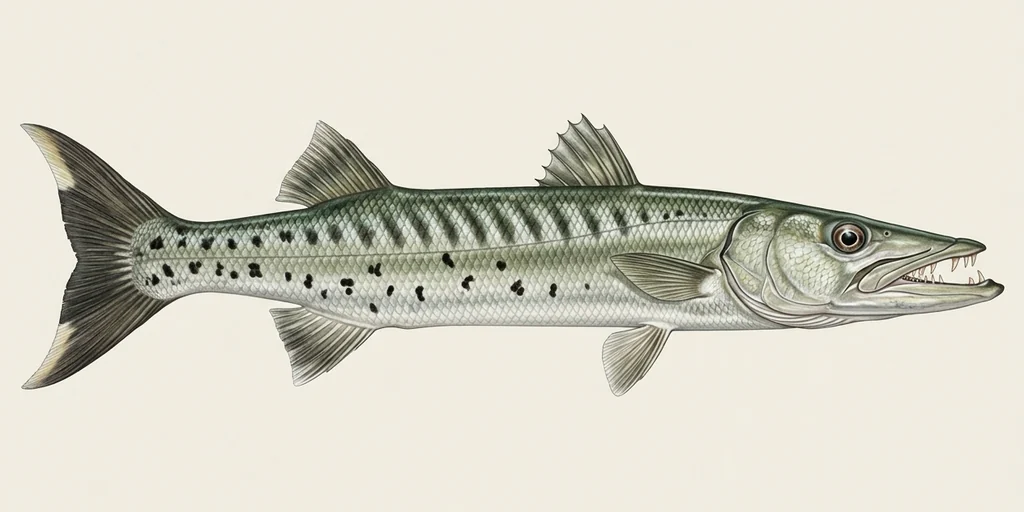
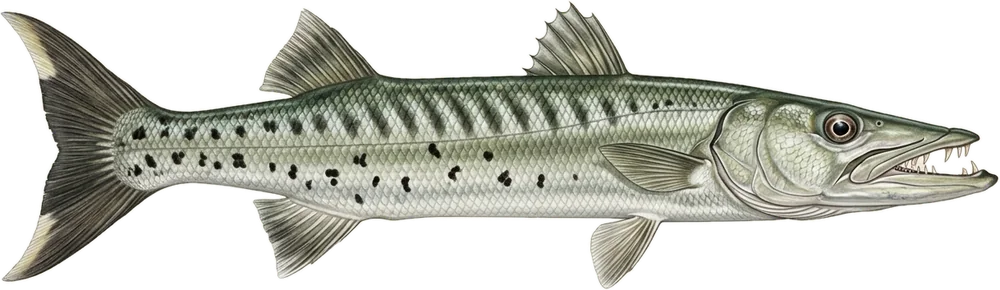
- Large mouth with a projecting lower jaw and long, dagger-like teeth
- Numerous dark oblique bars on the upper half of the body, scattered black spots on the lower flank
- Two widely separated dorsal fins and a dark tail fin with pale tips
Catch chances through the year
- Hardly any chance
- Possible
- Good
- Peak season
- Spawning (observe the closed season)
Editorial estimate for the home waters (Florida and the Caribbean), not a measurement and not a guarantee. The rules of the country you are visiting are binding.
How to recognise it
The body is long, slender and almost round in the middle, the head almost flat between the eyes. The mouth is large and the lower jaw projects. It holds two rows of teeth: small, razor-sharp ones on the outside and larger, dagger-like ones on the inside. The two dorsal fins are set far apart, and the first begins roughly above the base of the pelvic fins.
The back is brownish or blue-grey with a greenish sheen, the flanks silvery, the belly white. On the upper half of the body there are 18 to 23 dark oblique bars, which are mainly visible when the fish is at rest. Typical of the great barracuda are scattered black spots on the lower flank. The second dorsal fin, anal fin and tail fin are violet to black with pale tips.
FishBase gives a usual length of 1,4 metres, at most 2 metres, 50 kilograms and 18 years. The angling record, according to FishBase, is a fish of about 1,7 metres and 47 kilograms. According to the Florida Museum any barracuda over 1,5 metres is very large.
Direct comparison: great barracuda or European barracuda?
| Feature | Great barracuda | European barracuda |
|---|---|---|
| Lower flank | scattered black spots | no spots, silvery |
| Upper half of the body | 18 to 23 dark oblique bars | no striking bars, often a pale yellow lengthwise band when freshly caught |
| Pectoral fins | reach as far as the pelvic fins | do not reach the pelvic fins |
| Tail fin | black to violet with white tips | described without any special markings |
| Size according to FishBase | up to 2 m, usually around 1,4 m | up to 165 cm, usually around 60 cm |
There are several species of barracuda. You recognise the great barracuda, according to the Florida Museum, by the black spots on the underside of the body, which the other species lack. Young fish look different: they show a pale net pattern on the back and a dark lengthwise stripe that breaks up into spots as they grow, and they adapt their colouring to the bottom.
Its long shape recalls a pike. The two are not related; the barracuda forms a family of its own (Sphyraenidae).
Where it holds
The great barracuda lives worldwide in coastal tropical and subtropical seas. In the western Atlantic its range extends from Massachusetts to Brazil, including the Gulf of Mexico and the Caribbean. It also occurs in the eastern Atlantic off the West African coast, in the Indo-Pacific and in the Red Sea.
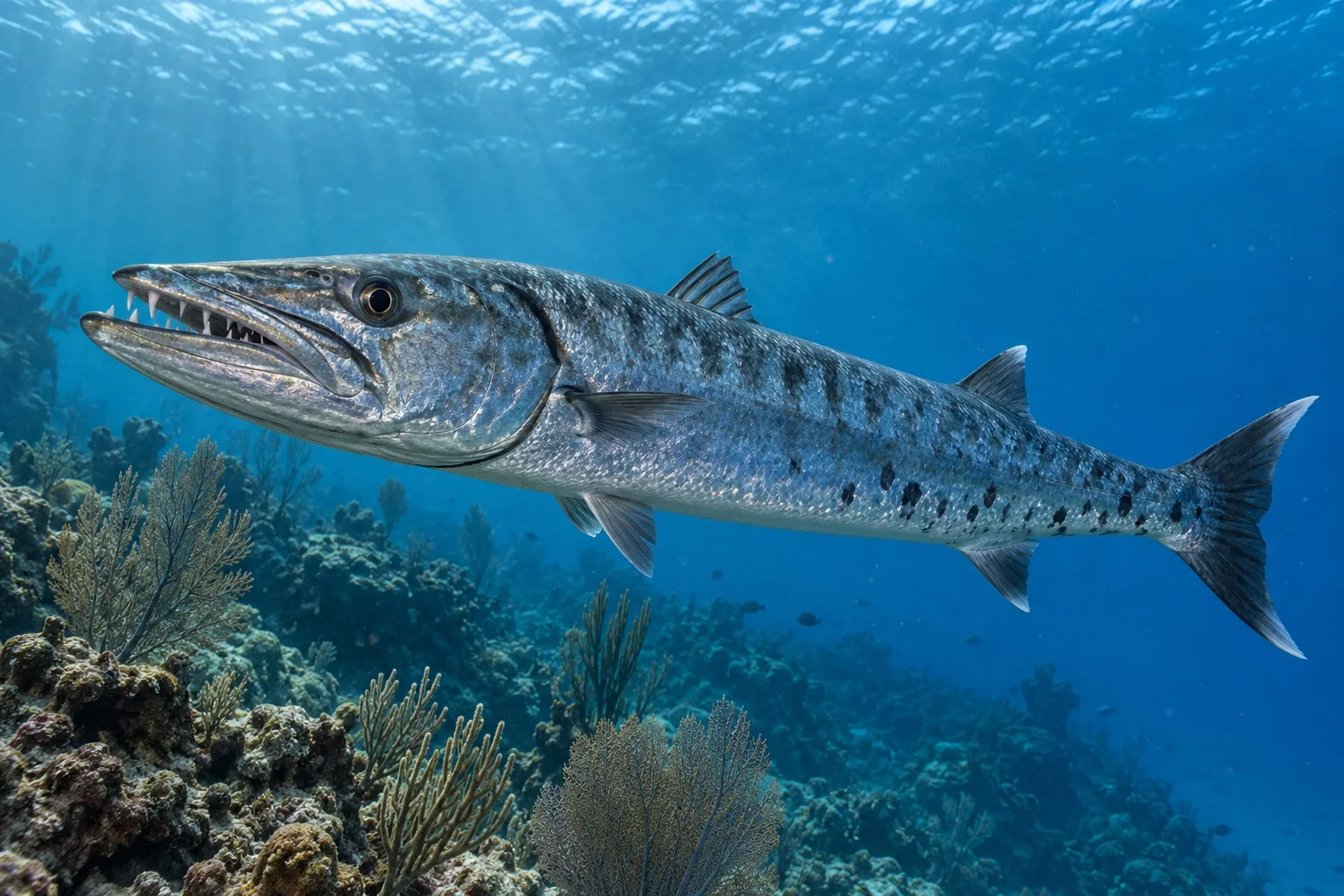
Typical haunts are coastal coral reefs, seagrass meadows and mangroves. It also lives in the open sea, usually at or near the surface, occasionally down to 100 metres. According to FishBase its habitat ranges from murky harbours to open sea. Young fish grow up in mangroves and seagrass meadows and move to deeper reefs in their second year.
Holding spots in the picture
Choose the time of day: the picture shows where the species holds. We do not show German seasons for travel fish; the bars give the chance of a catch for each month. Tap a fish or a spot in the list to bring it closer. The picture is schematic and AI-generated, and every water is different.
Chance of a catch per month according to the catch calendar
- J
- F
- M
- A
- M
- J
- J
- A
- S
- O
- N
- D
Spawning season
No main time As a sight hunter, the barracuda is on the move during the day.
Active time As a sight hunter, the barracuda is on the move during the day.
No main time As a sight hunter, the barracuda is on the move during the day.
No main time As a sight hunter, the barracuda is on the move during the day.
On the coast
Seagrass, gravel and stones in the shallows
Great barracuda is found here all year round.
Drop-off
Great barracuda is found here all year round.
Wreck, reef
Great barracuda is found here all year round.
Open water, mid-water
Great barracuda is found here all year round.
Just below the surface
Great barracuda is found here all year round.
The barracuda holds at coral reefs and reef edges, over seagrass meadows and at mangroves. It also hunts in the open sea, usually just below the surface. Young fish grow up in mangroves and seagrass before moving to deeper reefs.
Depth: It usually stays at or near the surface, occasionally going down as far as 100 metres.
Size comparison: AI-generated drawing, schematic.
How it hunts and reproduces
The barracuda is active by day and locates prey mainly by sight. It eats jacks, grunts, groupers, snappers, small tunas, mullet, herring and anchovies, as well as cephalopods. It tears large prey apart with its teeth and swallows small prey whole. It mostly hunts alone, sometimes in small groups over reefs and sandy bottom. Its top speed is estimated at about 58 kilometres per hour.
Little is known about reproduction. It probably spawns in deeper water off the coast, in the Florida Keys probably in spring. Eggs and larvae drift in open water, and the larvae settle in shallow, overgrown areas of the estuaries. It matures at about 60 centimetres, males at about two years and females at about four.
When and where the season is
The barracuda has no fixed season in Florida and the Caribbean. Anglers report catches all year round, at reef edges, over seagrass and at mangroves.
For trip planning the time of day matters more than the month: as a sight hunter it is active by day. It also occurs in the eastern Atlantic off West Africa, where no cases of ciguatera have so far been reported, according to FishBase.
How it is caught
Step by step: Great barracuda fishing: tips on bait, rigs and tackle – season, marks, bait, tackle and rules on one page.
The barracuda is caught on handlines and on the rod. According to the Florida Museum some anglers regard it as a sport fish because it fights hard. It reacts to flash: according to the Florida Museum it sometimes mistakes shiny objects, such as a diver’s knife, for a fish.
Anglers report that fast-retrieved, shiny lures and baitfish work well over reef edges and seagrass. Because of the sharp teeth many anglers fish with a wire hooklength. When removing the hook, it is best to use long pliers and keep your hands away from the mouth.
Respect the teeth: The dentition consists of razor-sharp outer and dagger-like inner teeth. Keep your distance when unhooking and work with pliers and a towel.
Do not eat on a hunch: Whether a barracuda carries ciguatera toxin cannot be seen, smelled or tasted. Anyone who keeps one in the Caribbean or Florida should know the health authorities‘ warnings.
Suitable lures
Fast-retrieved, shiny lures or baitfish on a wire hooklength.
AI-generated illustrations. A click opens the lure’s page.
Observe the health authorities‘ ciguatera warnings
What applies locally and what you need to know about ciguatera
Florida has its own rules for the barracuda: the Florida Fish and Wildlife Conservation Commission has set regional size limits and regional daily and per-boat limits in the Florida Administrative Code. We do not give specific figures, as they can change. Other Caribbean countries have their own regulations; the fisheries authority on the spot (Fischereibehörde) is binding in each case.
Ciguatera is poisoning by algal toxins that pass through the food chain into predatory fish in regions with coral reefs. The Bundesinstitut für Risikobewertung expressly names barracudas among the particularly affected species, where they live close to the coast. Contaminated fish cannot be recognised by appearance, smell or taste, and neither cooking nor freezing breaks down the toxin. For symptoms after a fish meal the BfR advises seeking medical help and mentioning the suspicion. This advice does not replace medical advice.
Symptoms include, according to the authority, nausea, diarrhoea, vomiting, joint and muscle pain, numbness and tingling in the mouth, hands and feet, and a reversal of the sensation of temperature. If you suspect it after a fish meal, seek medical help. This advice does not replace medical advice. According to the IUCN the great barracuda is not threatened (Least Concern, assessment of 2013).
Frequently asked questions (FAQ)
Can you eat barracuda?
It is eaten in many areas but is regarded as a carrier of ciguatera in much of its range. The toxin is neither visible nor removed by cooking. Follow the advice of the local health authorities; it does not replace medical advice.
How do I recognise the great barracuda?
By the scattered black spots on the lower flank, the dark oblique bars above and the dark tail fin with pale tips.
How big does a barracuda get?
Usually about 1,4 metres according to FishBase; the maximum values given are 2 metres and 50 kilograms.
Sources
The rating of catch chances is an editorial assessment. The facts come from these sources, and the text is worded in our own words. The illustration is an original design by Angel Momente in the style of a natural history plate (AI-generated, see the AI notice).
- FishBase: Sphyraena barracuda, Great barracuda
- Florida Museum of Natural History: Sphyraena barracuda (Great barracuda)
- Florida Administrative Code, Kapitel 68B-60 Barracuda: Regional Size Limits
- Florida Administrative Code, Kapitel 68B-60 Barracuda: Regional Bag and Vessel Limits
- Wikipedia: Großer Barrakuda
- Bundesinstitut für Risikobewertung: Ciguatera – Fragen und Antworten (16. Mai 2022)
- Naturalis, Fishes of the NE Atlantic and Mediterranean: Sphyraena sphyraena (Europäischer Pfeilhecht)
- FishBase: Sphyraena sphyraena (Europäischer Pfeilhecht, zur Unterscheidung)
Created with AI support from the sources listed. Figures only appear in the text if a source gives them. Last updated: 27 October 2026. Found a mistake? Write to us. Who is behind this site: About me.
More in the lexicon
- All fish species at a glance
- Catch calendar – month, water temperature and profile for 93 species
- Line calculator – breaking strain after the knot, drag guideline, backing
- Angling methods