
Knowledge – Fish
Wahoo: Features, habitat, season and baits
The wahoo (Acanthocybium solandri) is a slim, very fast relative of the mackerels and tunas found in warm seas worldwide. It lives alone or in small, loose groups and has a mouth full of sharp, serrated teeth. Anglers catch it mainly by fast trolling over deep water.
In short: According to the catch calendar, the best time is April to October. Good spots off the coast: just below the surface, open water and drop-offs. Proven baits: fast-trolled skirted lures in front of garfish and fast-running crankbaits on a wire trace. The wahoo has no gill rakers, which is how you can reliably tell it from the king mackerel. Off the Carolinas it is common mainly in the warm summer months. Step by step: fishing for wahoo.
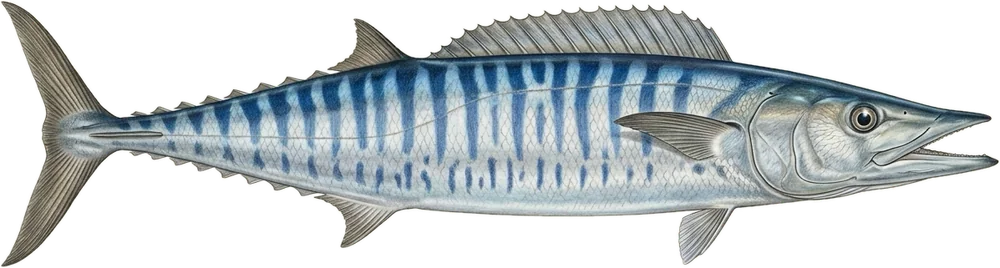
- Long, pointed snout, about as long as the rest of the head
- Long first dorsal fin, several times longer than the second, followed by 8 to 9 finlets
- 24 to 30 cobalt-blue vertical bars on the flanks
Catch chances through the year
- Hardly any chance
- Possible
- Good
- Peak season
- Spawning (observe the closed season)
Editorial assessment for the home water (south-eastern coast of the USA (Florida to North Carolina)), not a measured value and not a guarantee. The rules of the country you travel to are what count.
How to recognise it
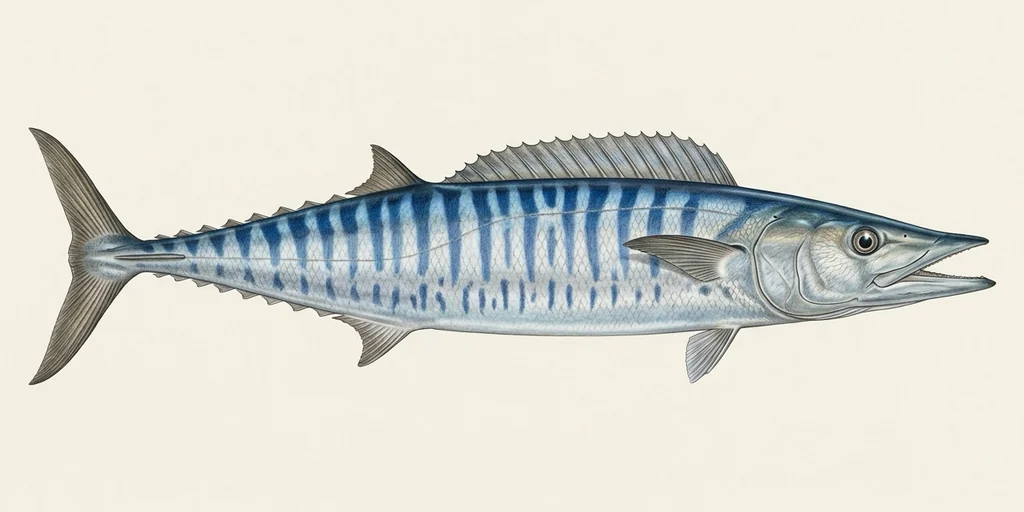
The wahoo has a long, slim body with an oval cross-section. The jaws form a pointed, beak-like snout about as long as the rest of the head. Inside sit strong, triangular, finely serrated teeth. The first dorsal fin is several times longer than the second, and 8 to 9 finlets follow behind the second dorsal and anal fins. The narrow tail stalk carries three pairs of keels.
The back is iridescent blue-green to steel blue, the flanks and belly silver. Across the sides run 24 to 30 cobalt-blue vertical bars that fade quickly after death. The lateral line drops sharply downwards under the first dorsal fin.
According to FishBase the wahoo grows up to 250 centimetres long and 83 kilograms in weight, typically 100 to 170 centimetres. It grows fast, lives only five to six years and, according to NOAA, can spawn at around one year old.
The fisheries authority (Fischereibehörde) of North Carolina names the king mackerel as the most common mix-up. You can tell the two apart reliably by the gills: the wahoo has no gill rakers at all, the comb-like projections on the inside of the gill arches. Add to that the long, pointed snout and the strong vertical bars.
Side by side
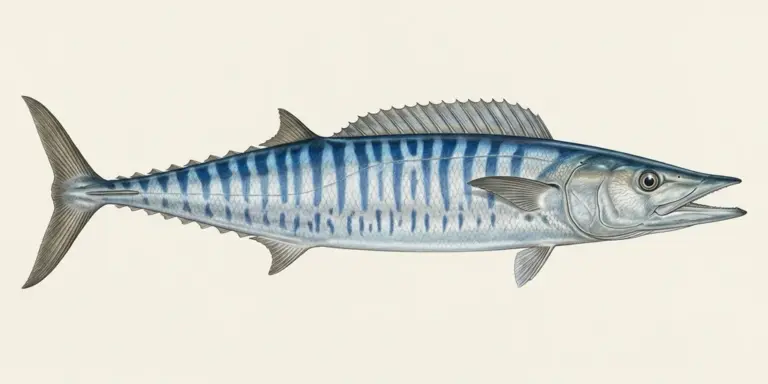
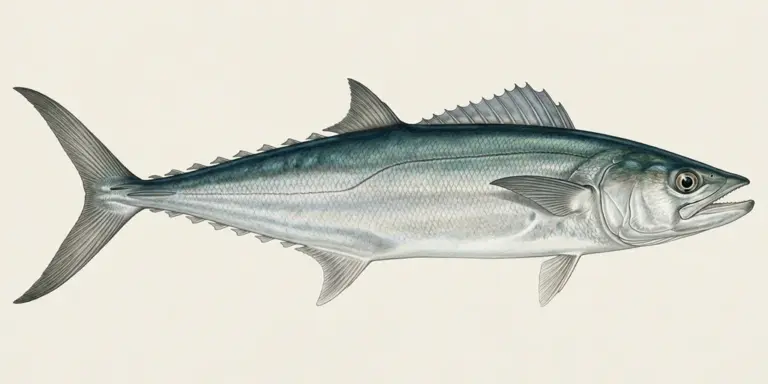
AI-generated illustrations.
Where it holds
The wahoo occurs in all tropical and subtropical seas, including the Caribbean, the Gulf of Mexico and the Mediterranean. In the western Atlantic it ranges, according to the fisheries authority (Fischereibehörde) of North Carolina, from New Jersey to Colombia. In the tropics it can be found all year round, at higher latitudes only in summer.
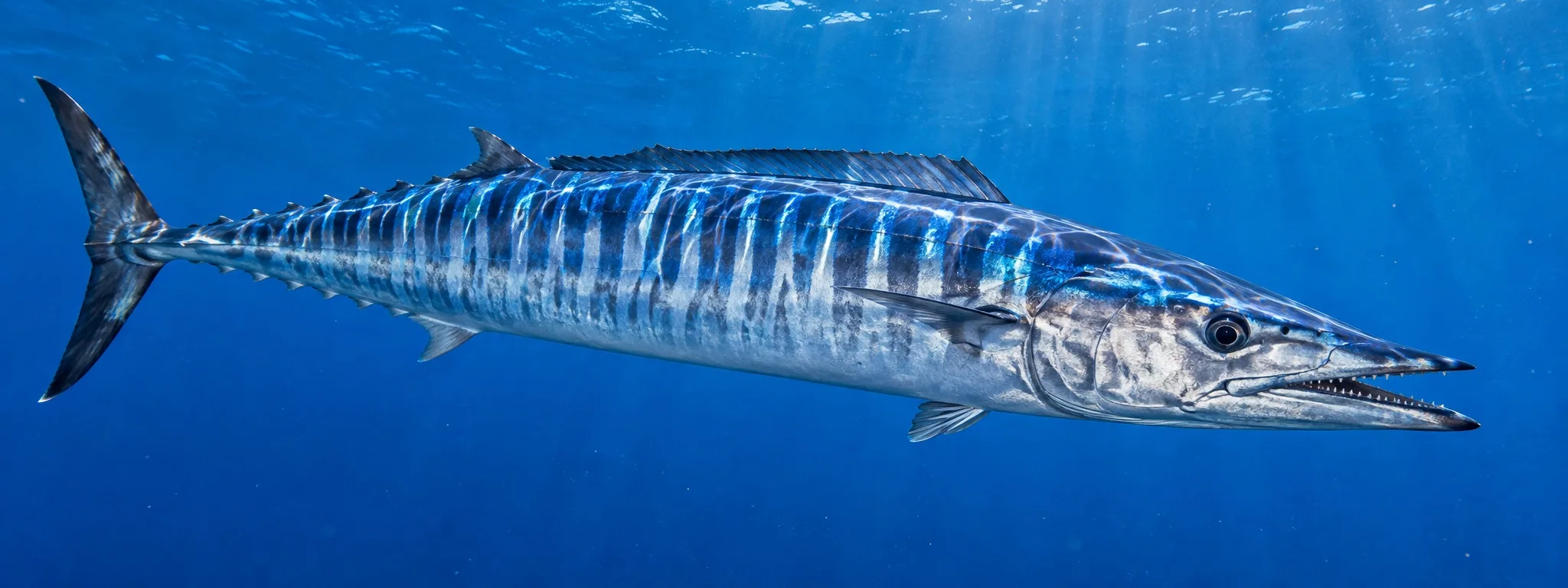
It lives just below the surface, according to FishBase usually in the upper 12 metres, and likes to stay near drifting objects such as sargassum fields. Migrations are little studied, but one tagged fish covered around 2700 kilometres in six and a half months.
Holding spots in the picture
Choose the time of day: the picture shows where the species holds. We do not show German seasons for travel fish; the bars give the chance of a catch for each month. Tap a fish or a spot in the list to bring it closer. The picture is schematic and AI-generated, and every water is different.
Chance of a catch per month according to the catch calendar
- J
- F
- M
- A
- M
- J
- J
- A
- S
- O
- N
- D
Spawning season
On the coast
Drop-off
Wahoo are found here all year round.
Open water, mid-water
Wahoo are found here all year round.
Just below the surface
Wahoo are found here all year round.
The wahoo hunts just below the surface over deep water, alone or in small, loose groups. It likes to hold by drifting weed fields and other flotsam, and also by banks and underwater humps.
Depth: It usually stays in the top 12 metres.
Size comparison: AI-generated drawing, schematic.
How it hunts and spawns
Wahoo hunt mainly other open-sea fish and squid. According to NOAA and the fisheries authority (Fischereibehörde) of North Carolina, frigate mackerel, butterfish, porcupinefish and round herring top the menu. With their sharp teeth they also cut larger prey into bite-sized pieces. The Florida Museum gives bursts of up to 75 kilometres per hour.
The spawning season is long. In the western central Atlantic the wahoo spawns from May to August according to the Florida Museum, most strongly in June and July, with spawning grounds in the Caribbean and off Florida. According to NOAA, a female releases between half a million and 45 million eggs a year, which drift freely in the water.
When and where the season is
The season information applies to the south-eastern coast of the USA from Florida to North Carolina. According to the fisheries authority (Fischereibehörde) of North Carolina, the wahoo moves north with the Gulf Stream in summer and back to the tropics in winter. Off the Carolinas and Bermuda it is, according to the Florida Museum, strongly seasonal and most common in the warm summer months.
This gives the assessment in the calendar: April to October good, the winter months only possible. Because the main spawning season falls in summer, the calendar does not rate any month as main season.
What you catch it with
Step by step: Fishing for wahoo: tips on bait, rig and tackle – season, spots, baits, tackle and rules on one page.
The wahoo is caught by trolling at high speed over deep water. According to the fisheries authority (Fischereibehörde) of North Carolina, many anglers use heavy line and colourful skirted lures in front of a garfish (ballyhoo) on a wire trace. Fast-running crankbaits and other trolling lures are also used.
A wire trace is recommended because of the sharp, serrated teeth. As wahoo hold around flotsam and sargassum, it is worth including such spots when trolling.
Take care on board: The teeth are triangular, sharp and finely serrated. Keep your fingers away from the mouth and remove the hook with pliers or a disgorger.
Check the gills: With smaller fish, a look under the gill cover helps: if the gill rakers are missing, it is a wahoo and not a king mackerel.
Suitable lures
Fast-trolled skirted lures in front of garfish and fast-running crankbaits on a wire trace.
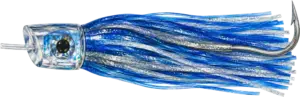
AI-generated illustrations. A click opens the lure’s page.
High trolling speed; wire trace because of the serrated teeth
Rules and licences
The rules of the country in whose waters you fish and the authority there are what count. In federal waters off the south-eastern US coast, the South Atlantic Fishery Management Council regulates the catch. A daily bag limit per person applies there; there is no minimum size (Mindestmaß) for recreational anglers. The fish must be landed with head and fins attached. Charter boats need their own federal permit.
In the coastal waters of the individual states, their own fishing licence also applies, in North Carolina for example the Coastal Recreational Fishing License. According to NOAA there are no nationwide rules for wahoo in the Gulf of Mexico; ask the fisheries authority (Fischereibehörde) of the state concerned. Anyone bringing fish from the Bahamas to the USA by sea must observe separate rules. Selling a recreational catch without a permit is prohibited.
According to NOAA the stock off the south-eastern US coast and in the Gulf of Mexico has not been assessed, but catch limits apply. The IUCN lists the wahoo as not threatened.
Frequently asked questions (FAQ)
When is wahoo season off the south-eastern US coast?
Mainly in the warm months. In summer the wahoo moves north with the Gulf Stream and is then most common off the Carolinas.
How do I tell a wahoo from a king mackerel?
The wahoo has no gill rakers on the gill arches. It also has a long, pointed snout and 24 to 30 distinct vertical bars.
Which baits catch wahoo?
Fast-trolled, colourful skirted lures, often with a garfish, and fast-running crankbaits, each on a wire trace.
Sources
The rating of catch chances is an editorial assessment. The facts come from these sources, and the text is worded in our own words. The illustration is an original design by Angel Momente in the style of a natural history plate (AI-generated, see the AI notice).
- FishBase: Acanthocybium solandri, Wahoo
- NOAA Fisheries: Atlantic Wahoo
- North Carolina Division of Marine Fisheries: Wahoo
- South Atlantic Fishery Management Council: Wahoo
- Florida Museum of Natural History: Wahoo
Created with AI support from the sources listed. Figures only appear in the text if a source gives them. Last updated: 27 October 2026. Found a mistake? Write to us. Who is behind this site: About me.
More in the lexicon
- All fish species at a glance
- Catch calendar – month, water temperature and profile for 93 species
- Line calculator – breaking strain after the knot, drag guideline, backing
- Angling methods