
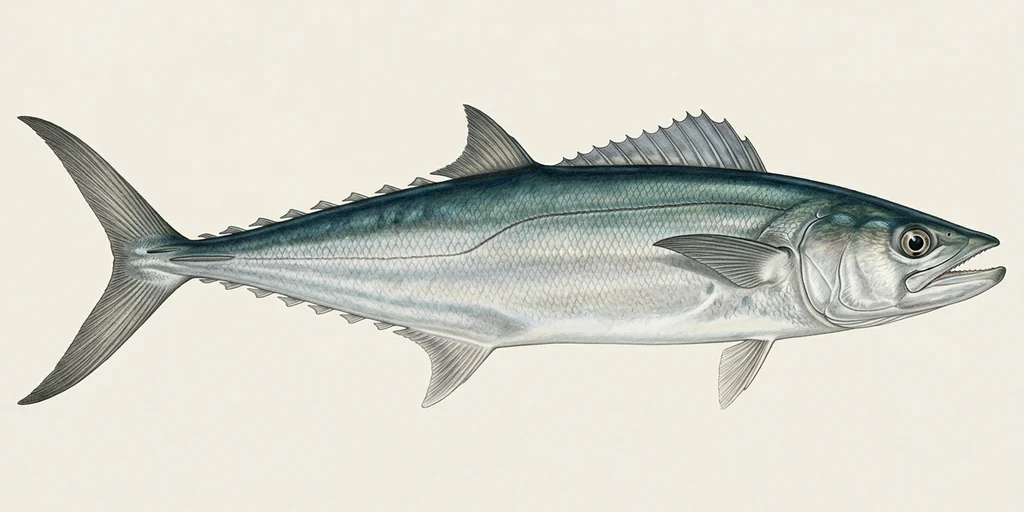
Knowledge – Fish
King mackerel: Features, season and catching
The king mackerel (Scomberomorus cavalla), also called kingfish in the USA, is the largest mackerel of the Atlantic. It hunts in schools in coastal open water from the Carolinas to the Gulf of Mexico and is the main target fish of many fishing competitions there.
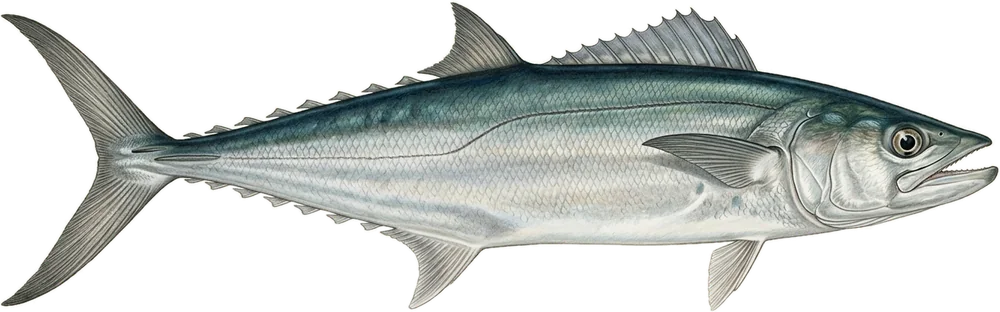
In brief: According to the catch calendar the best time is all year round. Good spots on the coast: open water just below the surface, and wrecks and reefs. Proven baits: live menhaden or round scad and dead cutlassfish when slow trolling, plus spoons and jigs. It moves with the water temperature: north in summer, off southern Florida in winter. The FDA and EPA advise pregnant women, nursing mothers and small children against eating it because of high mercury levels. Step by step: King mackerel fishing.
- Lateral line dips steeply downwards below the second dorsal fin
- First dorsal fin without a black spot in the front part
- Seven to ten small finlets behind the second dorsal and anal fins, deeply forked tail fin
Catch chances through the year
- Hardly any chance
- Possible
- Good
- Peak season
- Spawning (observe the closed season)
Editorial assessment for the home water (south-eastern coast of the USA and Gulf of Mexico), not a measured value and not a guarantee. The rules of the country you travel to are what count.
How to recognise it
The king mackerel is long and torpedo-shaped, with a pointed snout and a deeply forked tail fin. The back is iron grey to black with a blue and green sheen, the flanks and belly silvery. The mouth holds about 30 triangular, closely set teeth. When swimming fast it folds the first dorsal fin and the pectoral fins into grooves on the body.
The key feature is the lateral line: it runs high at first and bends steeply downwards under the second dorsal fin. The first dorsal fin is grey at the front and has no black spot. Behind the second dorsal fin and the anal fin come small finlets. Young fish carry bronze-coloured spots in five or six irregular rows, which fade as they grow.
According to the Florida Museum, king mackerel are usually 50 to 90 centimetres long. FishBase gives 1,84 metres, 45 kilograms and 26 years as maximum values. Most fish, according to figures from North Carolina, are between 3 and 12 years old, and females grow much bigger than males.
Young king mackerel are often confused with the Spanish mackerel (Scomberomorus maculatus), because it also has spots. According to NOAA Fisheries they can be told apart reliably by the steeply bending lateral line and the grey front part of the first dorsal fin, which is black in related species. The cero mackerel (Scomberomorus regalis) has an evenly running lateral line and scales on the pectoral fins.
It shares the family of mackerels and tunas (Scombridae) with the European mackerel, but grows many times larger. For eating the two differ markedly, see the section on mercury.
Side by side
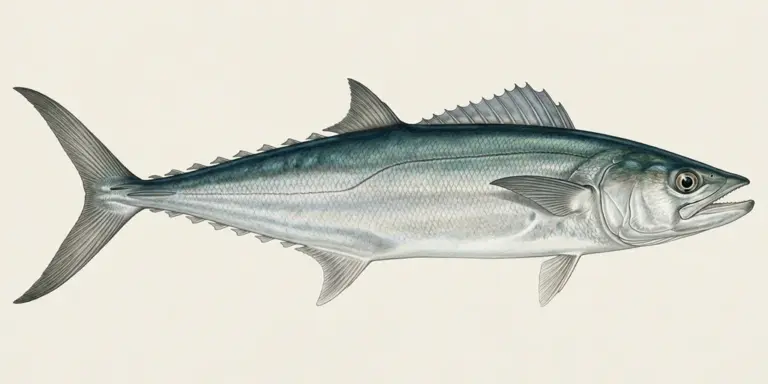
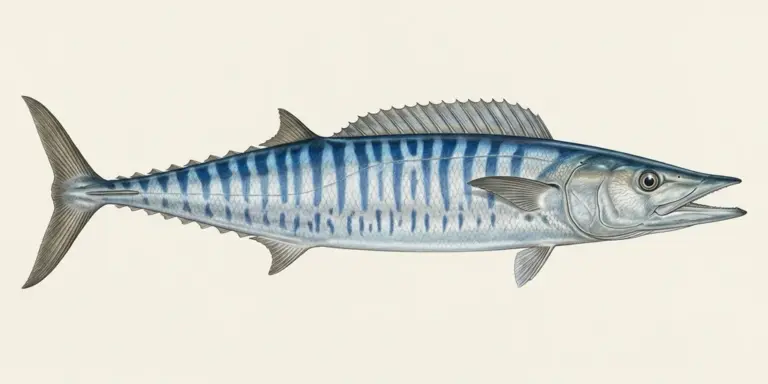
AI-generated illustrations.
Where it hunts
The king mackerel lives in the western Atlantic from Massachusetts to Brazil, including the Caribbean and the Gulf of Mexico. It is a fish of coastal open water and outer reefs. According to the Florida Museum there are permanent stocks off north-eastern Brazil, Louisiana and southern Florida.
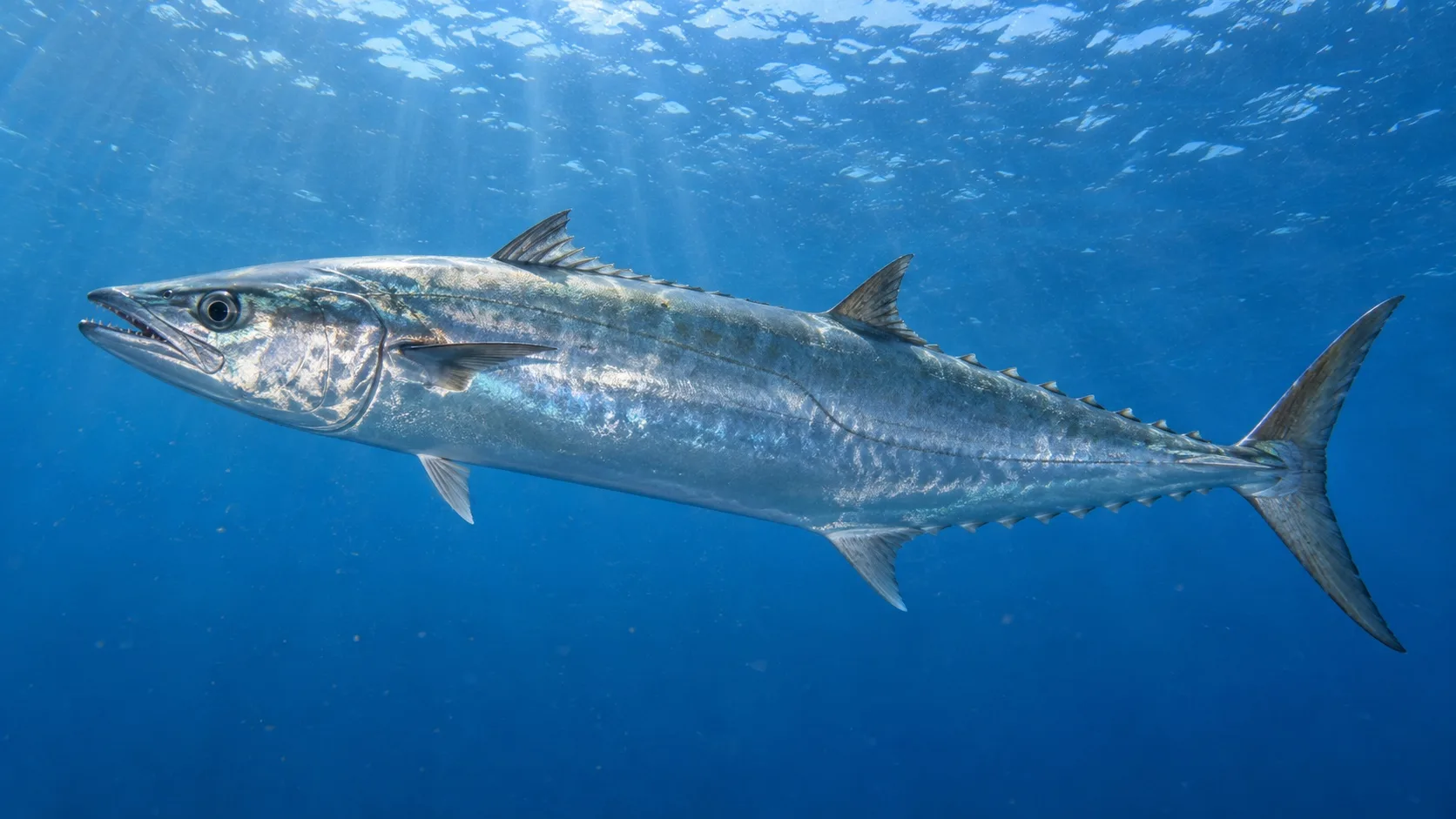
It prefers warm water and, according to NOAA Fisheries, rarely enters water below 20 degrees. The larvae were found at 26 to 31 degrees. In North Carolina it stands in winter on the edge of the continental shelf just inside the Gulf Stream, and in summer and autumn it moves to the beaches and off harbour and river mouths.
Holding spots in the picture
Choose the time of day: the picture shows where the species holds. We do not show German seasons for travel fish; the bars give the chance of a catch for each month. Tap a fish or a spot in the list to bring it closer. The picture is schematic and AI-generated, and every water is different.
Chance of a catch per month according to the catch calendar
- J
- F
- M
- A
- M
- J
- J
- A
- S
- O
- N
- D
Spawning season
On the coast
Surf close to the shore
King mackerel is found here all year round.
Wreck, reef
King mackerel is found here all year round.
Open water, mid-water
King mackerel is found here all year round.
Just below the surface
King mackerel is found here all year round.
The king mackerel hunts in schools in open water close to the coast and on outer reefs. While hunting it often shoots out of the water. In summer and autumn it comes right in to the beaches and to harbour and river mouths off the Carolinas.
Depth: It avoids water colder than about 20 degrees.
Size comparison: AI-generated drawing, schematic.
How it feeds and spawns
King mackerel feed mainly on shoaling fish such as menhaden, mullet, herring, sardines and anchovies, plus squid and prawns. In southern Florida halfbeaks are their favourite prey. When hunting they often leap out of the water; anglers in North Carolina call this skyrocketing.
According to NOAA Fisheries, spawning takes place on the outer shelf from May to October, with a peak from late May to early August. Eggs and larvae drift freely. King mackerel mature at two to three years, and females release, depending on size, between 69.000 and over 12 million eggs.
When and where the season is
The king mackerel travels in large schools with the water temperature and the food supply: to the north of its range in summer, to the south in winter. Stocks from the Atlantic and the Gulf meet from November to March in a mixing zone south of the Florida Keys.
For anglers that means: in winter southern Florida is the destination, in summer and autumn the coast of the Carolinas, where the fish come close to beach and pier. Whether you may keep a king mackerel depends on catch quotas, which can close seasons and areas early. So check the current rules before every trip.
How it is caught
Step by step: King mackerel fishing: tips on bait, rigs and tackle – season, marks, bait, tackle and rules on one page.
The king mackerel is caught from a boat or from the end of long piers. The North Carolina fisheries authority (Fischereibehörde) names slow trolling as the most popular method: several baits run at very low speed behind the boat. Live menhaden and round scad and dead cutlassfish are usual, plus spoons, jigs and other lures.
With its closely set, sharp teeth it easily cuts through thin hooklengths, which is why anglers report fishing with a short wire hooklength.
Check the lateral line before keeping a fish: Spanish mackerel and king mackerel are subject to different rules. The steep bend in the lateral line under the second dorsal fin tells you at once which species you have.
Use large fish sparingly: Anyone eating king mackerel should know the FDA and EPA advice on mercury, especially in pregnancy and for children. This does not replace medical advice.
Suitable lures
Live menhaden or round scad and dead cutlassfish when slow trolling, plus spoons and jigs.
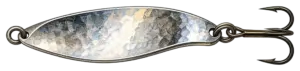
AI-generated illustrations. A click opens the lure’s page.
Observe the FDA and EPA mercury advice
What applies locally and what you need to know about mercury
The king mackerel is managed by NOAA Fisheries and the fishery councils for the Gulf and the South Atlantic. There are annual catch limits, minimum sizes (Mindestmaß), seasons and per-trip limits; seasons or areas can close early once the quota is reached. The rules of the individual states largely follow the federal rules. In North Carolina you need the Coastal Recreational Fishing License. We do not give figures: the responsible authority on the spot is binding.
According to NOAA Fisheries, neither of the two large stocks is overfished. Before the 1980s the fishery was barely regulated and the stocks were depleted; rules have existed since 1983, and the stocks have since been rebuilt. The IUCN lists the species as not threatened (Least Concern, assessment of 2022).
Mercury: the US authorities EPA and FDA have listed king mackerel since 2001 among the fish that pregnant women, women who might become pregnant, nursing mothers and small children should avoid because of the highest mercury levels. The native Atlantic mackerel, by contrast, is among the best choices there. In some areas ciguatera has also been reported in king mackerel, a fish poisoning caused by algal toxin. This advice does not replace medical advice.
Frequently asked questions (FAQ)
How do I tell king mackerel from Spanish mackerel?
By the lateral line: in the king mackerel it bends steeply downwards under the second dorsal fin. It also lacks the black spot at the front of the first dorsal fin.
Can you eat king mackerel?
Yes, it is eaten. However, the FDA and EPA advise pregnant women, nursing mothers, women who might become pregnant and small children against it because of high mercury levels. This does not replace medical advice.
When is the best time for king mackerel?
In winter off southern Florida and the Florida Keys, in summer and autumn further north, for example off North Carolina at beaches and piers.
Sources
The rating of catch chances is an editorial assessment. The facts come from these sources, and the text is worded in our own words. The illustration is an original design by Angel Momente in the style of a natural history plate (AI-generated, see the AI notice).
- FishBase: Scomberomorus cavalla, King mackerel
- NOAA Fisheries: King Mackerel
- Florida Museum of Natural History: Scomberomorus cavalla (King mackerel)
- North Carolina Division of Marine Fisheries: King Mackerel (Species Profile)
- Federal Register (EPA/FDA): Advice About Eating Fish, Revised Fish Advice (2017)
- U.S. EPA: EPA-FDA Advice about Eating Fish and Shellfish
- Bundesinstitut für Risikobewertung: Ciguatera – Fragen und Antworten (16. Mai 2022)
Created with AI support from the sources listed. Figures only appear in the text if a source gives them. Last updated: 27 October 2026. Found a mistake? Write to us. Who is behind this site: About me.
More in the lexicon
- All fish species at a glance
- Catch calendar – month, water temperature and profile for 93 species
- Line calculator – breaking strain after the knot, drag guideline, backing
- Angling methods