
Knowledge · Tackle
Oyster knife: Opening shellfish safely
An oyster knife is a short, sturdy lever tool for prising the shells of an oyster apart at the hinge. This page covers how it is built, how to open oysters with it without stabbing your hand, and what the authorities say about raw shellfish and collecting in the Wadden Sea.
Design: lever instead of blade
The oyster knife is meant to prise the shell open and release the oyster’s muscle, not to cut.
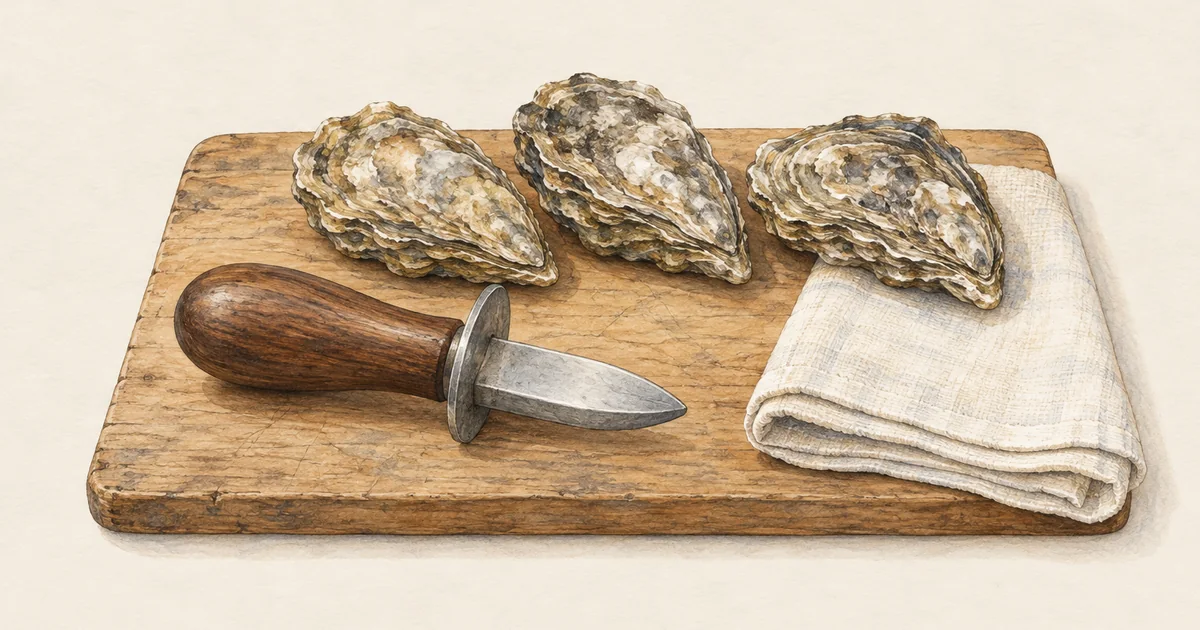
Some models have a guard between blade and handle, the hand guard. It is meant to stop the knife and your hand from slipping and driving too deep into the shell. The Berufsgenossenschaft Nahrungsmittel und Gastgewerbe (BGN) names the same aim for kitchen knives in general: the handle should be shaped so that the hand cannot slide onto the edge.
An ordinary kitchen knife is no substitute for raw oysters. A report by the broadcaster France 3 on accidents when opening oysters advises always using a proper oyster knife. The BGN lists the oyster knife among the special knives it considers worth buying if a kitchen prepares oysters.
Opening an oyster
Beforehand, scrub the shells with a stiff brush under cold running water, as North Carolina Sea Grant, a programme of the state university there, advises. According to the Bundeszentrum für Ernährung (BZfE), live shellfish must be closed. If a shell is slightly open, tap it. If it closes, the shellfish is fine.
- Protect your holding hand. A thick cloth is the minimum; a chain-mail glove made of steel mesh is better. What cut-resistant gloves can do is covered under filleting glove.
- Lay the oyster flat. The cupped shell goes underneath, the flat one on top. Place the oyster on a firm surface or hold it with your protected hand.
- Set the knife at the hinge. The hinge is at the pointed end. Press the tip of the knife into the gap between the shells until it finds a hold.
- Twist, don’t stab. Once the tip is firmly seated, twist the knife. The twist forces the shells apart.
- Sever the muscle. Use the blade to release the upper adductor muscle without cutting into the flesh, then lift off the flat lid shell. Check for shell splinters before the oyster goes on the plate.
Cut protection: When opening oysters the knife can slip and cause cuts or stab wounds, warns the BGN. In professional kitchens a stab-resistant glove is worn on the holding hand for this. According to an analysis by the French health surveillance institute InVS, reported by France 3, there are around 2000 accidents a year in France when opening oysters, just under a third of them in December.
Mussels and cooked oysters
Not every shellfish needs a knife. According to LAVES, the Landesamt für Verbraucherschutz und Lebensmittelsicherheit in Lower Saxony, mussels should generally not be eaten raw, only thoroughly cooked. For classic mussel dishes the BZfE gives a rule of thumb of five minutes‘ cooking and then five minutes‘ standing off the heat.
Oysters are also easier to open when cooked, because the animals are then dead. In a recipe feature in Blinker they go into the oven for 10 to 15 minutes at about 150 degrees, after which a sturdy knife with a short blade will do if need be. Whether that is enough to heat them through, the feature leaves open. The Bundesinstitut für Risikobewertung (BfR) advises heating shellfish evenly and thoroughly before eating, because a brief boil cannot reliably get rid of noroviruses.
Collecting oysters in the Wadden Sea: a guide
The oyster in the German Wadden Sea is mostly the Pacific oyster, a non-native species. The national park authority gives 1986 as the year the first farmed stock was put out off Sylt. Its larvae have spread from there. Oysters need a solid surface. Colonies are found, for example, on rock armour and on harbour sheet piling. They are harvested at low tide with a hammer and chisel and in work gloves, because the shells have very sharp edges.
Collecting live shellfish in the Wadden Sea national parks is subject to its own rules, and each federal state (Bundesland) sets them differently. The joint page of the national park authorities gives these key points (accessed in October 2026):
- Schleswig-Holstein: collecting in zone 2 with a valid fishing licence (Fischereischein), at most 10 kg a day. In zone 1 only in the coastal strip of about one kilometre.
- Hamburg: collecting for personal use in zone II.
- Lower Saxony: live shellfish in small quantities for personal consumption.
This is a guide, not legal advice. State law is what counts; if in doubt, ask the national park authority. Which licence you need is covered under Fishing licence and angling exam. Tides, channels and safety on the mudflats are covered in Fishing from the coast and in the surf.
Raw shellfish: three risks according to the authorities
Shellfish filter seawater and accumulate whatever drifts in it:
| Risk | Origin | What the authority says |
|---|---|---|
| Algal toxins (marine biotoxins) | toxic microalgae that shellfish feed on | BfR: diarrhoea or paralysis, fatal in severe cases; symptoms appear after minutes to two days |
| Noroviruses | sewage in the sea, the shellfish accumulates the viruses | BfR: always heat shellfish right through; LAVES: never eat mussels raw |
| Vibrio bacteria | bacteria in salt and brackish water, multiplying strongly above 20 °C | BfR: raw oysters are regarded as a high-risk food |
Shellfish for sale come from monitored areas. LAVES describes this official monitoring of the production and trade of live shellfish, the BfR the testing of fishing waters and shellfish before they are released. An oyster you take off the rock armour yourself has not been through this testing.
Vibrio bacteria affect the hands too: the BfR mentions wound infections from injuries while preparing shellfish, and the Robert Koch-Institut (RKI) reports such cases occasionally from Germany as well. According to the BfR, older people, people with weakened immune systems and people with diabetes, liver or heart disease are particularly at risk. This section reports what the authorities write and is no substitute for medical advice.
Common mistakes
- A kitchen knife instead of an oyster knife. France 3 recommends a proper oyster knife; the BGN counts it among the special knives of the kitchen.
- An unprotected holding hand. If the knife slips, it hits the hand holding the oyster. At the very least a thick cloth belongs in between.
- Using open shellfish. A shellfish that does not close when tapped counts as dead according to North Carolina Sea Grant and is thrown away.
- Treating brief heating as safe. What is enough to open them does not necessarily make noroviruses harmless, according to the BfR.
Frequently asked questions
Can I manage without an oyster knife?
For raw oysters, the France 3 report advises a proper oyster knife. For cooked oysters, the recipe in Blinker accepts a sturdy knife with a short blade. In both cases you protect the holding hand.
Does the rule about months with an R still apply?
The BZfE gives it for mussels, that is September to April: in summer the animals spawn, and they can take up toxins via microalgae. For goods sold in the shops it points to the monitoring of the shellfish beds.
What should I do if I cut myself while opening?
For wounds that have come into contact with warm seawater, the BfR advises cleaning them thoroughly with clean water and keeping an eye on them. As an early sign of a wound infection with Vibrio bacteria, the RKI names pain that is greater than the wound would suggest. Then it needs a doctor immediately, because according to the RKI such infections can be treated well if given antibiotics early. First aid for injuries at the water is covered under Hook injuries and first aid.
Can I eat oysters I have collected myself raw?
None of the authorities named here gives the all-clear on this. The BfR classes raw oysters in general as a high-risk food, and nobody has officially tested oysters you collect yourself. Whether you take the risk is up to you. Older people, people with weakened immune systems and the chronically ill have a higher risk of severe illness, according to the RKI.
Related
- Filleting glove: cut protection for the hand that holds
- Storage and hygiene: the cold chain and working cleanly with a raw catch
- Cool box and cool bag: transporting catch and shellfish cool
- Fishing from the coast and in the surf: tides, mudflats and paperwork on the North Sea and Baltic Sea
- Fishing licence and angling exam: which licence is required where
- Hook injuries and first aid: treating injuries at the water
- Line calculator: breaking strain and line capacity for the surf rod
Sources
- Blinker: Auf Austern-„Jagd“: Mit Hammer und Meißel zur Delikatesse (Ernte, scharfkantige Schalen, Garen, Ersatzmesser, Handschutz, Monate mit R)
- Berufsgenossenschaft Nahrungsmittel und Gastgewerbe: ASI 7.10 Sicherer Umgang mit Messern in Küchen (PDF) (Spezialmesser, Griff, Abrutschen, Stechschutzhandschuh)
- Bundesinstitut für Risikobewertung: Fragen und Antworten zu Vibrionen (rohe Austern, Wundinfektionen, Temperatur, Risikogruppen), Noroviren: Infektionsquellen erkennen und vermeiden (Durcherhitzen), Bewertung von marinen Biotoxinen und Merkblatt Marine Biotoxine (PDF) (Algengifte, Überwachung)
- Robert Koch-Institut: Antworten auf häufig gestellte Fragen zu Vibrionen (Verletzungen bei der Verarbeitung, Warnzeichen, Behandlung, Risikogruppen)
- LAVES Niedersachsen: Miesmuscheln aus dem niedersächsischen Wattenmeer (nicht roh essen) und Muschelhygieneüberwachung in Niedersachsen (amtliche Überwachung)
- Nationalparkverwaltungen Wattenmeer: Sport- und Freizeitfischerei (Sammelregeln) und Untermieter in Austernbänken (Pazifische Auster)
- Bundeszentrum für Ernährung: Fisch vom Einkauf in die Küche (geschlossene Schalen, Antippen) und Miesmuscheln: die Sache mit dem R im Monat (Monate mit R, Überwachung, Garzeit)
- North Carolina Sea Grant: A Primer on North Carolina’s Seafood (Abbürsten, offene Muscheln aussortieren)
- France 3: 2000 blessures chaque année en ouvrant des huîtres (Unfallzahlen nach InVS)
- Wikipedia: Austern (Lebensmittel) (Öffnen am Scharnier) und Wikipedia (englisch): Kitchen knife (Klinge, Handschutz), nur ergänzend
Text AI-assisted, drawing AI-generated. Sources opened and checked in October 2026; no graphics taken from the sources.
All figures are guide values without guarantee. For injuries and symptoms a doctor decides; for collecting, state law applies.