
Knowledge – Fish
Bonefish: Features, flats, season and methods
The bonefish (Albula vulpes), called Grätenfisch in German, is a silvery shallow-water fish of the western Atlantic. Anglers look for it on the flats, the shallow sand and seagrass flats of Florida, the Bahamas and the Caribbean, and almost always let it swim away again.
In short: According to the catch calendar, the best time is September to June. Good spots on the coast: seagrass, sandy bottom and the channel in front of the sandbank. Proven baits: shrimp and crab flies, small jigs with soft plastic or hair bodies, and dead shrimp. In Florida it is a pure catch and release fishery, and keeping fish is prohibited there. Worldwide there are several bonefish species that are barely distinguishable by appearance. Step by step: Fishing for bonefish.
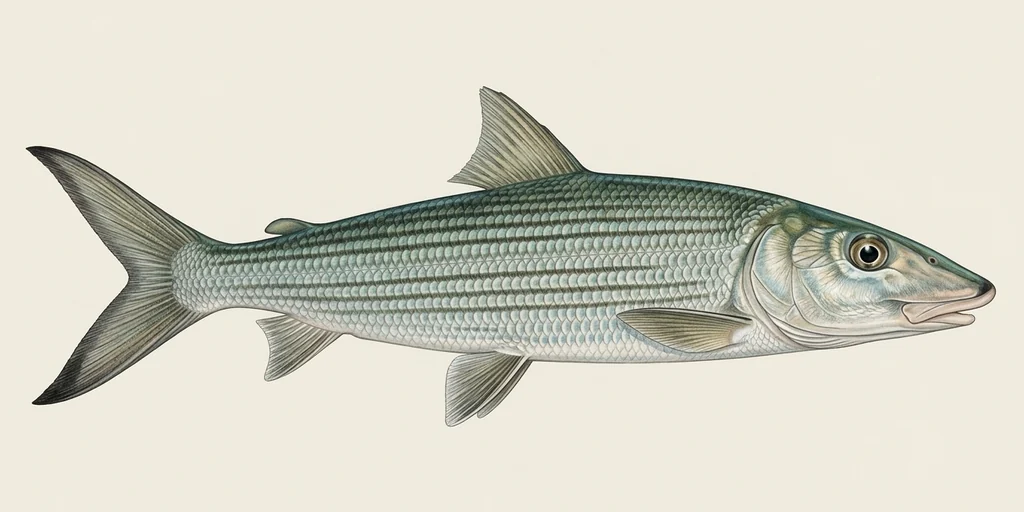
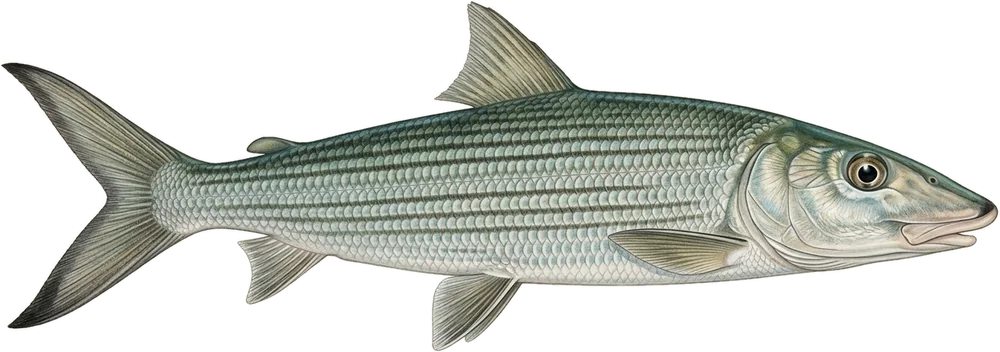
- Conical snout that projects well beyond the underslung mouth
- Dark lengthwise stripes between the scale rows on the blue-green back
- Deeply forked tail fin with a dark edge
Catch chances through the year
- Hardly any chance
- Possible
- Good
- Peak season
- Spawning (observe the closed season)
Editorial assessment for the home water (Florida, the Bahamas and the Caribbean), not a measured value and not a guarantee. The rules of the country you travel to are binding.
How to recognise it
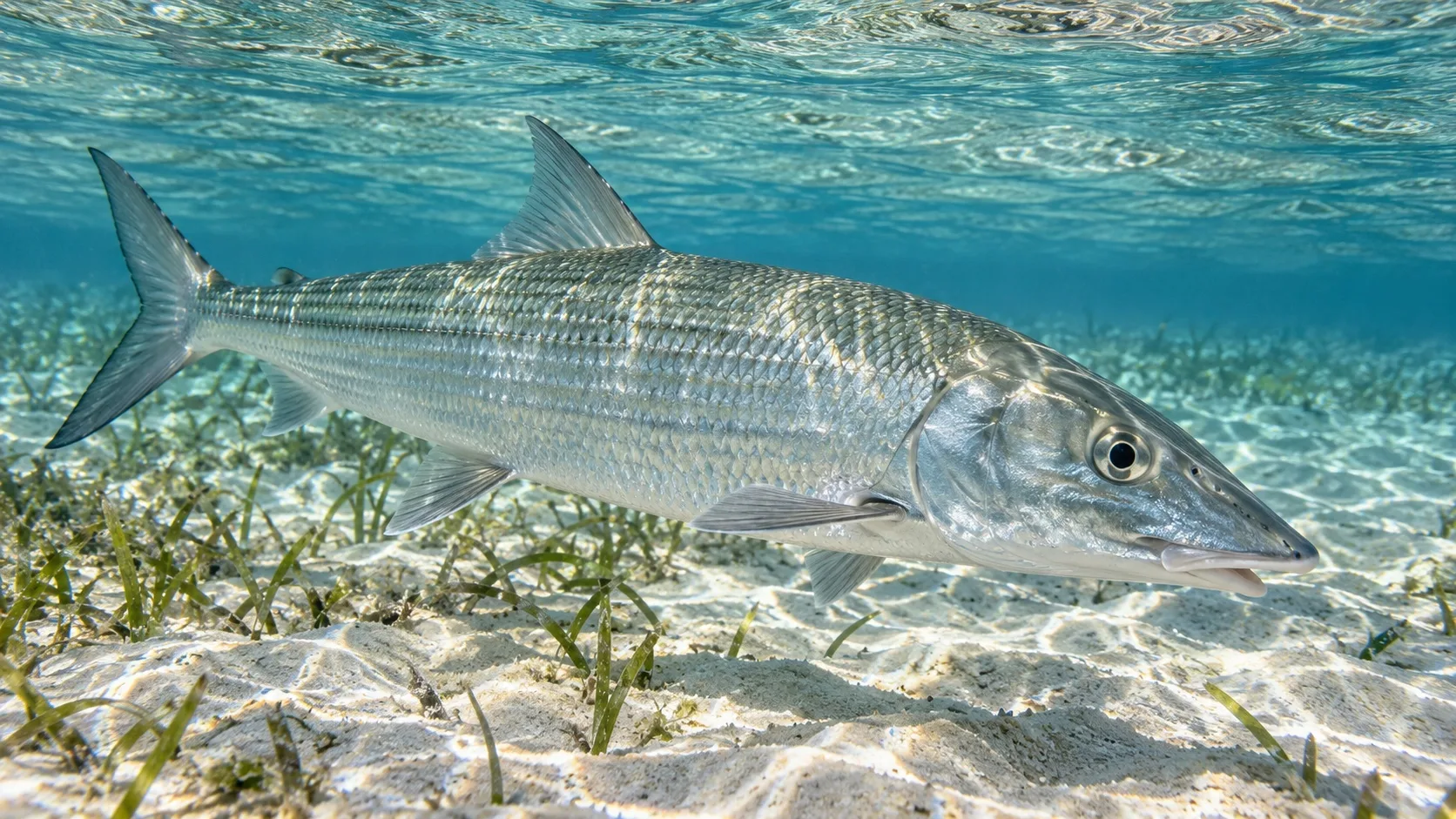
The body is slim, round and spindle-shaped. A conical snout that clearly overhangs the underslung mouth is typical. The bonefish uses it to root through the bottom for food. It has no spiny rays at all, and the pectoral fins are yellowish at the base.
Seen from above the fish looks blue-green, and it is pale silver on the flanks and belly. Dark lengthwise stripes run between the scale rows on the back, and the dorsal and tail fins have a dark edge. The tail fin is deeply forked. Juveniles start out with nine dark bars across the back, which fade as they grow.
In the Caribbean and the western Atlantic the bonefish reaches about 77 centimetres and roughly six kilograms, according to the Florida Museum. In Florida and the Bahamas fish of 1,8 to 2,7 kilograms are typical, and from about 3,6 kilograms a fish counts as big. The animals can live for more than 19 years.
The name bonefish stands for a whole group: genetic studies have told apart at least eight species of the genus Albula that look practically identical. Anyone who catches a bonefish in Hawaii, the Pacific or the Indian Ocean is therefore very likely to have a different species on the hook than in Florida.
The western Atlantic is also home to the Shafted Bonefish, in which the last ray of the dorsal and anal fin is drawn out into a thread; in Albula vulpes it is not. The bonefish is related to the tarpon: both go through a transparent, ribbon-shaped larval stage that is otherwise known only in eels.
Side by side
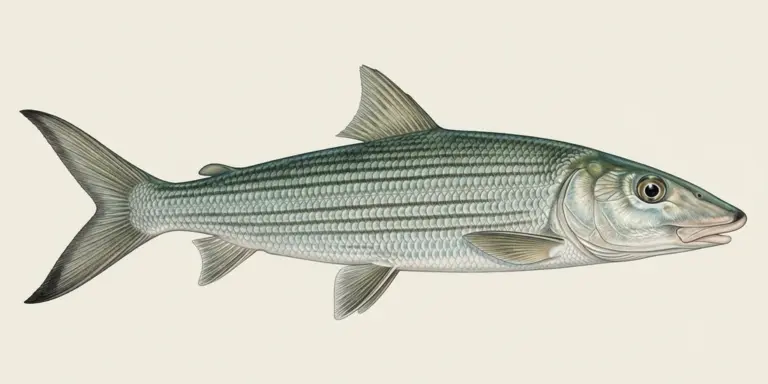
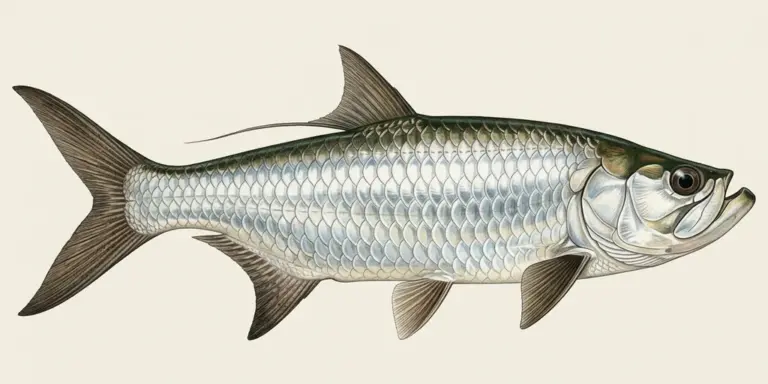
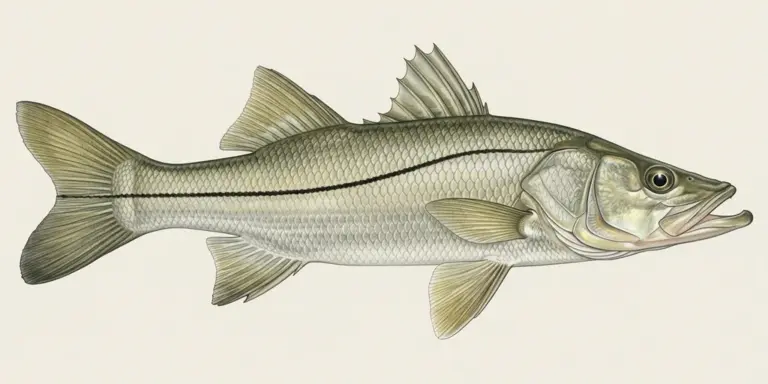
AI-generated illustrations.
Where it holds
Bonefish live mainly along the coast: on tidal flats, around mangroves, in river mouths and in the deeper channels next to them. The bottom ranges from sand through seagrass to rock. They are common in southern Florida, the Bahamas and Bermuda, and to the south their range runs through the Caribbean as far as Brazil.
The bonefish tolerates oxygen-poor water in warm lagoons because it can take air into its lung-like swim bladder. Telemetry studies in the Bahamas show a fixed pattern: with the rising tide the fish move onto the flats, and with the falling tide they drop back into deeper water. They often use a single spot for only a few days before moving on.
Holding spots in the picture
Choose the time of day: the picture shows where the species holds. We do not show German seasons for travel fish; the bars give the chance of a catch for each month. Tap a fish or a spot in the list to bring it closer. The picture is schematic and AI-generated, and every water is different.
Chance of a catch per month according to the catch calendar
- J
- F
- M
- A
- M
- J
- J
- A
- S
- O
- N
- D
Spawning season
Time of day The tide is what matters: as the water rises the fish enter the shallows to feed, and as it falls they move back into deeper troughs.
On the coast
gully in front of the sandbank
Bonefish (Grätenfisch) are here all year.
Seagrass, gravel and stones in the shallows
Bonefish (Grätenfisch) are here all year.
Sandy bottom
Bonefish (Grätenfisch) are here all year.
Drop-off
Bonefish (Grätenfisch) are here all year.
Bonefish feed on shallow flats of sand and seagrass, at mangroves and off river mouths. As the water falls they stand in the deeper troughs beside the flats. Large fish often stay in deeper water in summer.
Depth: To feed, bonefish often go into water less than 30 centimetres deep, and they mostly live between 1 and 15 metres. To spawn they move to the edge of the deep water and dive there down to around 137 metres.
Size comparison: AI-generated drawing, schematic.
How it feeds and spawns
It feeds on the bottom, often in less than 30 centimetres of water. In southern Florida the stomachs contain mostly crabs, shrimps, mussels, snails, bristle worms and small toadfish. The bonefish cracks hard shells with tooth plates on the tongue, in the upper jaw and in the throat. In very shallow water the dorsal fin sometimes sticks out as it does so. Anglers also watch for tail tips above the surface, known as tailing.
Smaller bonefish travel in schools of a few to hundreds of animals, while big fish are often alone. They leave the flats to spawn: in the Bahamas, according to a study in the journal Marine Biology, more than a thousand fish often gathered near the edge of deep water around new and full moon between October and May. Off Abaco, researchers from Florida Atlantic University followed bonefish on their spawning run down to about 137 metres. The larvae then drift for a long time as plankton in the open sea.
When and where the season is
In Florida, the Bahamas and the Caribbean bonefish are caught all year round. The Florida Museum describes a peculiarity of summer: big fish then often stay in deeper water and only return to the flats in greater numbers in autumn, when the water is cooler.
According to the studies, spawning falls roughly between October or November and May or June. On the days around new and full moon in this period some schools are missing from their usual flats because they head for the gathering sites. On the flats the tide matters more than the month: rising water brings the fish into the shallows to feed.
What it is caught on
Step by step: Bonefish fishing: tips on bait, rig and tackle – season, spots, baits, tackle and rules on one page.
Bonefish are caught on the fly rod and with light spinning gear, usually wading or from a shallow-draught boat, sight fishing. In a study in the Bahamas the fly anglers fished rods of classes 7 to 9 with crab and shrimp patterns. The spinning anglers used small jigs of about 7 grams with a rubber or hair body, or dead shrimps on the hook.
The approach is what counts. Bonefish are wary, and a whole school is easily spooked. Anglers report that the bait is best sunk to the bottom a little way in front of the fish and then only inched briefly, like a shrimp fleeing. As the bonefish is a very fast swimmer, the drag should be set lightly.
Release quickly, keep the fish in the water: In a study in the Bahamas 17 percent of released bonefish were eaten by lemon sharks or barracudas shortly afterwards. Fish that had lost their balance on release were hit six times more often. Keep the fight short and the fish in the water as far as possible.
Keep an eye out for sharks: Where there are many sharks, a freshly released fish is easy prey. Researchers recommend not releasing the bonefish right there in that case, but a little way off.
Suitable lures
Shrimp and crab flies, small jigs with a rubber or hair body, and dead shrimps.
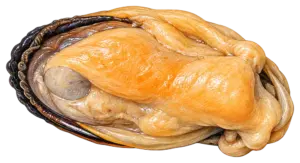
AI-generated illustrations. A click opens the lure’s page.
In Florida catch and release only; unhook the fish in the water if possible
What you need to know in the country you visit
In Florida the bonefish has been a pure catch-and-release fishery since 2013: taking fish is prohibited, and selling them is banned as well. The rules are in chapter 68B-34 of the Florida Administrative Code. Anyone fishing in Florida’s salt water generally needs a fishing licence, and for visitors it is also available for three or seven days (Florida Statutes 379.354).
In the Bahamas you have needed a personal fishing licence for fishing the flats since 2017; foreign boats additionally need a permit and certified guides (Flats-Fishing-Verordnung 2017). The other Caribbean countries have their own licence and protection rules. The competent local fisheries authority is always the one that counts. The International Union for Conservation of Nature (IUCN) lists Albula vulpes as near threatened.
Frequently asked questions (FAQ)
Can you eat bonefish?
The flesh is very bony and not regarded as a good food fish. In Florida bonefish may not be taken anyway, and almost everywhere they are released.
When is the best time for bonefish?
They are caught all year round. The tide matters more than the month: on a rising tide the fish come onto the flats to feed. In high summer big fish tend to stay in deeper water.
How big do bonefish get?
Up to about 77 centimetres in the western Atlantic. In Florida and the Bahamas 1,8 to 2,7 kilograms is typical, and from 3,6 kilograms a fish counts as big.
Sources
The rating of catch chances is an editorial assessment. The facts come from these sources, and the text is worded in our own words. The illustration is an original design by Angel Momente in the style of a natural history plate (AI-generated, see the AI notice).
- FishBase: Albula vulpes, Bonefish
- Florida Museum of Natural History: Discover Fishes – Bonefish
- VLIZ Marine Info: Danylchuk et al. (2011), Aggregations and offshore movements as indicators of spawning activity of bonefish (Marine Biology)
- Florida Atlantic University: Bonefish Dive Deep into the Abyss to Spawn (2020)
- Cooke & Philipp (2004): Behavior and mortality of caught-and-released bonefish in Bahamian waters, Biological Conservation (Carleton University)
- Danylchuk et al. (2007): Effects of recreational angling on the post-release behavior and predation of bonefish, J. Exp. Mar. Biol. Ecol. (University of Wisconsin)
- Florida Department of State: Florida Administrative Code, Chapter 68B-34 Bonefish
- Florida Senate: Florida Statutes 379.354, Recreational licenses, permits, and authorization numbers
- UNEP-LEAP / FAOLEX: Bahamas, Fisheries Resources (Jurisdiction and Conservation) (Flats Fishing) Regulations 2017
Created with AI support from the sources listed. Figures only appear in the text if a source gives them. Last updated: 27 October 2026. Found a mistake? Write to us. Who is behind this site: About me.
More in the lexicon
- All fish species at a glance
- Catch calendar – month, water temperature and profile for 93 species
- Line calculator – breaking strain after the knot, drag guideline, backing
- Angling methods