
Knowledge · Tackle
Cookware, cutlery and food by the water
If you spend the night by the water, pack your camping cookware sensibly: a few items made of the right material. Uncoated aluminium does not cope with acidic and salty food, and a coated pan does not cope with being heated empty. Raw and cooked food are kept apart, and your provisions are stored so that foxes, wild boar and gulls cannot get at them.
Aluminium, stainless steel, titanium or coated
One important difference between the three metals is thermal conductivity, that is, how well a material passes heat on. According to a table on Wikipedia, it is 236 W/(m·K) for pure aluminium, 22 for titanium and between 15 and 25 for stainless steel. So aluminium conducts heat about ten times as well as titanium or stainless steel. On a small stove, an aluminium base therefore spreads the heat more quickly across the whole surface, while with titanium and stainless steel it tends to stay where the flame hits.
Titanium weighs considerably less than steel at similar strength. Wikipedia gives a tensile strength in the range of many steels at a density of 4,5 instead of around 7,9 g/cm³. Stainless steel is heavier but has a smooth surface that is easy to clean.
| Material | Heat conduction | What to look for |
|---|---|---|
| Aluminium, uncoated | very good | do not cook or store anything acidic or salty in it |
| Stainless steel | low | heavier, smooth and easy to clean |
| Titanium | low | light and strong, heat stays at the flame |
| Non-stick coating (PTFE) | depends on the base metal | never heat empty, not over embers |
| Melamine resin (tableware) | not for cooking | only for cold and lukewarm food |
Aluminium: avoid acid and salt
Aluminium dissolves under the influence of acid and salt, writes the Bundesinstitut für Risikobewertung (BfR), Germany’s federal risk assessment institute. According to the institute, you can carry on using coated aluminium pots. In uncoated ones, salty or acidic food should, as far as possible, not be prepared or kept for long; as examples the BfR names apple sauce, tomato purée, rhubarb and salted herring. If you like to cook tomato sauce on a session or cook fish with lemon, use a coated pot or a stainless steel one for it.
The reason: if you take in aluminium often and regularly, it can be stored in bones, muscles and organs, according to the BfR. On average, teenagers and adults already use up half of the tolerable weekly amount through food alone. Aluminium cookware used the wrong way is an avoidable source.
Non-stick pan: never empty on the flame
Most non-stick coatings are made of the plastic PTFE (polytetrafluoroethylene). From around 360 °C it can decompose, according to the BfR, giving off harmful fumes without any visible smoke. So such a pan should never be heated high when empty. The BfR calls for particular care with gas, because it heats up very quickly. As long as there is water or food containing water in the pan, the temperature hardly rises above 100 °C. Directly above the flame of a gas or charcoal grill, on the other hand, around 360 °C is possible, according to the institute. Over embers and an open fire, therefore, only use cookware without a coating.
Mugs, cutlery and vacuum flask
Tableware made of melamine resin (melamine-formaldehyde resin) is hard and unbreakable and, according to the BfR, is often found in camping products. With tea, coffee, soup and other hot food it can release melamine and formaldehyde, and the BfR advises against this. It has no concerns about cold and lukewarm food. There is no obligation to label the material. If there is no information on the mug or the packaging, your hot coffee is better off in stainless steel.
For reusable mugs, the BfR names materials with a smooth surface such as porcelain, stainless steel, glass and plastics that keep their shape and withstand heat. Only use a mug as long as its surface is smooth, without hairline cracks or visible signs of wear.
As far as the BfR knows, the parts of vacuum flasks that touch the drink are not made of aluminium. It is a different matter with an insulated food container holding soup or stew: the BfR advises keeping hot food at a minimum of 60 °C throughout, because most bacteria multiply between 10 and 60 °C. So fill it piping hot and eat while it is still hot.
For cutlery, a spoon with fork tines at the tip saves you one item. Add a sharp knife for bread and vegetables; the filleting knife is kept for the fish. When preparing food, clean cutlery is better than bare hands, according to the BfR.
Preparing fish: pan, foil and two pairs of tongs
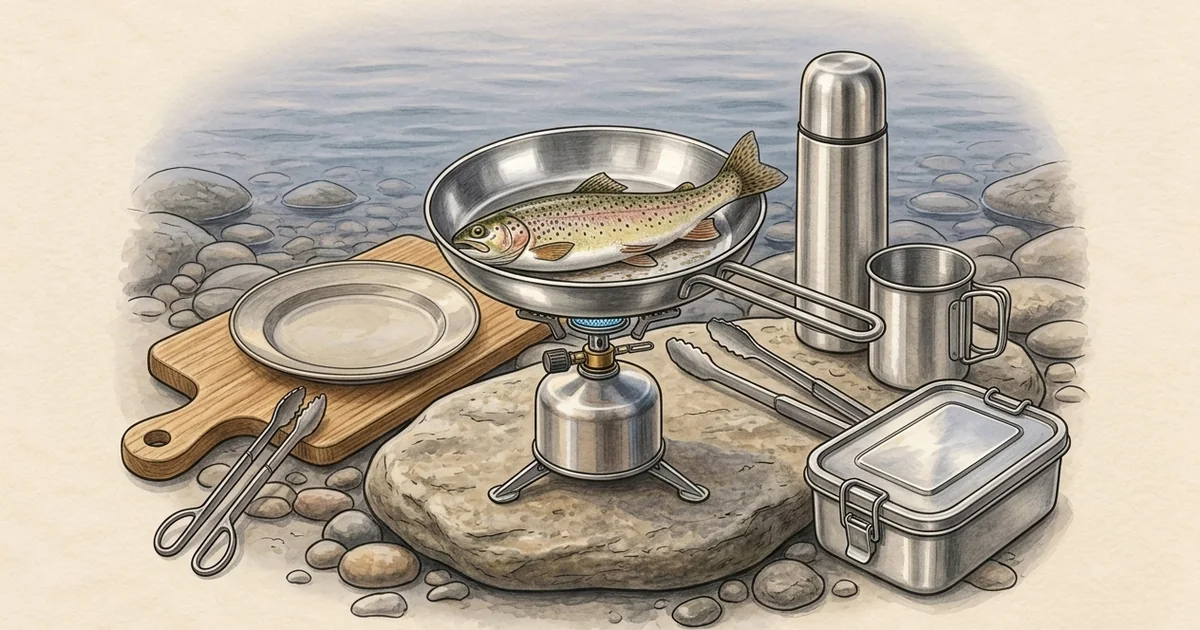
According to the BfR, raw fish can carry pathogens and calls for particular care with hygiene. Via hands, cutlery and boards, germs get onto food that will not be heated again. The BfR therefore advises never using the same kitchen utensils for raw and cooked food and using different tongs or forks when grilling. For raw food, plastic boards are better than wooden ones because they can be washed hot. On the bank, that means one board and one pair of tongs only for the raw catch, and a plate and a second pair of tongs for the finished food (Fig. 2). How to gut the fish beforehand is explained under Gutting a fish.
According to the BfR, fish is done as soon as the flesh no longer looks glassy and flakes easily with a fork. For anything grilled, the institute’s rule of thumb is “golden, not charred”: do not heat it more strongly or for longer than necessary.
Aluminium foil and grill trays
Cooking fish with lemon slices in aluminium foil seems the obvious thing to do by the fire. The BfR, however, advises against using aluminium foil to wrap acidic or salty food. If you do not want to do without foil, put at least one layer of baking paper between the fish and the foil. For aluminium grill trays, the institute explicitly names acidic vegetables and lemon slices as problematic; salt and seasoning only go on after grilling. Trays made of stainless steel or ceramic avoid the problem. How Steckerlfisch (fish grilled on a stick), grill baskets and fish roasters work is shown in Fish over the fire.
Washing your hands without a basin
After handling raw fish, the BfR advises washing your hands thoroughly with warm water and soap. The Bundesinstitut für Öffentliche Gesundheit (BIÖG) advises lathering them for 20 to 30 seconds and rinsing them under running water. A canister with a tap gives you that stream of water on the bank too, filled with drinking water from home (see Drinking water on the go). Without running water, wet wipes soaked in a cleaning agent are an alternative in the BfR’s view.
Health: According to the BfR, salmonella and other pathogens can multiply at anything above 7 °C. Salads, sauces and desserts that stand around unrefrigerated for a long time are therefore a particular risk, and perishable food must be kept cool even on a picnic (see Cool box). Food infections are dangerous above all for pregnant women, older people, people with pre-existing conditions and children under five. This text reflects advice from the BfR and BIÖG and does not replace medical advice.
Storing food out of reach of animals
Berlin’s Senate Department for the environment (Senatsverwaltung für Mobilität, Verkehr, Klimaschutz und Umwelt) describes how wild boar search litter bins and rubbish bins for food. Thanks to their good memory, they find places with picnic leftovers again. Any kind of feeding attracts them for good. Against foxes, the best thing according to the Senate is to remove any food lying around, leftovers included, and to keep rubbish closed. Shoes and small items that a fox might carry off as toys should be put away, at least overnight.
The raccoon likes to look for food by the water. With its front paws it feels for fish, frogs and crayfish in shallow water, and in towns it raids rubbish bins. As a rule it does not attack people, but it may bite if cornered. The Senate advises neither touching raccoons nor feeding or luring them. In Berlin, feeding most wild animals is prohibited according to the Senate (§§ 34 and 50 Landesjagdgesetz Berlin), and the fine can be up to 5.000 euros.
On the coast, gulls come into it as well. In Stralsund, the Möwenfütterungsverbotsverordnung (gull feeding ban, in force since 2021 and limited until the end of 2031) prohibits feeding around the harbour and the old town ponds, on the Sundpromenade and at the lido. Feeding there explicitly also includes putting out or offering feed or food that gulls are known to take. Violations can be fined up to 5.000 euros.
- Pack food in tubs with clip-on lids; do not leave bread and sausage loose in your bag.
- When eating, only take out what you need right then and close the rest again straight away.
- Put leftovers and packaging straight into a sealable bag, never into the bushes or the water.
- Before you go to sleep, put tubs and rubbish bags in the car or a tightly closing box, and take your shoes into the tent with you.
Pointer: The examples from Berlin and Stralsund only apply there. Whether feeding is prohibited is regulated differently from place to place by hunting law and local authorities. What applies at your water is in the water rules (Gewässerordnung) and your fishing permit (Erlaubnisschein); if in doubt, ask the municipality or the lower hunting authority (Untere Jagdbehörde).
Washing up without washing-up liquid in the water
Washing-up liquid does not belong in a lake or river, not even if it says “biodegradable” on the bottle. The Umweltbundesamt (UBA), Germany’s environment agency, explains why: the surfactants, i.e. the cleaning agents, are fully biodegradable. That does not apply to other ingredients such as fragrances and dyes, preservatives or phosphonates. Many of them can build up in the environment and in living things and harm aquatic organisms. Despite sewage treatment plants, some of these substances still reach the environment, according to the UBA. On the bank, even that stage is missing.
- Wipe grease and leftovers out of the pot and pan with kitchen paper while they are still warm, and put the paper in the rubbish bag.
- Pack anything that has touched raw fish in a separate leakproof bag.
- At home, clean everything with hot water and washing-up liquid or put it in the dishwasher. For that, the BfR recommends programmes of at least 60 °C.
- Let mugs and tubs dry completely before they go back in the box.
Packaging, foil and paper go home with you. Why even small bits of litter do harm on the bank and what many water rules require is explained under Leaving your fishing spot clean.
Checklist for the cooking box
- Pot with lid, coated or stainless steel for acidic and salty food
- Pan without non-stick coating for an open fire
- Stainless steel mug for hot drinks
- Vacuum flask for tea or coffee
- Combination cutlery and a knife for bread and vegetables
- two pairs of tongs or forks, one for raw, one for cooked
- small plastic board just for raw fish, plus a plate
- Baking paper, if aluminium foil comes along
- Canister with tap and drinking water, soap, wet cleaning wipes
- Kitchen paper and two sealable bags for rubbish and used dishes
- Food tubs with clip-on lids, perishables in the cool box
- Stove and fuel; choice and safety under Camping stove
Common mistakes
- Wrapping fish with lemon in bare aluminium foil. Acid and salt dissolve aluminium. The BfR advises against it; if you do not want to do without foil, put baking paper in between.
- Preheating the non-stick pan empty on the gas stove. From around 360 °C the coating can decompose, and gas heats up very quickly.
- Pouring hot tea into a melamine mug. The BfR advises against hot food in melamine resin.
- Using one pair of tongs for everything. That way germs from the raw fish end up on the finished food.
- Leaving food and leftovers out overnight. Wild boar remember such places, and foxes carry off small items.
Frequently asked questions
Is titanium healthier than aluminium?
The BfR’s concerns relate to uncoated aluminium with acidic and salty food; according to the institute, coated aluminium pots are fine. The BfR pages evaluated here say nothing about titanium.
Can the coated pan go on the campfire?
Better not. According to the BfR, temperatures of around 360 °C can occur directly above the fire of gas and charcoal grills, and from there PTFE can decompose. For embers and campfires, use a pan without a coating. Whether a fire is allowed on the bank at all is covered under Fire, barbecues and stoves on the bank.
How long can cooked food stand unrefrigerated?
The BfR names two ways: keep it hot at a minimum of 60 °C or cool it to below 7 °C within a few hours. Without refrigeration on the bank, you are better off eating it straight away.
Is biodegradable washing-up liquid all right at the lake?
No. According to the UBA, the surfactants in cleaning products are biodegradable anyway, but other ingredients are not, and some harm aquatic organisms. Wipe your dishes out with paper on the bank and wash them at home.
Related
- Camping stoves at the fishing spot: gas, methylated spirit, solid fuel and wood compared
- Cool box and cool bag: keeping your catch and food cold
- Drinking water on the go: containers, filters and boiling
- Fish over the fire: grill basket, fish on a stick and fish roaster
- Storage and hygiene: storage times, freezing and kitchen hygiene at home
- Leaving your fishing spot clean: rubbish, leftovers and water rules
- Night session packing list: everything for a night at the water
- Line calculator: calculating breaking strength and backing for the tackle
Sources
- Bundesinstitut für Risikobewertung: Fragen und Antworten zu Aluminium in Lebensmitteln und verbrauchernahen Produkten (Säure und Salz, Alutöpfe, Anreicherung, Isolierkannen)
- Bundesinstitut für Risikobewertung: Ausgewählte Fragen und Antworten zum Grillen (Alufolie, Backpapier, getrennte Zangen, 7 °C, Risikogruppen)
- Bundesinstitut für Risikobewertung: Ausgewählte Fragen und Antworten zu Geschirr mit Antihaftbeschichtung aus PTFE (360 °C, Gas, Grillfeuer)
- Bundesinstitut für Risikobewertung: Fragen und Antworten zu Geschirr und Küchenutensilien aus Melamin-Formaldehyd-Harz (heiße Speisen, Kennzeichnung) und Fragen und Antworten zur Nutzung kundeneigener Mehrwegbecher (Materialien, Haarrisse)
- Bundesinstitut für Risikobewertung: Lebensmittelinfektionen im Privathaushalt (Utensilien und Bretter, Garpunkt, Warmhalten, feuchte Tücher)
- Bundesinstitut für Öffentliche Gesundheit: Händewaschen (Dauer, fließendes Wasser, unterwegs)
- Senatsverwaltung für Mobilität, Verkehr, Klimaschutz und Umwelt Berlin: Wildtiere im Stadtgebiet, Wildschwein, Fuchs und Waschbär (Nahrungssuche, Fütterungsverbot in Berlin)
- Hansestadt Stralsund: Stralsunder Möwenfütterungsverbotsverordnung vom 26. Oktober 2020 (PDF) (Fütterungsverbot, Geltungsdauer)
- Umweltbundesamt: Reinigung im Haushalt (Inhaltsstoffe von Reinigungsmitteln im Gewässer)
- Wikipedia: Wärmeleitfähigkeit (Werte der Metalle) und Wikipedia: Titan (Element) (Dichte), beide nur ergänzend
Text AI-assisted, drawing AI-generated. Sources opened and checked in November 2026; no graphics taken from the sources.
All figures are guide values without guarantee. What may go in your pot and pan depends on the material, the coating and the food; this text does not replace medical advice, and what applies at your water regarding animals and rubbish is set by the federal state, the municipality and the water rules.