
Knowledge · Tackle
Fish over the fire: Grill basket, Steckerlfisch and hinged fish grill
For grilling fish by the water you can manage with three pieces of kit: the wooden stick for Steckerlfisch (fish on a stick), the hinged fish grill, a hinged wire rack or grill basket for whole fish, and the soaked wooden plank for fillets. Whether it works out depends on the embers, a chilled and gutted catch and the doneness test at the thickest point.
From catch to grill
Only a fish that has been stunned and killed and then gutted goes on the fire. The gills come out too. The junior angler recipes of the Landesfischereiverband Bayern use, for fish in a parcel, a gutted trout, a char or a tench with the head on but without gills. They do not scale it, because the small scales of these species are eaten. How to remove scales and skin from other species is described under Scaling and skinning fish.
Keep the catch cold until it goes on the grill. The Bundeszentrum für Ernährung (BZfE) advises transporting fish chilled, for example in a cool bag (see Cool box and cool bag). Shortly before grilling, pat it dry. The magazine Rute & Rolle recommends scoring whole fish once or twice on each side so that they cook evenly.
Cyprinids such as roach, bream or silver bream carry many fine bones loose in the flesh. The learning portal of the Fischerjugend in the LFV Bayern describes a bone cut for this: score the back and tail section crosswise at intervals of 2 to 3 millimetres. It is described there for the frying pan. The sources do not say whether it helps just as much on a stick.
Which fish suits which method
For the grill, the BZfE mainly names species with firm, rather oily flesh such as mackerel and medium-oily ones such as trout. Grilled with the skin on, the flesh stays protected. Rute & Rolle counts trout, char and zander among the firm-fleshed fish that hold their shape over the fire. More delicate fish need more protection and indirect heat there, so they do not lie directly over the embers.
How much fat a fish brings is shown in an overview in the learning portal of the LFV Bayern, per 100 grams of raw fish: mackerel 11 to 15 per cent, carp 4 to 8, trout and whitefish 2 to 3, pike, zander and perch only about 0,5 per cent. According to Blinker, a great many species are suitable for Steckerlfisch. From fresh water the magazine lists trout, char, whitefish, perch, roach and bream, from the sea mackerel and herring. The speciality portal of the Bavarian agriculture ministry names trout, salmon trout, whitefish and various coarse fish from lakes, rivers and ponds as the usual fish.
| Catch | Examples | Suitable method |
|---|---|---|
| whole portion-sized fish, firm flesh | trout, char, whitefish, mackerel | Stick or hinged fish grill |
| Coarse fish with many bones | Roach, bream | Stick |
| lean flesh | zander, pike, perch | Plank or hinged fish grill, perch also on a stick |
| large fish | large pike, carp | Fillets with skin on a plank or in a grill tray |
Cut up large fish beforehand, as described under Filleting fish. Rute & Rolle advises grilling fillets with the skin on: it holds the piece together and turns crispy at the right heat.
Steckerlfisch step by step
Steckerl is Bavarian for a small stick. It means a whole fish threaded lengthways on a stick and cooked at an angle beside the embers. The steps:
- Bring sticks. Blinker suggests fresh willow branches with the bark removed or sharpened beech sticks 60 to 80 centimetres long. A recipe from ORF soaks wooden skewers in water overnight.
- Season. Brush the gutted fish with oil inside and out, then salt and pepper it.
- Skewer. Push the stick through the mouth, pierce the flesh right at the start of the backbone and slide it along one side of the backbone until it is just short of the end. Let it come out briefly there, switch to the other side, pierce again at the base of the dorsal fin and bring it out through the middle of the tail fin.
- Wait for the embers. The Bundesinstitut für Risikobewertung (BfR) advises waiting after lighting until the heavy smoke has passed. For the heat, Blinker gives a hand test: hold your hand about 30 centimetres above the embers. If you can stand it there for three seconds, you are ready to go.
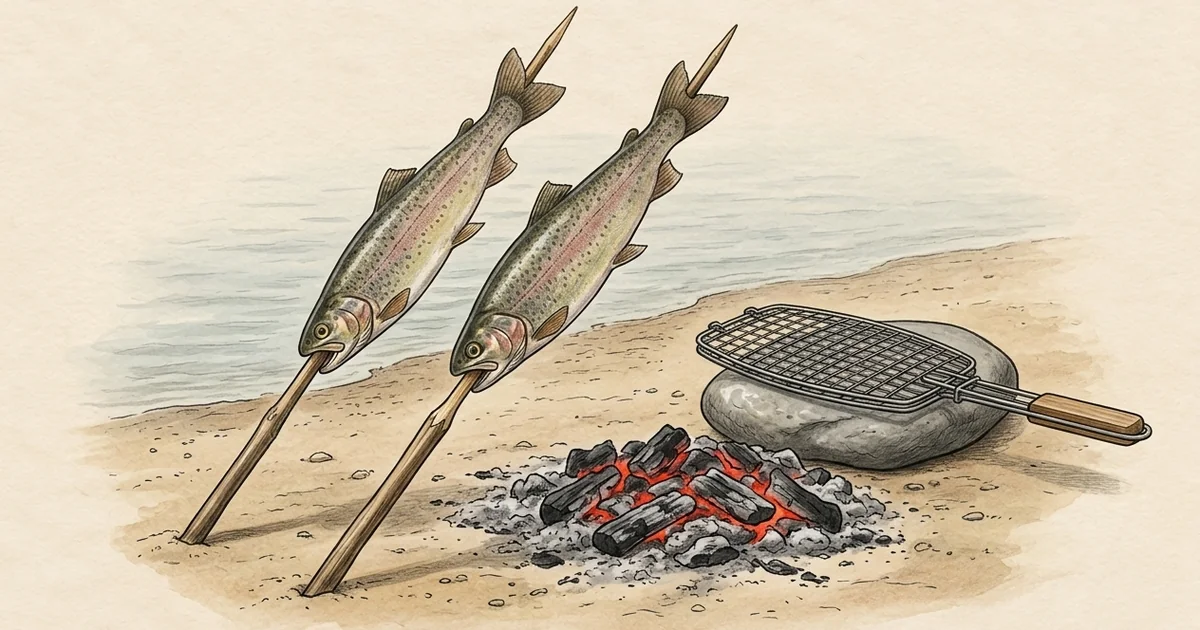
- Set up. Blinker puts the sticks into a holder at an angle of about 45 degrees, with the embers below. Fig. 1 instead shows the stick at an angle in the ground to the side of the embers; what that means for the fat is explained below the list. At first the back faces the embers. If it is too hot, the skin on the back splits and the fish burns on the outside before it is cooked inside.
- Turn and baste. Blinker turns the fish on the stick again and again and brushes them regularly with oil or butter so that they cook through evenly and the skin turns crispy. You turn the stick; the fish stays on it.
- Doneness test. The ORF recipe grills char, trout or mackerel of 300 to 400 grams for about 8 to 10 minutes per side. That is a guideline. Only the test at the backbone shows whether the fish is done, see below.
When fat drips into the embers, more polycyclic aromatic hydrocarbons (PAHs) form, according to the BfR, substances with a carcinogenic effect. As a remedy, the BfR names grill trays that catch the fat, and also grills whose heat source is vertical to the food. Applied to Steckerlfisch: if the stick stands to the side of the embers as in Fig. 1, the fat falls beside them. The BfR itself does not mention Steckerlfisch.
Hinged fish grill, grill tray and parcel
The hinged fish grill, also called a grill basket, consists of two wire grids with a hinge and handle. The whole fish lies between them, and you turn the grid. According to the BZfE, such a grill clamp holds whole fish such as trout or zander together when turning. Rute & Rolle recommends a clean, well-preheated grate and, if oil is used, only a heat-resistant one such as rapeseed oil.
A grill tray catches escaping fat. According to the BfR, stainless steel, ceramic and aluminium are all suitable. However, ions dissolve out of aluminium, especially with acid and salt, and pass into the food. With frequent intake, the metal can accumulate in the body. On an aluminium tray, therefore, only salt and season after grilling. According to the BfR, aluminium foil should not wrap acidic or salty foods. The institute explicitly names marinades and lemon slices. A layer of baking paper between fish and foil significantly reduces the transfer.
For the parcel, the junior angler recipe of the LFV Bayern folds the foil over the fish so that a small cavity for steam remains above the belly. The sides are folded tight like a paper boat. The recipe salts the fish inside and out and lays it directly on oiled foil. Following the BfR’s advice, a layer of baking paper belongs in between with salted fish (Fig. 2). The recipe cooks it in the oven at 180 degrees for 20 to 30 minutes depending on size. Over a fire the heat fluctuates more, so the doneness test decides.
Wooden plank for fillets
According to a recipe in Rute & Rolle from 2019, fish does not dry out so quickly on a plank. That makes it suitable for lean species such as zander too, as well as classics such as salmon and trout. The wood gives the fish flavour. Almost any wood works; hickory tastes rather sharp, cedar a little sweeter. The magazine avoids very resinous planks of pine or fir because they taste bitter. Soak the plank for at least an hour before grilling, otherwise it will char in the heat.
The fillet goes on the wet plank washed, patted dry and lightly salted. Rute & Rolle cooks zander fillets this way for around 20 minutes at about 110 degrees in the smoke. On a gas grill the plank sits in the indirect zone, so not over the burner.
Telling when it is done: test and core temperature
According to the BfR, fish is done when the flesh no longer looks glassy and flakes easily under a fork. Check where the fish is thickest, so on a whole fish at the backbone. A probe thermometer measures more precisely. The sources differ on the temperature:
- For food in general, the BfR gives at least 70 degrees for two minutes at all points.
- For food businesses, EU Regulation No 1276/2011 gives at least 60 degrees at the core for at least one minute for parasites other than flukes (trematodes).
- The learning portal of the Fischerjugend gives at least 80 degrees for fish.
But the fish should not go on too hot a fire. Above 150 degrees, according to the BfR, more heterocyclic aromatic amines form in meat and fish, further undesirable substances. The institute’s rule of thumb is “golden, not charred”. Which parasites occur in fish and which values apply to freezing is covered under Parasites in fish.
Health: The BfR does not consider raw or undercooked fish advisable for small children, pregnant women and people with a weakened immune system. For these guests, cook the fish right through. This text does not replace medical advice.
Hygiene and fire safety by the water
Germs on raw fish are killed by sufficient heat, but before that they can reach other food via hands, utensils and surfaces, writes the BfR. It therefore advises separate tongs for raw and cooked food, washing hands with warm water and soap between steps and disposing of leftover marinade straight away. The learning portal of the Fischerjugend adds: only wash fish with clean drinking water, because the water of the fishing water may contain coliform bacteria, and do not pour waste water into the water (see Leaving your fishing spot clean).
Checklist for a barbecue evening by the water:
- Drinking water in a jerrycan and soap (see Drinking water on the go)
- two pairs of tongs or forks, one only for raw fish
- Board and knife for the raw catch, kept apart from the crockery
- Probe thermometer and baking paper
- soaked sticks or plank, hinged fish grill with oil
- Cool box for the catch until grilling
- solid firelighters instead of liquid ones
- Fire blanket, bucket of sand or powder extinguisher
Fire: The Berliner Feuerwehr advises never letting the grill out of your sight, not using accelerants such as petrol or methylated spirit and not tipping embers onto the ground to cool. Only dispose of charcoal once it has gone completely cold. According to the BfR, glowing charcoal releases a lot of carbon monoxide, and grilling indoors is life-threatening. Whether you may make a fire on the bank at all is governed by state forest and nature conservation law, the water rules and your fishing permit (Erlaubnisschein). More under Fire, grilling and stoves on the bank and Grill and fire bowl on the bank.
Common mistakes
- Holding the fish in the flames. Too much heat splits the skin on the back; the fish burns on the outside and stays raw inside. First the hand test, then the fish.
- Putting it on too early. While the charcoal is still smoking heavily, more PAHs settle on the food, according to the BfR.
- Lemon and salt directly in aluminium foil. Acid and salt dissolve aluminium. Put baking paper in between or only season after grilling.
- One pair of tongs for everything. The tongs from the raw fish carry germs onto the cooked one.
- Dry or resinous plank. Unsoaked, it chars; pine and fir make the fish bitter.
Frequently asked questions
How long does a Steckerlfisch take?
A recipe from ORF gives about 8 to 10 minutes per side on the grill for fish of 300 to 400 grams. That depends heavily on the embers, the distance and the size. The fish is done when the flesh at the backbone is no longer glassy and comes apart easily.
Can fish go on the grill in aluminium foil?
The BfR advises against using aluminium foil for acidic or salty foods. If you do not want to do without it, put a layer of baking paper between fish and foil. That significantly reduces the transfer of aluminium.
Which fish are best for grilling?
The BZfE names species with firm, rather oily flesh such as mackerel and medium-oily ones such as trout. According to Rute & Rolle, lean fish such as zander or pike dry out less quickly on the soaked plank. The hinged fish grill holds a whole zander together when turning.
Related
- Gutting fish: the belly cut before grilling
- Parasites in fish: heating and freezing according to the authorities
- Smoking fish: hot and cold smoke
- Grill and fire bowl on the bank: designs and safe use
- Cool box and cool bag: keeping the catch cold until it reaches the grill
- Vacuum-packing and freezing fish: for what does not go straight on the fire
- Cookware, cutlery and provisions: what else belongs in the kitchen box
- Line calculator: breaking strain and backing for the catch beforehand
Sources
- Bundesinstitut für Risikobewertung (BfR): Bedenkenlos Grillen, Fragen und Antworten (PAK, Grillschalen, Aluminium, Hygiene, Amine, Kohlenmonoxid)
- BfR: Lebensmittelinfektionen im Privathaushalt (Garprobe bei Fisch, 70 Grad für zwei Minuten, Risikogruppen)
- Europäische Union: Verordnung (EU) Nr. 1276/2011 (60 Grad im Kern für eine Minute gegen Parasiten)
- Bundeszentrum für Ernährung (BZfE): Sommergerichte mit Fisch (geeignete Arten, mit Haut grillen), BZfE: Fisch vom Einkauf in die Küche (Fischzange für ganze Fische) und BZfE: Grillgenuss ohne Risiko (gekühlter Transport)
- Landesfischereiverband Bayern, Lernportal der Fischerjugend: Fische vorbereiten für die Zubereitung (Fettgehalt, Grätenschnitt), Betäuben und Schlachten (Trinkwasser, Abwasser, 80 Grad) und Rezept Fisch in Alufolie (PDF) (Päckchen, Kiemen, Schuppen)
- Blinker: Steckerlfisch grillen für jedermann (2018, aktualisiert 2019; Stäbe, Winkel, Aufspießen, Handprobe, Drehen)
- Rute & Rolle: Feuer frei für Fisch (Fischarten, Rost, Filets) und Rute & Rolle: Gesmokter Zander mit BBQ-Lauch (2019; Holzplanke, Holzarten, Wässern, Garzeit)
- Bayerisches Landwirtschaftsministerium, GenussErbe Bayern: Steckerlfisch (übliche Fischarten) und Wikipedia: Steckerlfisch (Stab über oder neben der Glut, nur ergänzend)
- ORF, Guten Morgen Österreich: Rezept Steckerlfisch (PDF) (Fischgröße, Garzeit, Spieße wässern)
- Berliner Feuerwehr: Grillen (Aufsicht, Glut, Löschmittel)
Text AI-assisted, drawing AI-generated. Sources opened and checked in November 2026; no graphics taken from the sources.
All information is for guidance only and without guarantee. Cooking times depend on the embers, wind and size of the fish; what counts is the doneness test on the finished fish.