
Knowledge · Tackle
Grill and fire bowl on the bank: Safely and only where allowed
When grilling at your swim, the embers usually burn only a few steps from bank grass, reeds, tent or the edge of the forest. Fire services give guideline values for distances and rules for putting fires out, the states‘ forest acts draw limits around the forest, and whether a fire may burn by the water at all also depends on the municipality, the landowner and the water rules (Gewässerordnung).
Designs: how close the embers are to the ground
- Disposable grill: charcoal and grate in a flat tray on very short feet. The federal environment agency Umweltbundesamt (UBA) advises against them because it considers these grills particularly harmful to the environment and dangerous. The park rules of the Swiss canton of Basel-Stadt require heat-resistant, paved ground such as stone for short-legged and disposable grills; on grass the grill tray there must sit 30 cm above the ground, otherwise there is a risk of burn damage.
- Folding charcoal grill: a charcoal pan on legs that folds flat for carrying. When buying, the Feuerwehr Nürnberg recommends a stable build, heat-resistant materials and an ash catcher; the GS mark indicates such properties. If the legs are short, the same applies as for the disposable grill.
- Gas grill: The Berliner Feuerwehr and the Baden-Württemberg interior ministry name two points: tight connections and a hose that does not lie in the heat. The UBA recommends gas or electric grills to reduce the health burden of grilling. Handling cartridges is described on the page Camping stove.
- Fire bowl: an open wood fire in a metal bowl. According to the UBA, fire bowls and fire baskets on fireproof ground prevent the fire from spreading and make it easier to put out. The Landesfeuerwehrverband Sachsen requires them to be set up so they cannot tip over. Only dry, untreated wood belongs in the fire (UBA). Legally it is no loophole; some water rules explicitly mention fire bowls.
- Small wood stove (hobo stove): Wood burns with an open flame in this too. Design and handling are described under Camping stove; whether your state’s forest act treats it like a fire is a question for the forestry authority.
Position, distances and lighting
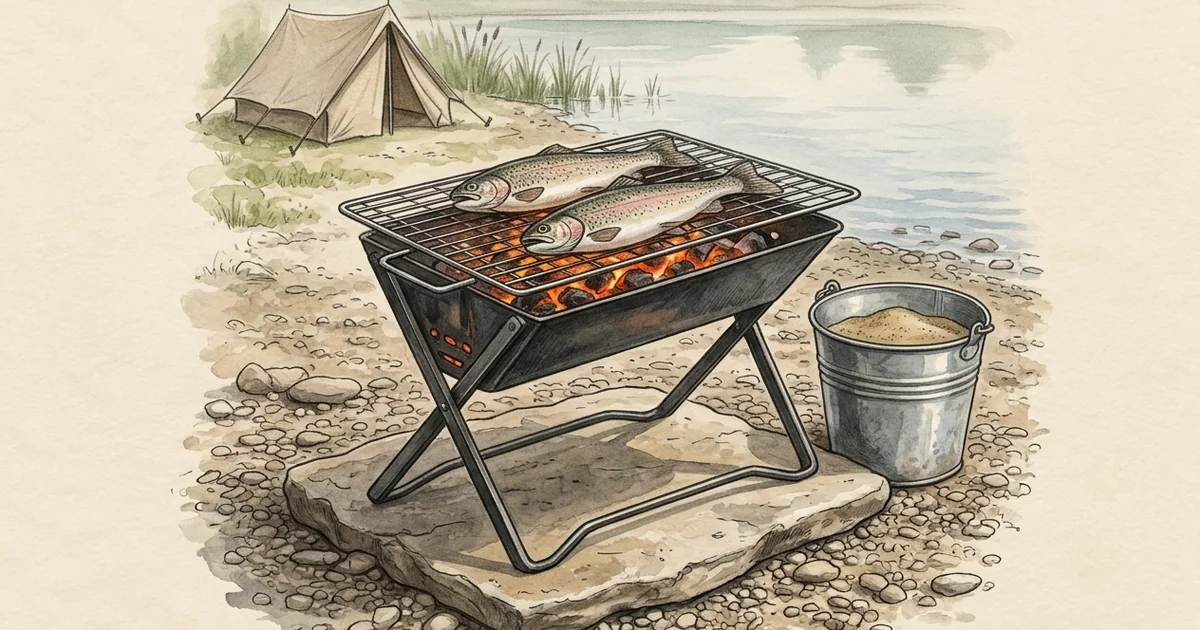
The Baden-Württemberg interior ministry requires a stable grill on a fireproof surface. On the bank that means level, firm and non-flammable, such as a stone slab. Once the grill is lit, according to the Berliner Feuerwehr, it stays where it is.
For the distances (Fig. 1), fire services and authorities give guideline values that differ:
- 5 m to flammable materials is the figure from the Feuerwehr Nürnberg. By the water that means dry grass, reeds, rod bag and chair.
- At least 10 m to tents and to buildings with flammable outer walls is what the Landesfeuerwehrverband Sachsen requires for grills and campfires, more in windy conditions.
- 3 m to trees and shrubs, to the side and upwards, is given by the Basel-Stadt grilling rules for the parks there.
- 2 to 3 m distance for children is recommended by the Feuerwehr Nürnberg and the state fire brigade associations of Saxony and Saarland.
Watch the wind: the Berliner Feuerwehr requires that neither sparks nor embers are blown away. According to the Feuerwehr Nürnberg, wide, flapping clothing can catch fire at the embers.
To light it, use solid firelighters. The Aktion Das Sichere Haus recommends firelighters marked with the standard EN 1860-3. Methylated spirit or petrol often evaporate before the charcoal is properly glowing; when relighting, the vapour cloud can, according to the association, turn into a fireball up to three metres across. According to the UBA, charcoal with the test mark DIN EN 1860-2 contains no pitch, petroleum, coke or plastic.
If fat drips onto the charcoal, it can flare up (Baden-Württemberg interior ministry). Smother burning fat with the grill lid or a fire blanket. The Feuerwehr Nürnberg and the Landesfeuerwehrverband Saarland reject water on it; the association warns of a fat explosion.
Carbon monoxide: embers never belong in the tent
According to the Bundesinstitut für Risikobewertung (BfR), glowing charcoal releases so much carbon monoxide that grilling indoors and in garages is life-threatening, even with windows and doors wide open. The Berliner Feuerwehr rules out gas and charcoal grills in enclosed spaces entirely. The Landesfeuerwehrverband Saarland warns against putting the grill indoors to cool down. On a night session, the grill, fire bowl and cooling charcoal therefore stay outside the tent, even when it gets cold. Signs of poisoning are covered under Fishing tent, warmth for the night under Sleeping bag.
Putting out embers and disposing of ash
The advice seems contradictory: the Berliner Feuerwehr advises never putting out a grill with a bucket of water because the steam can scald. The UBA, on the other hand, recommends dousing the embers of a campfire with water when leaving, and the Landesfeuerwehrverband Saarland says the same for a disposable grill on the beach. It depends on the situation:
| If … | then … | according to |
|---|---|---|
| fat in the grill is burning | lid or fire blanket on top, no water | Feuerwehr Nürnberg, LFV Saarland |
| embers fall into the grass | put out immediately: water, sand or extinguisher | Feuerwehr Nürnberg |
| you have finished with the charcoal grill | let it cool under supervision, no bucket of water over it | Berliner Feuerwehr, LFV Saarland |
| you have finished with the disposable grill on the beach | douse with water, including the sand underneath | LFV Saarland |
| you leave the fire bowl | douse the embers completely, then check | UBA, LFV Sachsen |
Where you use water, keep your face and hands out of the steam. Afterwards check the spot again, as the Landesfeuerwehrverband Sachsen requires.
Only dispose of charcoal and ash once they are completely cold (Berliner Feuerwehr). Whether there are still embers in it often cannot be seen, writes the Baden-Württemberg interior ministry; plastic containers and cardboard boxes are therefore ruled out, and a metal bucket is suitable. According to the UBA, cooled charcoal ash belongs in the general waste, not on the compost. The Berliner Feuerwehr rejects tipping embers onto the ground to cool.
Burying is not putting out. According to the Landesfeuerwehrverband Saarland, hot charcoal in sand keeps glowing for days, and children burn themselves on it when they step in. The Baden-Württemberg interior ministry only mentions burying for remains that have first been carefully doused.
In case of a burn: The Berliner Feuerwehr advises cooling the area immediately with plenty of water until the pain noticeably eases, covering it as sterilely as possible and seeking medical help straight away. According to the Deutscher Feuerwehrverband, cool minor burns for no more than ten minutes and without ice; the Feuerwehr Nürnberg warns of hypothermia. For serious burns, call the emergency number 112. What belongs in the bag is covered under First-aid kit. This text does not replace medical advice.
Forest fire danger: reading the index and levels
The German Weather Service (DWD) publishes the forest fire danger index (Waldbrandgefahrenindex, WBI). It describes how strongly the weather favours a forest fire, in five levels, from level 1 with very low to level 5 with very high danger. The map looks a few days ahead and is updated every morning. For bankside meadows a second index often fits better: the grassland fire index (Graslandfeuerindex) assesses open, unshaded terrain with dead grass and no green regrowth, also in five levels.
Both indices are forecasts, not bans. The WBI is used by the state authorities for their warnings; according to the DWD, the situation on the ground may differ. In Brandenburg, for example, forest fire danger levels are triggered and publicly announced when there is a fire risk (§ 22 LWaldG); at levels 4 and 5 the fire ban near the forest then also applies to forest owners and the others who are otherwise exempt (§ 23 para. 2 LWaldG). You can find out which level currently applies from your state’s forestry authority.
The UBA advises doing without campfires altogether during longer dry spells or increased forest fire danger, and notes that forest fires are almost always caused by people. According to the Berliner Feuerwehr, isolated showers do not change an increased risk after dry, warm days.
What the state, municipality and water rules regulate
No single law governs whether a fire may burn on the bank. The state’s forest act, the municipality, the landowner, the water rules and, in a protected area, its regulation all come into play. Examples based on the wording of the source, as of November 2026:
- Bavaria: Anyone who wants to build or operate an open fireplace or light an unattended fire in the forest or less than 100 m from it needs a permit (Art. 17 para. 1 BayWaldG).
- Brandenburg: In the forest and less than 50 m from the edge of the forest, it is prohibited to light or keep a fire (§ 23 para. 1 LWaldG).
- Berlin: A fire outside a fireplace set up and marked by the forest owner, in the forest or closer than 100 m, needs prior approval from the Berliner Forsten (§ 19 para. 1 LWaldG). In its guidance, the Berliner Feuerwehr speaks of a year-round ban on grilling and campfires up to 100 m from the forest, including on the beaches of the Havel and bathing lakes. In practice that means: no grilling near the forest without approval.
- Federal waterways: Federally owned bank plots and service tracks may not be used for other purposes, explicitly including lighting fires (§ 2 para. 1 no. 2 WaStrBAV).
- Water rules: At the Neurather See (Grevenbroich), making fires anywhere on the lake grounds is prohibited, explicitly including in fire bowls and with grilling equipment.
The Bavarian angling exam (Fischerprüfung) asks about it too. In the 2023 question catalogue, the correct answer is that a fire by the water needs the consent of the person entitled to the land and must not breach public-law regulations. The wrong answer there is that it is part of common use, meaning what anyone may do without permission. That is exam material in Bavaria, not legal text for other states.
According to the UBA, the municipality decides whether, when and how a campfire is allowed; according to the Landesfeuerwehrverband Sachsen, campfires need a permit in most municipalities. According to the Berliner Feuerwehr, whoever operates the grill is responsible for any resulting damage. The order of questions: first the fishing permit (Erlaubnisschein) and water map, then the club or owner, for parks and bathing spots the public order office, near the forest the forestry authority, in a protected area the lower nature conservation authority. The states at a glance: Fire, grilling and stoves on the bank; protected areas: Nature conservation on the bank. This text is not legal advice.
Checklist before and after grilling
Before lighting
- Fishing permit and water rules read, distance to the forest under state law checked
- DWD forest fire and grassland fire index checked for today, done without in dry conditions
- Spot level and firm, grill or bowl on stone so it cannot tip, no branches above
- 5 m to grass, reeds and kit, 10 m to the tent, children 2 to 3 m away
- Fire blanket, bucket of sand or powder extinguisher within reach, plus water for the fire bowl and disposable grill
- solid firelighters to hand, no methylated spirit and no petrol
- Wind direction checked: sparks drift neither towards the tent nor towards the edge of the forest
Before you leave the spot
- embers never left alone until they are out
- fire bowl doused with water, for a disposable grill the sand underneath too
- nothing tipped out, nothing buried
- cold charcoal and ash in the metal bucket, into the general waste at home
- grill not put in the tent to cool
- fire site checked once more at the end, rubbish packed
Common mistakes
- Putting the disposable grill on the grass. The tray sits too low and the grass underneath gets damaged. Basel-Stadt requires stone or a paved path for it.
- Burying the embers in the sand. They keep glowing underneath for days, and the next person steps in.
- Helping it along with methylated spirit. The vapour cloud over warm charcoal ignites all at once.
- Putting out a fat fire with water. A lid or fire blanket smothers the flame; water can trigger a fat explosion.
- Giving the all-clear after a shower. A short spell of rain does not make a dry forest safe. The index, the level and the authority remain decisive.
Frequently asked questions
Can I use a disposable grill at my swim?
That is decided by the forest act, the municipality, the owner and the water rules. The UBA advises against disposable grills in general. If you do light one, put it on stone, and at the end douse it with water together with the ground beneath.
Is it enough to cover the embers with sand?
No. According to the Landesfeuerwehrverband Saarland, charcoal stays hot under sand for days. Sand is suitable for smothering a fire, not for disposal. Douse the embers or let them cool in the grill under supervision and take them away cold.
Can I warm the tent with the cooling grill?
No. According to the BfR, glowing charcoal gives off so much carbon monoxide that it becomes life-threatening in enclosed spaces, even with the door open. The cooling grill stays outside too.
Where can I see whether there is a forest fire risk today?
The DWD publishes the maps for the forest fire danger index and the grassland fire index daily. Whether your state has declared a warning level is announced by the state forestry authority.
Related
- Fire, grilling and stoves on the bank: distance to the forest and bans by federal state
- Fish over the fire: grill basket, fish on a stick and fish roaster
- Camping stove at the fishing spot: gas, meths, solid fuel and wood
- First-aid kit for fishing: what belongs in the kit, from plasters to emergency blanket
- Night fishing and weather shelter: tent, umbrella and rules for the night
- Night session packing list: what to take on a weekend session
- Leaving your fishing spot clean: rubbish, ash and leftover groundbait
- Line calculator: calculating line strength and spool capacity
Sources
- Berliner Feuerwehr: Grillen (Standplatz, Löschen, Gas, Innenräume, Entsorgung, Verbrennung) und Waldbrandgefahr (100 m zum Wald)
- Landesfeuerwehrverband Saarland: Sicher Grillen, Handreichung Brandschutzaufklärung (PDF, 2020) (Vergraben, Einweggrill, Fettbrand, Auskühlen)
- Landesfeuerwehrverband Sachsen: Brandschutzmerkblatt 50, Lagerfeuer und Grillen (PDF) (10 m, kippsicher, Ablöschen, Genehmigung)
- Feuerwehr Nürnberg: Unfälle in der Grillsaison (5 m, Fettbrand, Kleidung, Kauf)
- Innenministerium Baden-Württemberg: Gefahrloses Grillvergnügen (Untergrund, Fett, Blecheimer)
- Aktion Das Sichere Haus: Grillen ohne Benzin oder Spiritus (EN 1860-3, Feuerball)
- Umweltbundesamt: Umweltfreundlich und gesund grillen (Einweggrill, Holzkohle, Asche) und Lagerfeuer können für Mensch und Umwelt schädlich sein (Feuerschale, Ablöschen, Gemeinde)
- Deutscher Feuerwehrverband: Sicheres Grillvergnügen, acht Tipps (Brandwunden höchstens zehn Minuten kühlen)
- Bundesinstitut für Risikobewertung: Ausgewählte Fragen und Antworten zum Grillen (Kohlenmonoxid)
- Deutscher Wetterdienst: Waldbrandgefahrenindex (Stufen, Landesbehörden) und Graslandfeuerindex (offenes Gelände)
- Kanton Basel-Stadt: Grillieren (Rasen, Bäume)
- Freistaat Bayern: Bayerisches Waldgesetz, Art. 17 (Erlaubnis unter 100 m), Land Brandenburg: Waldgesetz, §§ 22 und 23 (50 m, Gefahrenstufen), Land Berlin: Landeswaldgesetz, § 19 (Genehmigung unter 100 m) und Bund: Wasserstraßen-Betriebsanlagenverordnung, § 2 (Feuer auf Ufergrundstücken)
- Stadt Grevenbroich: Gewässerordnung Neurather See (PDF) (Feuerschalen und Grills verboten) und LfL Bayern: Fragenkatalog Fischerprüfung 2023 (PDF) (Frage 5.206, Feuer am Gewässer)
Text AI-assisted, drawing AI-generated. Sources opened and checked in November 2026; no graphics taken from the sources.
All information is for guidance only and without guarantee. Whether and where a fire may burn on the bank is decided by your federal state (Bundesland), the municipality, the owner and the water rules; this text does not replace legal or medical advice.