
Knowledge · Tackle
Drinking water on the go: Canister, filter and boiling
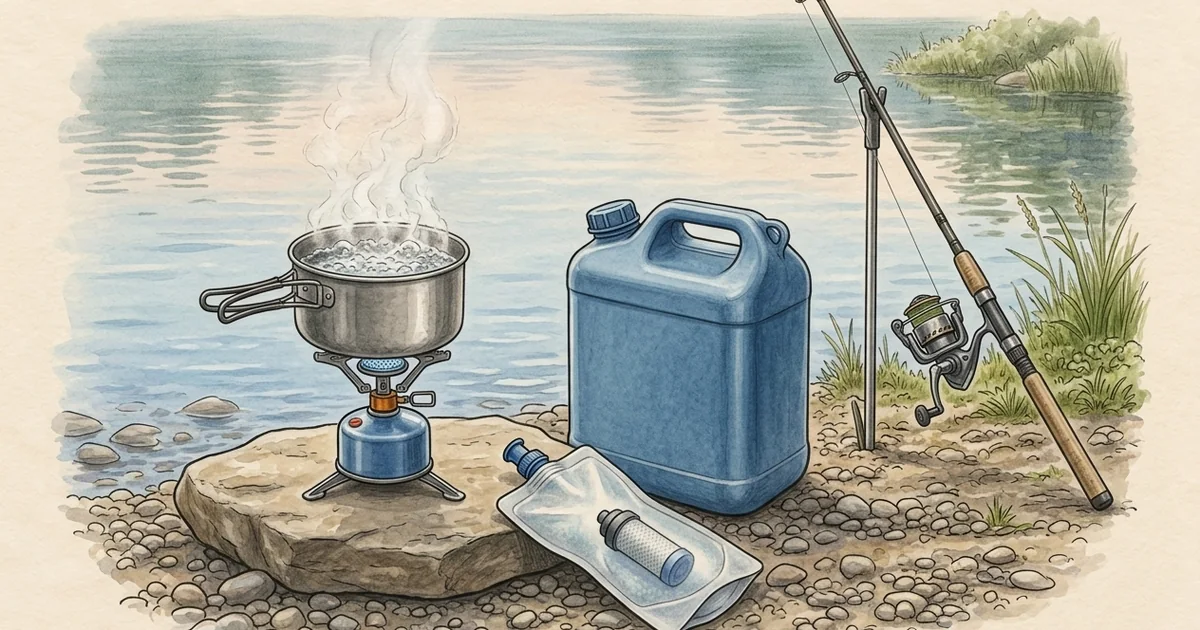
Water from a lake, river or stream is not drinking water, even if it looks clear. Anyone who has to treat water at the tent while fishing first thinks of small hand filters when it comes to filtering water when camping, but according to the US health authority CDC, most portable filters hold back parasites but not viruses or bacteria. If you can, bring tap water in a clean jerrycan; for the rest, boiling is the best method.
Why lake water is not drinking water
A lake or river takes in whatever comes from its surroundings. The federal environment agency Umweltbundesamt (UBA) names sewage, stormwater overflows and run-off from fields as routes by which faeces get into the water; bathers and birds contribute locally. According to the UBA, sewage treatment plants only partly remove the pathogens from human faeces. The CDC, too, does not generally consider even water straight from a clear mountain stream safe.
The water contains three groups of pathogens: bacteria, viruses and parasites, meaning single-celled intestinal parasites such as Giardia and Cryptosporidium. A little is enough. For Cryptosporidium, the dose at which half of those exposed become infected is 10 to 1.000 oocysts, the resistant resting forms of the pathogen, according to the Robert Koch Institute (RKI). The RKI explicitly advises caution when drinking or swallowing water from lakes and rivers.
The CDC names diarrhoea, vomiting and stomach pain as common consequences. Children, pregnant women, people aged 65 and over and anyone with weakened immunity are at greater risk. According to the RKI, Cryptosporidium only shows after 1 to 12 days, usually after 7 to 10, so often long after the trip. This text does not replace medical advice.
Blue-green algae: boiling does not help
According to the UBA, cyanobacteria, commonly called blue-green algae, multiply massively in nutrient-rich waters and produce toxins that harm health. According to a fact sheet from the Brandenburg health ministry, most species are harmless and only a few produce toxins. According to the EPA, only a laboratory analysis shows whether a bloom is producing toxins. You can recognise the bloom itself by these signs:
- visibility depth under one metre
- bluish-green cloudiness
- blue-green or reddish-brown streaks, creamy mats on the surface or clouds in the water
According to the fact sheet, the mats are often washed up or pushed together near the bank and in bays, exactly where anglers sit. The situation depends heavily on wind and weather and can change within a few hours or days. Dogs and other warm-blooded animals are also at risk.
According to the US Environmental Protection Agency EPA, boiling does not remove the toxins and can even increase their concentration. In certain species, around 95 per cent of the toxin microcystin is still inside the cells during a bloom’s growth phase. When a cell dies or bursts, it gets into the water. According to the EPA, dissolved toxin is generally harder to remove than the toxin in the cells. According to the EPA, test standards with which independent bodies test household devices for these toxins were still being developed in 2016. So do not take water from a bloom at all, not even boiled or filtered.
Boiling, filters, tablets and UV compared
The CDC sets out a clear ranking: boiling kills germs best, and the second-best solution is filtering followed by disinfecting. Neither boiling nor disinfecting helps against harmful chemicals and toxins. According to the EPA, heavy metals and salts also remain in the water.
| Method | works against | does not or barely work against |
|---|---|---|
| Boiling, 1 minute at a rolling boil | bacteria, viruses, parasites | blue-green algae toxins, chemicals, salt |
| Filter, pores up to 1 µm | parasites | viruses, not all bacteria |
| Filter, pores up to 0,3 µm | parasites, bacteria | viruses |
| Chlorine or iodine | bacteria, viruses | parasites, especially Cryptosporidium |
| Chlorine dioxide | bacteria, viruses, Giardia | Cryptosporidium only partly |
| UV device | bacteria, viruses, parasites | cloudy water, larger quantities |
Boiling
According to the World Health Organization (WHO), bringing water to a rolling boil is enough to kill disease-causing bacteria, viruses and parasites, even in cloudy water and at high altitude. The CDC gives one minute at a rolling boil, and three minutes above 6.500 feet, around 2.000 metres. Cryptosporidium, which chlorine barely affects, is reliably killed by boiling according to the RKI.
Then, according to the WHO, let the water cool down on its own, without ice cubes, and protect it from fresh contamination. Boiled water has no lasting protective effect: anyone who reaches in with an unwashed hand undoes the work. Clear cloudy water before boiling if the taste and appearance bother you. Boiling needs fuel, so factor it in when planning your Camping stove.
Filters and pore size
A filter states its pore size in micrometres (µm); one micrometre is a thousandth of a millimetre. The CDC distinguishes two levels: filters with an absolute pore size of no more than 1 µm hold back parasites, but not viruses and not all bacteria. Only at no more than 0,3 µm are bacteria caught too. Viruses pass through both. According to the CDC, only reverse osmosis, in which pressure forces the water through a semi-permeable membrane, holds back all three groups and also removes salt.
A filter alone is therefore not enough if viruses may be present, for example downstream of settlements and sewage treatment plants. Then filtering is followed by boiling or disinfecting. Follow the instructions for every device, because according to the CDC that is the only way it works as intended. For household filters, the Bundeszentrum für Ernährung warns that germs can multiply in filter units.
Tablets and UV light
According to the CDC, chlorine and iodine kill bacteria and viruses but work poorly against parasites. Chlorine dioxide tablets kill Giardia and only partly work against Cryptosporidium. The RKI confirms that the resting forms of Cryptosporidium are resistant to chlorination. According to the EPA, disinfection works less well in cloudy or coloured water, so filter first. According to the CDC, pregnant women and people with thyroid problems or iodine hypersensitivity should avoid iodine-treated water, and nobody should drink it for more than a few weeks at a time.
According to the CDC, portable UV devices kill parasites, bacteria and viruses, but only in small quantities of clear water. Suspended particles shield the germs from the light. UV devices need power. How to charge batteries safely by the water is covered under Batteries and power banks.
Treating water at your swim, step by step
If the jerrycan is empty and there is no tap nearby, proceed in this order. It follows the recommendations of the CDC, EPA and WHO.
- Choose the spot. According to the EPA, flowing water is usually better than standing water. No water with floating debris, dark colour, strange smell or blue-green algae streaks. Take it upstream of your camp and toilet spot.
- Let it settle. Let cloudy water stand and pour it through a clean cloth or a coffee filter.
- Filter. With a filter of no more than 0,3 µm, parasites and bacteria stay in the filter according to the CDC, viruses do not.
- Boil or disinfect. Boil for one minute at a rolling boil; where that is not possible, use a tablet or UV device according to the instructions.
- Cool and cover. Let it cool without ice and pour it into a clean container with a lid.
- Take it out cleanly. Scoop with a clean cup, never with your hand.
Washing-up water and soap residue do not belong in the water; more on this under Leaving your fishing spot clean.
How much water to take
For an emergency supply at home, the Bundesamt für Bevölkerungsschutz und Katastrophenhilfe (BBK) ideally reckons with 2 litres per person per day, 0,5 litres of which are for cooking. The CDC sets at least one US gallon, around 3,8 litres, for drinking, cooking and brushing teeth, and more in a hot climate. On hot days, the Bundesinstitut für Öffentliche Gesundheit (BIÖG) recommends two to three litres for drinking alone, including when out and about. What else matters in the heat is covered under Sun, heat and ticks.
Worked example: Two anglers sit by the carp lake from Friday morning to Sunday evening, which is around 2,5 days. Based on the BBK figure, they need 2 × 2,5 × 2 litres = 10 litres. With the CDC minimum it is 2 × 2,5 × 3,8 litres = 19 litres, and rather more on hot days. Two 10-litre jerrycans cover the higher figure too, but weigh around 20 kilograms when full.
Jerrycans: cleaning, filling, storing
Tap water from home is the simplest solution if the container is clean. The points follow the CDC instructions for water supplies:
- Food-grade container with a tight-fitting lid, shatterproof rather than glass, ideally with a narrow neck for pouring
- never a container that has held chemicals such as bleach or pesticides
- wash with washing-up liquid before filling, rinse thoroughly and let it air-dry
- label it “drinking water” with the filling date and replace stored water every six months
- store cool and out of direct sunlight, away from petrol and pesticides, so in the car not next to the spare fuel can
- take water out with a clean cup, do not touch the inside or the water with your hands
According to the Bundeszentrum für Ernährung, shop-bought plastic bottles (PET) should not be left in blazing sun or in the car for long. Otherwise acetaldehyde can pass from the bottle into the water. The substance is considered harmless to health there, but spoils taste and smell. Where the jerrycan and cooking pot fit in your kit is shown under Cookware, cutlery and provisions.
Common mistakes
- Assuming clear water is clean. You cannot see pathogens. The CDC does not consider even a clear stream safe.
- Relying on the filter alone. Most portable filters let viruses through. Where sewage can get in, boiling or disinfecting is part of the process.
- Boiling water from a blue-green algae bloom. According to the EPA, the toxins remain, and their concentration can even rise when boiled.
- Treating chlorine tablets as a cure-all. According to the RKI, chlorine barely works against Cryptosporidium, whereas boiling does so reliably.
- Leaving boiled water standing open. It does not protect itself. Store it covered and do not cool it with ice.
Frequently asked questions
How long does water need to boil?
The WHO considers bringing it to a rolling boil sufficient. The CDC gives one minute at a rolling boil, three minutes above around 2.000 metres. Then let it cool without ice.
Can I make Baltic Sea water drinkable?
Not with boiling and ordinary filters. According to the EPA, salt stays in the water when boiled or disinfected. According to the CDC, only reverse osmosis removes it. How salty the North Sea and the Baltic Sea are is covered under Types of water.
Is a filter enough for a mountain stream?
Against parasites and, with pores up to 0,3 µm, against bacteria yes, against viruses no. The CDC recommends disinfecting or boiling after filtering. According to the CDC, boiling alone is the best choice.
What to do about diarrhoea after a fishing trip?
If the symptoms persist, take the question to a doctor’s surgery. Tell them that you drank water from a lake or river, because according to the RKI, Cryptosporidium usually only becomes noticeable after 7 to 10 days. This page does not replace medical advice.
Related
- Camping stove at your swim: gas, methylated spirit and wood for boiling water
- Cookware, cutlery and provisions: pot and mug for on the go
- Fishing trip by canoe or kayak: kit for several days on the water
- Fishing while hiking and trekking: packing light for trips on foot
- Toilet on the go: distance from the water and from where you collect it
- Sun, heat and ticks: how much to drink and warning signs in the heat
- Types of water: from stream to brackish water
- Line calculator: working out breaking strain and backing for the trip
Sources
- CDC: About Water Treatment Options When Hiking, Camping, or Traveling (klares Bachwasser, Rangfolge, Kochdauer, Porengrößen, Tabletten, Jod, UV, Beschwerden)
- CDC: How to Create an Emergency Water Supply (Menge pro Tag, Behälter, Reinigen, Lagern, Entnahme)
- US EPA: Emergency Disinfection of Drinking Water (Grenzen von Kochen und Entkeimen, Absetzen, Wahl der Wasserstelle)
- US EPA: Harmful Algal Blooms and Cyanotoxins, Frequently Asked Questions (PDF) (Abkochen gegen Blaualgengifte, Prüfnormen für Geräte) und US EPA: Cyanobacteria and Cyanotoxins, Fact Sheet (PDF) (Gift in und außerhalb der Zellen)
- WHO: Boil water, Technical brief (Wirkung des Abkochens, Abkühlen, Schutz vor neuer Verunreinigung)
- Robert Koch-Institut: RKI-Ratgeber Kryptosporidiose (Ansteckung über Wasser, Infektionsdosis, Inkubationszeit, Chlor und Abkochen)
- Umweltbundesamt: Badegewässer (Verschmutzung, Kläranlagen) und Umweltbundesamt: Schadstoffe und Belastungen in Badegewässern (Eintragswege, Cyanobakterien)
- Land Brandenburg, Gesundheitsministerium: Faltblatt Blaualgen (PDF) (Erkennen einer Blüte, Buchten, Tiere)
- BBK: Vorsorgen für Krisen und Katastrophen (PDF) (Wassermenge pro Person und Tag)
- BIÖG: Tipps bei Hitze (Trinkmenge an Hitzetagen)
- Bundeszentrum für Ernährung: Wasser, Zubereitung und Lagerung (PET-Flaschen in Sonne und Auto, Keime in Filtergeräten)
- Wikipedia: Umkehrosmose (Begriff, nur ergänzend)
Text AI-assisted, drawings AI-generated. Sources opened and checked in November 2026, no graphics taken from the sources.
All information is for guidance only and without guarantee. This text does not replace medical advice; if in doubt, the local health office (Gesundheitsamt) knows whether a body of water is contaminated.