
Knowledge · Tackle
Toilet on the go: Folding spade, camping toilet and distance from the water
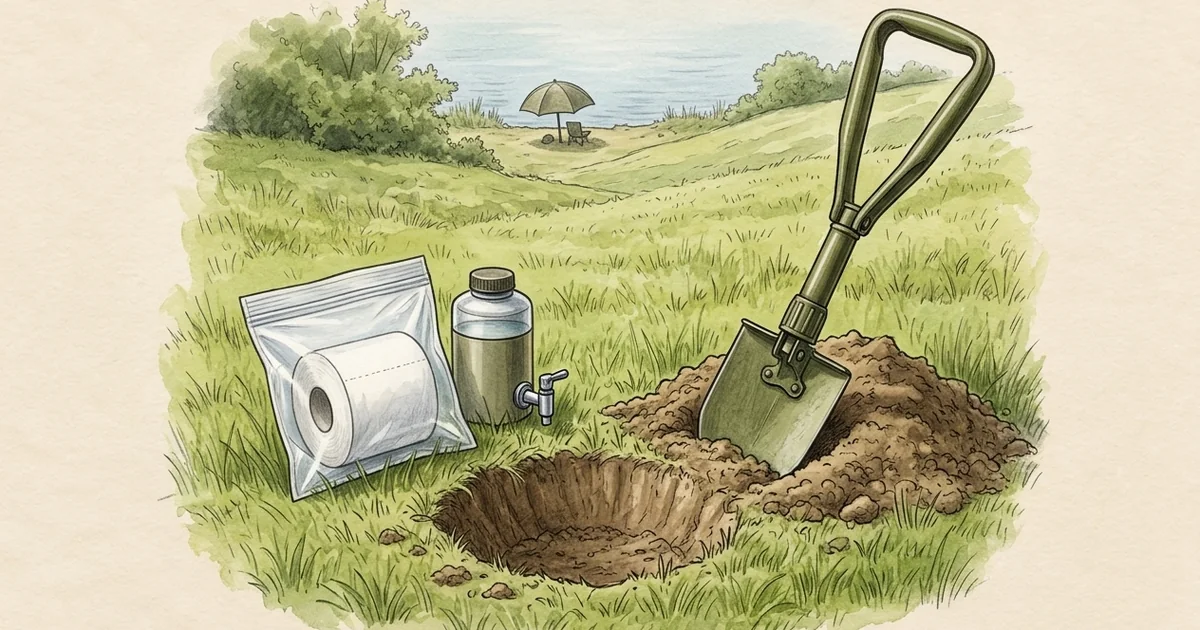
Faeces on the bank can carry pathogens into the water where others swim and fish. So if you stay overnight by the water, you need camping toilet kit: a trowel or folding spade, bags for the paper and, on longer trips, a camping toilet. What matters is the distance from the water and where the contents end up.
What faeces do in the water
The German Environment Agency (Umweltbundesamt, UBA) names gastrointestinal illness as a risk when swimming in lakes and rivers. Faeces carry pathogens into the water, and people swimming in it take them in. Besides sewage and runoff from fields, the UBA says the swimmers themselves or birds can also contaminate a spot with faecal bacteria. That is why two gut bacteria are measured at official bathing sites: Escherichia coli and intestinal enterococci.
Fishing spots are often on shallow banks, and whatever lies there is washed into the water by the next rain. What that looked like at Berlin bathing lakes after heavy rain is described under Leaving your fishing spot clean.
Then there are nutrients. The final report of a pilot project at a natural bathing lake, funded by the Deutsche Bundesstiftung Umwelt (DBU), states that nitrogen enters a bathing pond mainly through the urine of people and animals. Even bathers who had not showered and did not urinate in the water brought in an average of 6,5 milligrams of phosphorus and around 150 000 colony-forming units of E. coli per single swim. According to the UBA, inputs of nitrogen and phosphorus help cyanobacteria, the blue-green algae, to multiply. In nutrient-rich waters they can appear in masses and produce toxins.
Distance and depth: two recommendations compared
None of the sources evaluated here gives a statutory number of metres for going to the toilet outdoors. There are recommendations from expert bodies, and they differ mainly on the depth of the hole. The US National Park Service works in feet and inches; the converted values are in the table, and you can check them with the Unit converter.
| point | Deutscher Alpenverein | US National Park Service |
|---|---|---|
| space | at least 50 m from any water | at least 200 ft, around 61 m, from water, camp and trails |
| Hole depth | 5–10 cm | 6–8 in, around 15–20 cm |
| Toilet paper | ideally take it away in a bag, bury it only in an emergency | take it away, as well as hygiene products |
| Washing | no figure given | around 61 m from the water, a small amount of biodegradable soap |
At the fishing spot this means: the distance is measured from the water, not from the tent or the rod rest. If you want to follow both bodies, take the larger value in each case. Ditches, channels and hollows that drain towards the bank when it rains are no place for it. You leave the reed belt alone anyway; why is explained in Nature conservation on the bank.
Step by step outdoors
- Look for a toilet first. The US National Park Service advises using existing toilets whenever possible. On a club water that might be the clubhouse; on trips, the campsite or a public bathing area.
- Choose a spot. At least 50 m from the water according to the Deutscher Alpenverein (DAV), around 61 m according to the US National Park Service, which gives the same distance from camp and trails too.
- Dig a hole. The DAV gives a depth of 5 to 10 cm, the US National Park Service 15 to 20 cm. If you have no tool, the DAV says a stone or a stick will do for digging.
- Bag the paper. Used toilet paper goes into a bag that you seal. According to the US National Park Service, you also take sanitary towels and tampons away with you.
- Fill it in. Fill the hole with the soil you dug out. If you like, the DAV suggests putting stones or branches on top.
- Wash your hands. With soap and water from the container, away from the bank, as described in the next section.
Folding spade, trowel and hygiene bag
If you regularly spend the night outdoors, the DAV says you should carry a small spade or shovel. Two designs are common. The trowel is a small hand shovel without a shaft and fits in a side pocket of your fishing rucksack. The folding spade has a shaft that folds against the blade for transport. With the longer lever you make easier progress in rooty or firm bank soil, but you carry more weight.
Checklist for the hygiene bag
- Toilet paper, packed dry in a sealed bag
- several resealable bags for used paper and hygiene products, plus an opaque outer bag
- Trowel or folding spade
- Cleansing wipes for your hands; used wipes go in the rubbish bag
- Soap and a water container with a tap, more on this under Drinking water on the go
- Hand sanitiser if someone in the group has a weakened immune system
- a head torch for the way at night
Washing your hands without a basin
The Federal Institute for Public Health (Bundesinstitut für Öffentliche Gesundheit, BIÖG) advises washing your hands after every toilet visit, before eating and after contact with animals, animal feed or animal waste. By the water this applies equally to bait, fish and your packed lunch. Thoroughly, according to the BIÖG, means washing for 20 to 30 seconds, lathering the thumbs, fingertips, backs of the hands and the spaces in between, then rinsing under running water and drying. A container with a tap provides that running water on the bank too.
If there is nowhere to wash, the BIÖG names cleansing wipes for visibly dirty hands. You then keep unwashed fingers away from your face and food and wash them thoroughly at home. The institute considers a sanitiser useful mainly where there is a higher risk of infection, for example when in contact with people with weakened immune systems. Soapy water does not belong in the water: the US National Park Service advises carrying washing water around 61 m away from the bank and using only a little biodegradable soap. These notes are no substitute for medical advice.
Camping toilet with bags or chemicals
For several nights in the same spot, in a motorhome or on a boat, a camping toilet is an option. In a bag toilet, a bucket or folding frame with a seat, a bag hangs inside that is sealed after use and taken away. A cassette toilet collects everything in a tank to which a sanitary additive is added against odour and gas build-up. According to the award criteria of the Blue Angel eco-label (Blauer Engel), the use of such mobile toilets is increasing, especially in camper vehicles and leisure boats.
According to these criteria, most additives for them act as biocides, meaning they contain substances against microorganisms, such as aldehydes like formaldehyde or cationic surfactants. They suppress putrefaction in the tank but, because of their toxicity to bacteria, are considered particularly problematic for sewage treatment plants and the environment. Additives carrying the eco-label must be compatible with sewage treatment plants. Even their packaging must state that the tank may only be emptied at a disposal facility for faeces and that the contents belong neither in the water nor in the soil.
Rule of thumb for the tank: The contents of a chemical or cassette toilet only go into a disposal station for faeces, never into the water, never into the bushes and never into a dug hole. Before your trip, ask the campsite, harbour or motorhome pitch where the nearest station is.
Where a full toilet bag may go is set by the local waste regulations. If in doubt, the waste advice service of the district or town can tell you.
Protected areas and club waters
In a protected area, its ordinance applies. For nature reserves, § 23 para. 2 of the Federal Nature Conservation Act (BNatSchG), in accordance with more detailed provisions, prohibits all actions that may destroy, damage or alter the area or its components or cause lasting disturbance. Under § 24 para. 3, national parks are to be protected like nature reserves, taking into account their protective purpose and with exceptions specific to the area. What this means for landing, camping and going into the bushes is set out in the area’s ordinance; the national park administration or the lower nature conservation authority can tell you more.
How specific this can get is shown by the Müritz National Park in Mecklenburg-Western Pomerania. Canoeists and other paddlers may only go ashore there at the designated rest areas and campsites; everywhere else, landing is prohibited. According to a leaflet from the national park office, there are toilets at public bathing areas, at the Granziner Mühle portage and at the campsites. So if you are out by boat there, you plan your breaks at these points. How to plan such a trip is explained under Fishing trip by canoe or kayak.
On club and association waters, the water rules (Gewässerordnung) also apply. They are a rule of the fishery manager for its own waters, not state law. The water rules of the Landesanglerverband Brandenburg, for example, prohibit leaving rubbish, equipment and other things on the bank of its waters or throwing them into the water. They do not explicitly mention toilet paper or relieving yourself. Whether there is a toilet at the clubhouse and what applies on your water can be found in Fishing permit and water rules or directly from the club. Whether you may stay overnight by the water at all is covered in Camping and staying overnight at the fishing spot.
Common mistakes
- Leaving paper under a stone. The DAV advises taking it away in a bag and burying it only in an emergency. The US National Park Service advises taking it away without exception.
- Burning paper when it is dry. According to the DAV, burning is only acceptable if nothing else can catch fire; it expressly warns of forest fires. What applies to fires on the bank is covered under Fires, barbecues and stoves on the bank.
- Only going as far as the nearest bush. If it is only a few metres from the water, that is not enough: the DAV’s 50 m count from the waterline.
- Emptying the chemical tank anywhere. According to the Blue Angel, even additives compatible with sewage treatment plants belong neither in the water nor in the soil.
- Going straight from the toilet to bait and bread. The BIÖG expressly names going to the toilet and mealtimes as times to wash your hands.
Frequently asked questions
How far from the water do I need to go to relieve myself?
The Deutscher Alpenverein recommends at least 50 m from any water, the US National Park Service at least 200 ft, so around 61 m. It is measured from the water, not from the tent. These are recommendations; what applies in a protected area or on a club water is set out in the ordinance and the water rules (Gewässerordnung).
May I bury toilet paper?
The DAV considers this acceptable only in an emergency and advises taking the paper away in a small bag. The US National Park Service advises always taking paper and hygiene products away. A resealable bag in your hygiene bag solves the problem.
Where do the contents of a camping toilet go?
The tank of a cassette toilet is only emptied at a disposal facility for faeces. Before your trip, ask the campsite, harbour or motorhome pitch where the nearest station is. It never goes into the water or the ground, not even with an eco-friendly additive. For the full bag of a bag toilet, the local waste regulations apply.
Is sanitiser enough instead of washing my hands?
For on the go, the BIÖG first names cleansing wipes when there is no water, and thorough washing as soon as possible. It considers a sanitiser useful mainly where there is a higher risk of infection. With a container with a tap you can wash properly on the bank too.
Related
- Leaving your fishing spot clean: rubbish, cigarette ends, leftover groundbait and what the law says
- Night session packing list: what comes along for a night by the water
- Fishing trip by canoe or kayak: planning, luggage and rules on the water
- Drinking water on the go: containers, filters and boiling
- Nature conservation on the bank: protected areas, reeds and nesting sites
- First aid kit for fishing: contents, hooks and ticks
- Night fishing and weather shelter: umbrella, tent and night-time rules
- Line calculator: work out breaking strain and backing
Sources
- Deutscher Alpenverein: Die Outdoor-Toilette (Abstand 50 m, Lochtiefe 5–10 cm, Spaten oder Schaufel, Papier mitnehmen, Verbrennen und Waldbrand)
- U.S. National Park Service: Leave No Trace Seven Principles (Toiletten nutzen, 200 ft Abstand, 6–8 in Tiefe, Papier und Hygieneartikel mitnehmen, Waschen abseits vom Wasser)
- Umweltbundesamt: Schadstoffe und Belastungen in Badegewässern (Magen-Darm-Erkrankungen, Badende und Vögel als Quelle, Cyanobakterien), Umweltbundesamt: Badegewässer (Stickstoff und Phosphor) und Umweltbundesamt: Bewertungskriterien (E. coli und intestinale Enterokokken)
- Bundesinstitut für Öffentliche Gesundheit: Händewaschen (Anlässe, 20 bis 30 Sekunden, fließendes Wasser) und Bundesinstitut für Öffentliche Gesundheit: Desinfektionsmittel (unterwegs ohne Waschmöglichkeit)
- Umweltbundesamt und RAL: Blauer Engel, Vergabekriterien Kläranlagenverträgliche Sanitärzusätze DE-UZ 84a (PDF) (biozide Zusätze, Entleerung nur über Entsorgungseinrichtungen, nicht in Gewässer oder Erdreich)
- Nationalparkamt Müritz: Wasserwandern im Müritz-Nationalpark (Anlandeverbot) und Faltblatt Wasserwandern 2026 (PDF) (Toiletten im Nationalpark)
- Bundesministerium der Justiz: Bundesnaturschutzgesetz § 23 und § 24 (Naturschutzgebiete, Nationalparke)
- Landesanglerverband Brandenburg: Gewässerordnung (Abfälle und Gegenstände am Ufer)
- Deutsche Bundesstiftung Umwelt: Abschlussbericht Modellprojekt Naturbadesee, AZ 26806, 2013 (PDF) (Stickstoff aus Urin, Phosphor und E. coli je Badegast)
Text AI-assisted, drawing AI-generated. Sources opened and checked in November 2026; no graphics taken from the sources.
All information is a guide only, without guarantee. What applies in a protected area and on your water is governed by the area’s ordinance, state law and the water rules (Gewässerordnung); this text is no substitute for legal or medical advice.