
Knowledge · Tackle
Vacuum-packing and freezing fish: Shelf life and hygiene
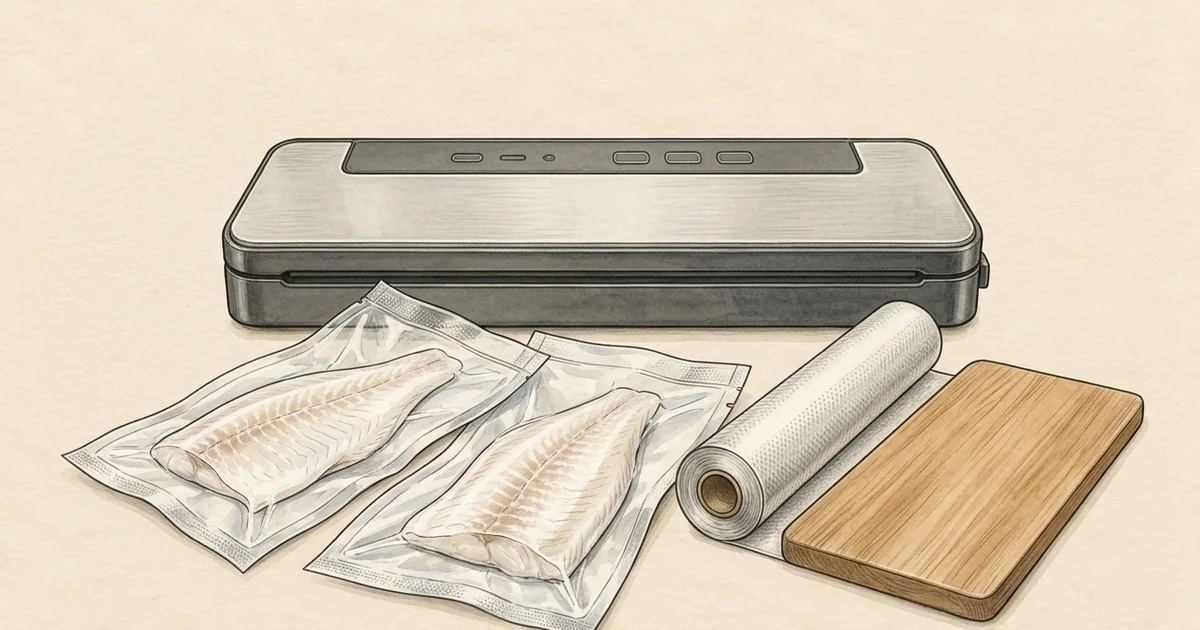
A vacuum sealer sucks the air out of the bag and seals it. If you pack your catch this way before you freeze the fish, you slow down freezer burn and rancid flavours. It does not make the fish any safer, though: only cold slows down germs, and one dangerous pathogen produces its toxin precisely where there is no oxygen.
From the fishing spot to the chopping board
The bag only preserves what goes into it fresh. According to the Bundesinstitut für Risikobewertung (BfR), a large share of bacteria survives deep-freezing, and the cold does not kill viruses. The Kompetenzzentrum für Ernährung in Bayern (KErn) advises freezing only fresh food that has already cooled down. A killed fish goes straight into the cool box at the water, into the fridge at home and from there onto the chopping board without a long delay.
The learning portal of the Landesfischereiverband Bayern recommends making every fish ready for the kitchen before storing it: scale it if needed, remove the gills, gut it and wash it. According to the learning portal, it can then go into the fridge for up to two days or straight into the freezer. Other sources give shorter time limits. The steps are shown in Gutting fish and Scaling and skinning fish.
Cut portions before the film goes on
The learning portal advises portioning before freezing and gives two reasons: small packs take up less space in the freezer, and after thawing they go into the pan without any further cutting. A perch or a trout up to about 30 centimetres stays whole; according to the learning portal that is enough for one person. Larger fish you cut into steaks of equal thickness so that all pieces cook for the same time, or you take off the fillets.
Carp, bream and other cyprinids have lots of fine intermuscular bones. Score them before freezing, because thawed flesh turns soft and is harder to cut. How to score at intervals of a few millimetres is explained under Filleting and boning fish, the right knife under Filleting knife.
Small pieces also freeze through faster. In the Bavarian question catalogue for the angling exam (LfL), fillets should be frozen quickly and at the lowest possible temperature. Portions as large as possible to save effort are the wrong answer there. KErn recommends using a quick-freeze or blast-freeze function if your appliance has one.
External and chamber vacuum sealers
The household appliances tested by Stiftung Warentest in its 2017 test are external sealers, which it calls film sealers. You place only the open end of the filled bag in the appliance and lock the lid. The pump draws the air out, then the appliance closes the opening with a seam at the sealing bar. Because the bag stays outside, this design is also called an external vacuum sealer.
For this you need special bags or rolls. Their film is textured. According to Stiftung Warentest, this texture stops the two walls of film from sticking together, and only then can the air escape. A smooth freezer bag therefore cannot be vacuumed in an external sealer.
There are also chamber sealers. In them, the whole bag and its contents lie in a closed chamber and are sealed there (Wikipedia). For fish in brine, marinade or stock, a tightly closing freezer container remains the simple option.
- Dry fillets, whole portion-sized fish: external sealer with a textured bag.
- Fish in marinade, brine or stock: a tightly closing freezer container instead of a bag.
- No sealer at home: besides vacuum packing, the Bundeszentrum für Ernährung (BZfE) also accepts airtight freezer boxes or freezer bags. Press out as much air as you can before closing.
Step by step: vacuum-packing and freezing a fillet
- Work with a clean board, knife and hands. Keep raw fish apart from anything that will not be heated again; the rules are under Storage and hygiene.
- Rinse the portion only briefly with a little cold water and pat it dry with kitchen paper, as the BZfE describes for the kitchen.
- Cut the bag long enough to leave plenty of room for the seam above the fish. Before filling, fold the edge outwards by about three centimetres. According to Stiftung Warentest this keeps it clean, and only a clean edge gives a tight seam.
- Lay the fish in flat, fold the edge back and place the opening in the appliance. Lock the lid and start. The appliance draws the air and seals in one go.
- Check the seam: it runs across the full width without creases or gaps, and the film lies tight against the fish. If the pack goes soft again and fills with air, seal it again.
- Label the pack. The BZfE lists contents, quantity and freezing date. For anglers, add the species and the date by which you want to eat the fish (table below).
- Straight into the freezer. Arrange the packs so that they freeze through quickly, and use the blast-freeze function if your appliance has one (KErn). The BZfE assumes minus 18 degrees Celsius for freezers.
Vacuum is no substitute for chilling
Without air, spoilage is slower because oxidation and many germs need oxygen, writes Stiftung Warentest. One pathogen does not need it: according to the BfR, Clostridium botulinum can produce a very potent nerve toxin precisely when oxygen is excluded, and it can cause paralysis. The BfR therefore considers it important to keep vacuum packs within the cold chain. The Lower Saxony state office LAVES gives a limit: in a vacuum, growth and toxin formation can only be prevented at no more than 7 degrees Celsius. The office lists vacuum-packed smoked fish and lightly salted fish as products with a particular risk.
The Bavarian exam catalogue asks when botulism bacteria multiply especially fast. The correct answer there is: vacuum-packed at over 10 degrees. So vacuum-packed fresh fish never belongs in a warm kitchen, the car or the garage, but straight into the fridge or freezer. In the fridge, reckon with the same short time limits as for unpacked fish. That is a precautionary rule of this site, because none of the sources extends the time limit because of the vacuum. The time limits themselves are under Storage and hygiene, smoking under Smoking fish.
Health: according to the BfR, problems with vision and swallowing, a dry mouth and paralysis after a meal can point to botulism. Anyone affected needs medical treatment immediately. This text is no substitute for medical advice.
How long fish keeps in the freezer
Freezing stops germs, but the fat in the fish keeps ageing. The Austrian consumer association Verein für Konsumenteninformation (VKI) explains that fat oxidises even below zero and then tastes rancid. The Bavarian exam catalogue therefore says: the less fat a fish has, the longer it can be stored. The BZfE sorts species into three groups by fat content.
| Group | Fat content (BZfE) | Examples | frozen (VKI) |
|---|---|---|---|
| lean | under 2 % | Zander, plaice | up to 8 months |
| medium fat | 2 to 10 % | trout, redfish | no separate figure |
| oily | over 10 % | Herring, salmon, mackerel; eel (VKI) | eel, salmon: 1 to 3 months |
For fish in general, the BZfE gives 6 to 9 months in the freezer, an older VKI guide 2 to 4 months. So the ranges differ widely, and they are guide values for quality, not expiry dates. In a 2025 press release, the VKI gives minus 18 degrees Celsius as the storage condition for its guide values. None of the sources gives a separate figure for the medium-fat species; following the rule from the exam catalogue, they lie between the other two groups.
Worked example: a zander goes into the freezer on 10 October. According to the VKI it keeps for up to eight months, so until about 10 June. The BZfE gives six to nine months for fish, the lower limit would be 10 April. The older VKI guide gives fish four months at most, which would be 10 February. If you plan cautiously, write the earliest date on the label: “until February”. An eel from the same day has one to three months according to the VKI, so 10 November to 10 January; to be cautious, that means “until November”.
On fish, freezer burn shows as brownish-red, dried-out patches (VKI). Possible causes are damaged packaging, trapped air and fluctuating temperatures, exactly what a tight vacuum seam helps against. According to the VKI, freezer burn on fish can also point to a storage error or a broken cold chain.
Parasites: freezing by temperature and time
For food business operators who sell fish for eating raw or marinated and salted, the EU hygiene regulation prescribes a freezing treatment. The wording in Verordnung (EG) Nr. 853/2004, Annex III Section VIII Chapter III Part D: “Freezing treatment to kill parasites other than trematodes must consist of lowering the temperature in every part of the product to at least: a) – 20 °C for not less than 24 hours; or b) – 35 °C for not less than 15 hours.” Trematodes are flukes; the figure does not apply to them.
The regulation is aimed at businesses. For fish you caught yourself that is to be eaten raw, the LAVES gives at least 24 hours at minus 20 degrees for sea fish and at least one week at minus 20 degrees for freshwater fish. An appliance running at minus 18 degrees does not reach these values. A freezer thermometer shows what your freezer can manage. The time only counts from the moment the core is that cold too. Which parasites this concerns and which cooking values apply is under Parasites in fish. The vacuum itself does not kill parasites; the authorities only name freezing and heat for that.
Thawing: open the bag, fish into the fridge
The BfR advises removing the packaging for thawing and placing the frozen food covered in a bowl. The liquid that comes out is disposed of carefully. The BZfE puts larger fish, fillets and portions on a sieve in the fridge overnight so that the meltwater can drain. For the vacuum pack this means: cut it open, put the fish on a sieve over a dish, cover it, bottom shelf. Afterwards clean your hands, surfaces and everything that came into contact with the meltwater.
Raw fish that has been thawed should not go back into the freezer raw. The BfR says raw animal foods must first be heated through completely after thawing; only then can they be cooled and frozen again. According to Stiftung Warentest, used bags can be washed out and reused, but it urges caution with raw fish.
Common mistakes
- Vacuum-packing fish that is not quite fresh. Most of the germs in it before freezing survive (BfR). Chill first, then pack promptly.
- Treating the vacuum as a substitute for chilling. Without oxygen the botulism bacterium can multiply; the LAVES gives no more than 7 degrees Celsius as the limit. Vacuum-packed fresh fish is never left warm.
- Getting the edge wet. Fish juice, brine or marinade at the sealing point makes the seam leak, air gets in and freezer burn forms. Pat the fish dry and fold the edge over before filling. Fish in brine or marinade goes into a tightly closing freezer container.
- Thawing in the closed bag on the worktop. The BfR advises removing the packaging and thawing covered in the fridge.
Frequently asked questions
Does vacuum-packed fish keep longer in the fridge?
You should not count on it. None of the authorities used here gives a longer time limit for vacuum-packed fresh fish, and according to the LAVES the botulism bacterium in a vacuum can only be held back by chilling to no more than 7 degrees. Calculate as for unpacked fish and freeze early.
Does vacuum-packing kill parasites?
No. Parasites are killed by cold for long enough or by heat. For eating raw, the LAVES gives at least seven days frozen at minus 20 degrees Celsius for freshwater fish and at least one day for sea fish.
How long can I freeze an eel?
The VKI gives one to three months for eel and salmon, and up to eight for lean species such as zander. Fat oxidises even when frozen. So eat oily fish first and write the date on the pack.
Related
- Cool box and cool bag: getting the catch to the kitchen cold
- Storage and hygiene: time limits in the fridge, thawing and refreezing
- Parasites in fish: which worms occur and what cold and heat do
- Filleting and boning fish: cutting fillets and dealing with bones before freezing
- Filleting knife: the flexible blade for clean portions
- Fish over the fire: grill basket, fish on a stick and fish roaster for the thawed catch
- Smoking fish: hot and cold smoking and storing smoked fish
- Line calculator: working out breaking strain and line capacity for rod and reel
Sources
- Bundesinstitut für Risikobewertung: Korrektes Kühlen von Lebensmitteln im Privathaushalt (Bakterien im Frost, Auftauen, Wiedereinfrieren) und Verbrauchertipps: Schutz vor Botulismus durch Lebensmittel (PDF) (Erreger, Kühlkette, Beschwerden)
- Landesamt LAVES Niedersachsen: Merkblatt Clostridium botulinum (PDF) (7 Grad im Vakuum) und Sushi selber machen (Gefrierzeiten für Rohverzehr)
- Bundeszentrum für Ernährung: Fisch, vom Einkauf in die Küche (Verpacken, Trockentupfen, Auftauen), Fisch, Gesundheit und Umwelt (Fettgruppen), Lagerung (6 bis 9 Monate) und Lebensmittel richtig lagern (minus 18 Grad, Beschriften)
- Verein für Konsumenteninformation, Österreich: Fisch, mehr als nur Fastenspeise (Lagerdauer nach Art), Fisch, herausgefischt (2 bis 4 Monate), Einfrieren: Wie lange sind Lebensmittel haltbar? (Gefrierbrand an Fisch) und Presseinformation Haltbarkeit eingefrorener Lebensmittel (PDF) (Fett, Gefrierbrand, minus 18 Grad)
- Bayerische Landesanstalt für Landwirtschaft: Staatliche Fischerprüfung, Prüfungsfragen 2023/2024 (PDF) (Fragen 4.148, 4.149 und 4.151)
- Landesfischereiverband Bayern, Lernportal: Fische aufbewahren, zerteilen und filetieren (küchenfertig, Portionen, Gräten) und Kompetenzzentrum für Ernährung Bayern: Gefrier-Navi (PDF) (Portionen, Schockfrost)
- Europäische Union: Verordnung (EG) Nr. 853/2004 (Gefrierbehandlung gegen Parasiten, Anhang III Abschnitt VIII Kapitel III Teil D)
- Stiftung Warentest: Vakuumierer im Test (Bauart, Beutel, Rand) und Wikipedia: Vakuumiergerät (Gerätearten, nur ergänzend)
Text AI-assisted, drawing AI-generated. Sources opened and checked in November 2026; no graphics taken from the sources.
All information is a guide only and without guarantee. How long your catch keeps depends on freshness, fat content, packaging and the temperature of your appliance; this text is no substitute for medical advice.