
Knowledge – Fish
Cobia: Features, season and catching
The cobia (Rachycentron canadum), in German also called Offiziersbarsch, is an elongated predator of warm seas. Anglers look for it mainly off the US coast from Virginia to Florida and in the Gulf of Mexico, where it moves close inshore in spring and summer.
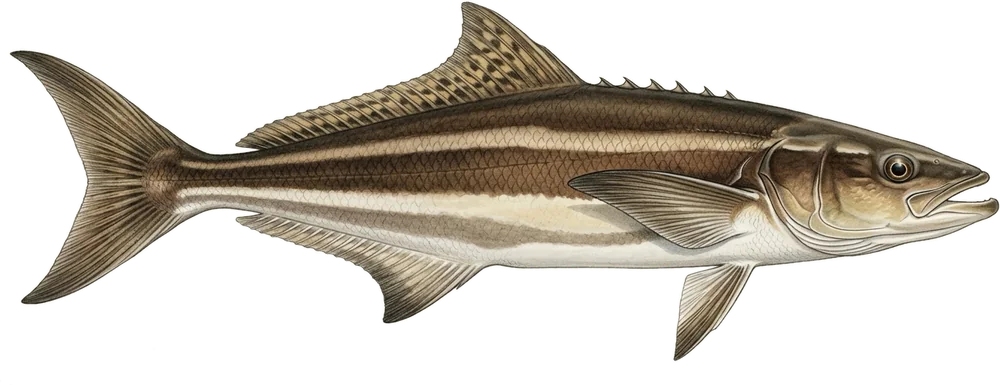
In short: According to the catch calendar the best time is March to September. Good spots along the coast: wrecks, reefs, open water and just below the surface. Proven baits: live baits near the bottom at reefs and wrecks, bucktail jigs when sight fishing, flies too. Often mistaken for a shark or a remora, reliably recognised by the seven to nine free-standing dorsal spines. Minimum sizes and catch limits are set by the US authorities. Step by step: How to fish for cobia.
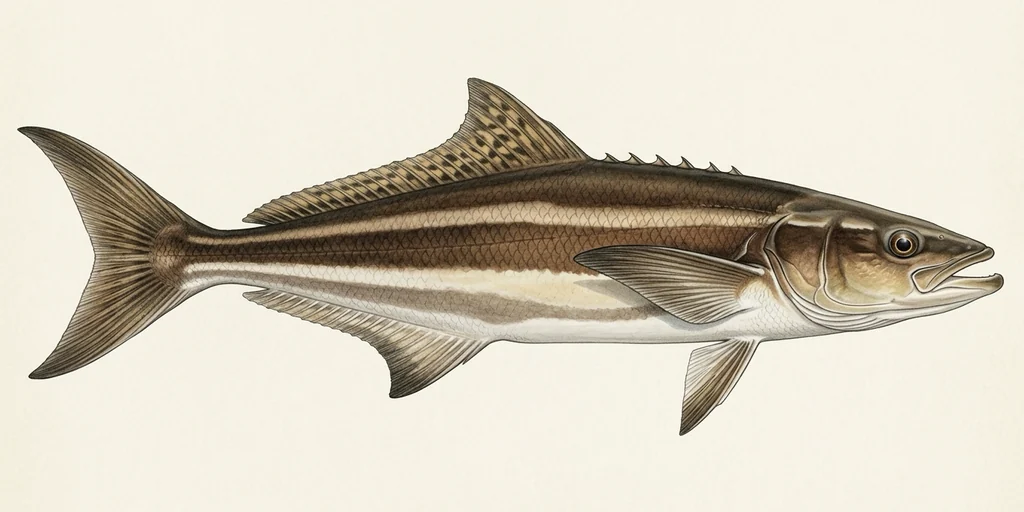
- First dorsal fin of seven to nine short, single spines with no membrane between them
- Broad, flat head with a projecting lower jaw
- Dark lengthwise band from the mouth to the tail base, edged pale above and below
Catch chances through the year
- Hardly any chance
- Possible
- Good
- Peak season
- Spawning (observe the closed season)
Editorial assessment for the home water (south-eastern coast of the USA and Gulf of Mexico), not a measured value and not a guarantee. The rules of the country you travel to are what count.
How to recognise it
The body is long and torpedo-shaped, the head broad and flattened, the eyes small. The lower jaw projects beyond the upper jaw. The most reliable feature sits on the back: the first dorsal fin consists of seven to nine short, strong spines that stand singly and are not joined by fin membrane. Behind them follows a long second dorsal fin with a raised front part.
Back and flanks are dark brown, the belly lighter. A narrow dark band runs from the mouth to the tail base, accompanied above and below by paler stripes. Juveniles carry striking black-and-white lengthwise stripes with bronze, orange and green patches. In adult fish the tail fin is crescent-shaped, the upper lobe longer than the lower. The cobia has no swim bladder.
According to the Florida Museum, cobia usually measure 50 to 120 centimetres and weigh up to about 23 kilograms; the record given there is 61 kilograms. FishBase gives maximum values of 2 metres in length, 68 kilograms and an age of 15 years. NOAA Fisheries gives up to 12 years for US waters.
Direct comparison: cobia or remora?
| Feature | Cobia | Remora |
|---|---|---|
| Front of the back | 7 to 9 short, free-standing spines | oval sucker disc with 16 to 28 lamellae on head and nape |
| Belly | light, greyish white to silvery | dark |
| Tail fin of adult fish | sickle-shaped, upper lobe longer | almost straight, black with white corners |
| Lengthwise band | present | also present, not useful for telling them apart |
| Size according to FishBase | up to 2 m and 68 kg | up to 110 cm and 2,3 kg |
With its dark back, flat head and tall dorsal fin, a cobia in the water is often taken for a shark or a remora. NOAA Fisheries even calls the remora its closest living relative. On the hook the free-standing spines on the back settle the question quickly, because the remora has a sucker disc there. The dark lengthwise band does not help: according to the Florida Museum the remora has one too.
In the USA the cobia is often called ling or lemonfish. It has nothing to do with the northern ling of the same name.
Where it holds
The cobia lives worldwide in tropical and subtropical seas and is absent only from the eastern Pacific. In the western Atlantic its range runs from Canada to Argentina according to FishBase, including the Gulf of Mexico and the Caribbean. It is most common in US waters from Virginia southwards into the Gulf.
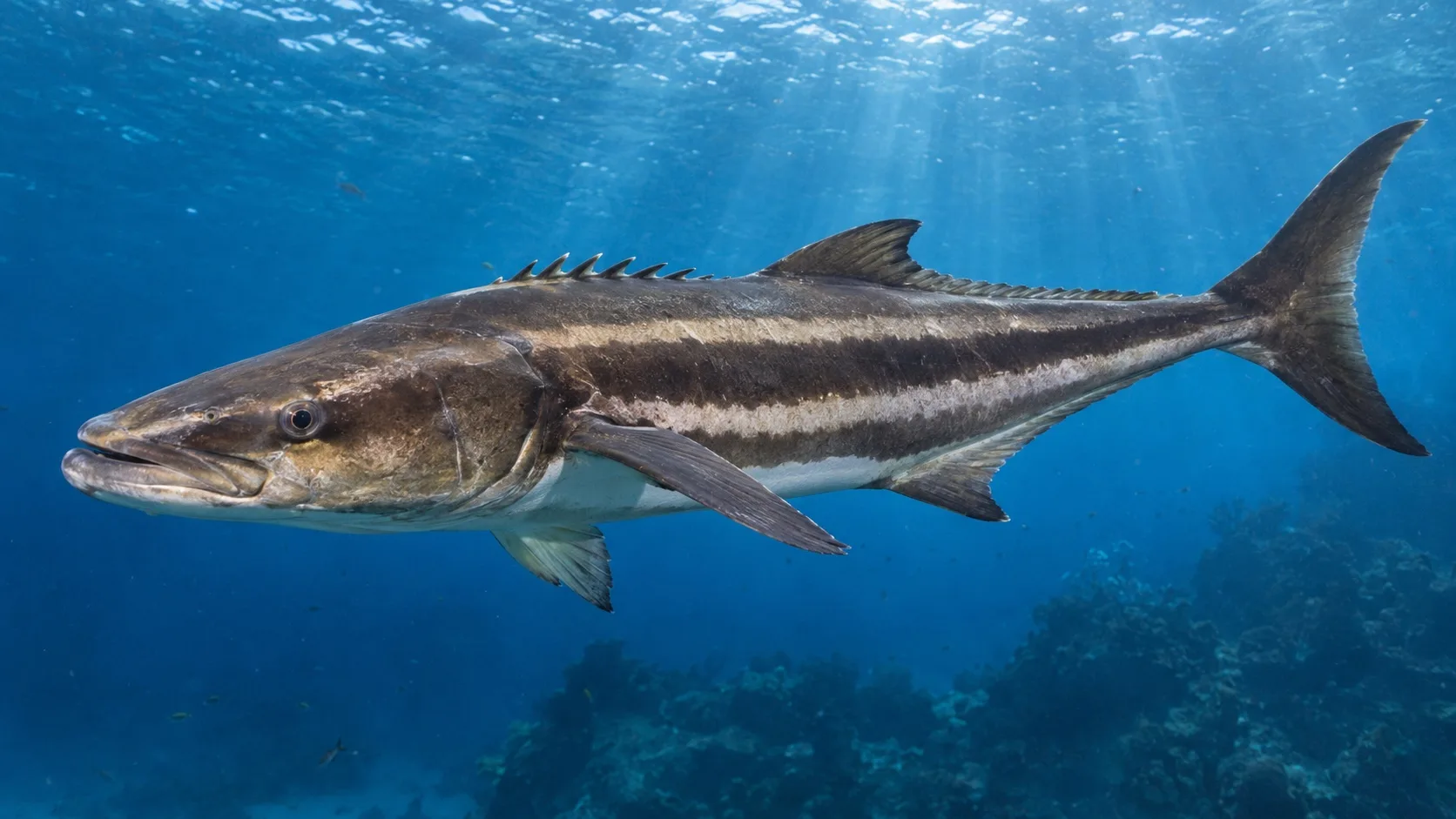
It seeks out anything that interrupts open water: buoys, pilings, platforms, wrecks, artificial reefs and flotsam. It also attaches itself to large animals such as rays, sea turtles and sharks. Juveniles use estuaries (river mouths with brackish water), bays, sounds and beach stretches. The Florida Museum gives 20 to 30 degrees as the preferred water temperature.
Holding spots in the picture
Choose the time of day: the picture shows where the species holds. We do not show German seasons for travel fish; the bars give the chance of a catch for each month. Tap a fish or a spot in the list to bring it closer. The picture is schematic and AI-generated, and every water is different.
Chance of a catch per month according to the catch calendar
- J
- F
- M
- A
- M
- J
- J
- A
- S
- O
- N
- D
Spawning season
On the coast
Wreck, reef
Cobia (black kingfish) is found here all year round.
Open water, mid-water
Cobia (black kingfish) is found here all year round.
Just below the surface
Cobia (black kingfish) is found here all year round.
Cobia look for anything that offers cover in open water: wrecks, artificial reefs, buoys, pilings, oil platforms and floating debris. They often accompany rays, turtles or sharks just below the surface. Juveniles live in bays, estuaries and off beaches.
Size comparison: AI-generated drawing, schematic.
How it feeds and spawns
The cobia feeds mainly on crustaceans, plus fish and cephalopods. In older fish off South Carolina swimming crabs make up most of the diet, which is why it is also called crabeater in English. It often swallows prey whole. It follows rays, turtles and sharks and eats what they leave.
Adults travel alone or in small groups. For spawning they form aggregations, in bays and river mouths as well as in open water. A female spawns several times in a season. Females become sexually mature at about three years, males at two.
When and where the season is
The cobia is a migratory fish. On the US Atlantic coast it moves south and further offshore in late autumn and winter, and migrates up the coast in spring. According to the ASMFC it comes into the shallow coastal water as soon as it reaches 20 to 25 degrees. Off South Carolina it holds close inshore from April to October, most often in late spring.
The spawning season moves north with the warmth: a peak in May off South Carolina, in June off North Carolina, in July off Virginia. For the Gulf of Mexico the Florida Museum gives April to September, NOAA Fisheries late summer to early autumn. Fish from the north-eastern Gulf winter off southern Florida, probably as far as the Florida Keys. Further north the season only begins in spring.
How it is caught
Step by step: How to fish for cobia: tips on bait, rigs and tackle – season, holding spots, bait, tackle and rules on one page.
In the USA the cobia is fished mainly in two ways: with natural baits near the bottom and by sight fishing. When sight fishing, anglers scan the surface for fish holding at a buoy in a harbour entrance or accompanying a ray, and cast the bait to them. The fisheries authority of North Carolina names bucktails for this, that is jigs with a tuft of animal hair.
Near the bottom anglers fish with live baits at reefs and wrecks. In addition, the cobia takes the hook when trolling for king mackerel, and on the fly rod it is a sought-after catch.
Watch buoys and rays: A cobia rarely holds in empty water. Flotsam, buoys at harbour entrances, wrecks and large rays or turtles are the places where a close look pays off.
Identify the species and the rules before landing it: Because the cobia is easily mistaken for a shark, look at the free-standing dorsal spines. Anyone who wants to keep it must observe the minimum size in US federal waters and land the fish with head and fins.
Suitable lures
Live baits near the bottom at reefs and wrecks, bucktail jigs when sight fishing, flies too.
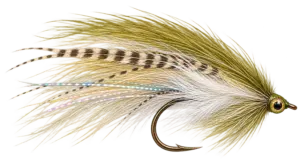
AI-generated illustrations. A click opens the lure’s page.
Check the US rules on minimum size (Mindestmaß) and limits with the responsible authority
What applies locally
In the USA several bodies share responsibility. In the Gulf of Mexico and off the east coast of Florida, NOAA Fisheries and the Gulf Council manage the stock, and from Georgia northwards the Atlantic States Marine Fisheries Commission. Minimum sizes, limits per person or boat and annual catch quotas apply, and these are set anew for each season. We therefore do not give figures: the rules of the responsible authority on the spot are binding.
Anglers do not need a federal permit for the cobia, but they do need the fishing licence of the state concerned, for example the Coastal Recreational Fishing License in North Carolina or the Saltwater Fishing License in South Carolina.
On the IUCN Red List the cobia is classed as not threatened (Least Concern, assessment of 2012). The 2020 stock assessment classed the Atlantic stock as neither overfished nor subject to overfishing. For the Gulf stock, NOAA Fisheries reports no overfished status but overfishing is occurring.
Frequently asked questions (FAQ)
How do I tell a cobia from a shark?
By the first dorsal fin: the cobia has seven to nine short spines there with no fin membrane between them. Add the broad, flat head and the dark lengthwise band on the flank.
When is cobia season in the USA?
On the Atlantic coast from spring to autumn, as soon as the coastal water reaches 20 to 25 degrees. Off South Carolina it is there from April to October, peaking in late spring. In winter many fish hold off southern Florida.
How big does a cobia grow?
Usually 50 to 120 centimetres and up to about 23 kilograms. FishBase gives maximum values of 2 metres and 68 kilograms.
Sources
The rating of catch chances is an editorial assessment. The facts come from these sources, and the text is worded in our own words. The illustration is an original design by Angel Momente in the style of a natural history plate (AI-generated, see the AI notice).
- FishBase: Rachycentron canadum, Cobia
- NOAA Fisheries: Cobia
- Florida Museum of Natural History: Rachycentron canadum (Cobia)
- South Carolina Department of Natural Resources: Cobia
- Atlantic States Marine Fisheries Commission: Cobia
- North Carolina Division of Marine Fisheries: Cobia (Species Profile)
- Florida Museum of Natural History: Echeneis naucrates (Schiffshalter)
- FishBase: Echeneis naucrates (Schiffshalter, zur Unterscheidung)
Created with AI support from the sources listed. Figures only appear in the text if a source gives them. Last updated: 27 October 2026. Found a mistake? Write to us. Who is behind this site: About me.
More in the lexicon
- All fish species at a glance
- Catch calendar – month, water temperature and profile for 93 species
- Line calculator – breaking strain after the knot, drag guideline, backing
- Angling methods