
Knowledge – Fish
Barramundi: Features, spawning, rules in Australia
The barramundi (Lates calcarifer), also known in English as Asian sea bass, lives in the Indo-Pacific from the Persian Gulf to northern Australia. It moves between rivers, estuaries and the coast and changes sex during its life. In Australia it counts among the most important food fish and most popular sport fish.
In short: According to the catch calendar the best time is March to May and September to October. Good spots in the river: undercut bank; on the coast: seagrass. Proven baits: lures worked close to cover such as undercut banks, sunken wood and overhanging trees. It starts out male and later becomes female. In Queensland slot limits and closed seasons apply: east coast 1 November to 31 January, Gulf of Carpentaria 7 October to 31 January, and then targeted catch and release is not allowed either (as of October 2026). Step by step: Fishing for barramundi.
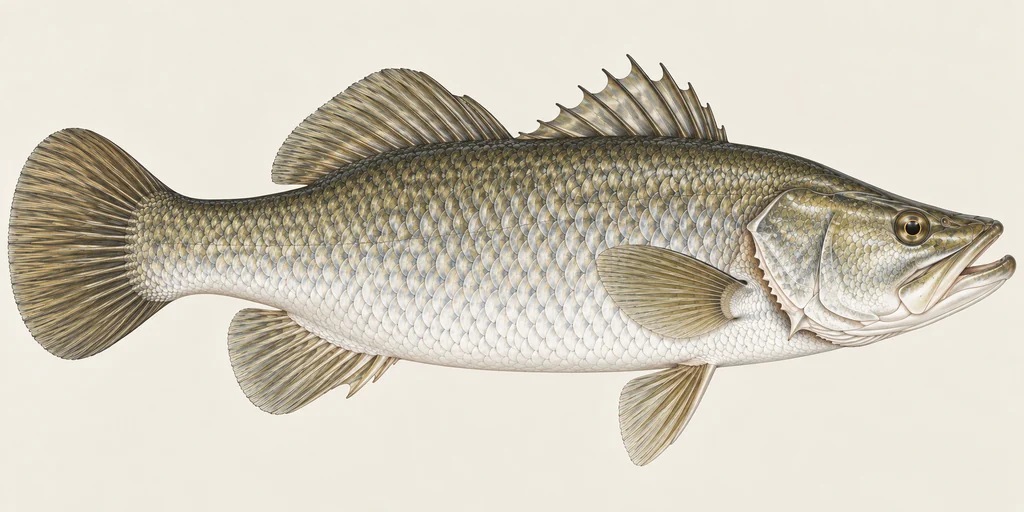
- Large, slightly oblique mouth, upper jaw reaching back beyond the eye
- Serrated lower edge of the preopercle with a strong spine at the corner
- Rounded tail fin
Catch chances through the year
- Hardly any chance
- Possible
- Good
- Peak season
- Spawning (observe the closed season)
Editorial assessment for the home waters (northern Australia (Queensland, Northern Territory)), not a measured value and no guarantee. The rules of the country you travel to are binding.
How to recognise it
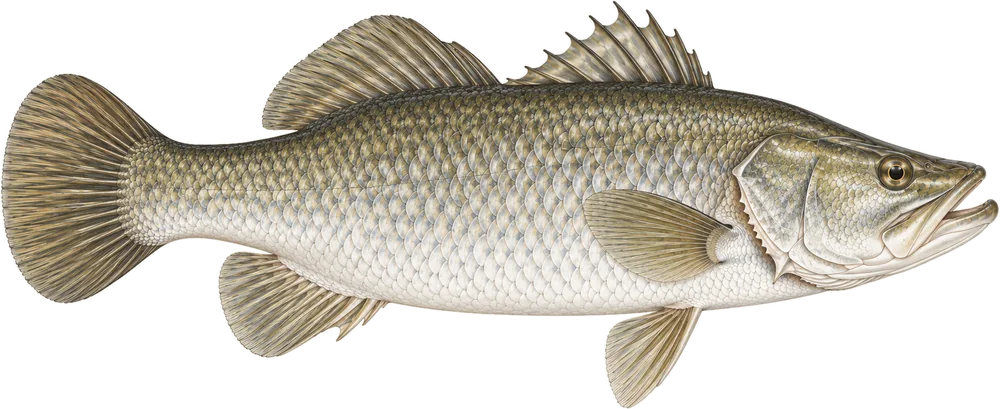
The barramundi has an elongated, laterally flattened body and a large, slightly oblique mouth. The upper jaw reaches back beyond the eye. The lower edge of the preopercle is serrated and carries a strong spine at the corner; the gill cover also has a small spine. The dorsal fin has 7 to 9 spines and 10 to 11 soft rays, and the tail fin is rounded.
FishBase gives maximum values of 200 centimetres, 60 kilograms and 35 years. The Australian stock assessment gives 35 years and 150 centimetres as maximum values.
Despite the English name Asian sea bass, it is not closely related to the European sea bass. It belongs to the family Latidae.
The risk of confusion lies mainly in the name: the barramundi cod belongs to the groupers and may not be kept in Queensland. Anyone reporting a catch or looking up the rules should therefore pay attention to the full name.
Side by side
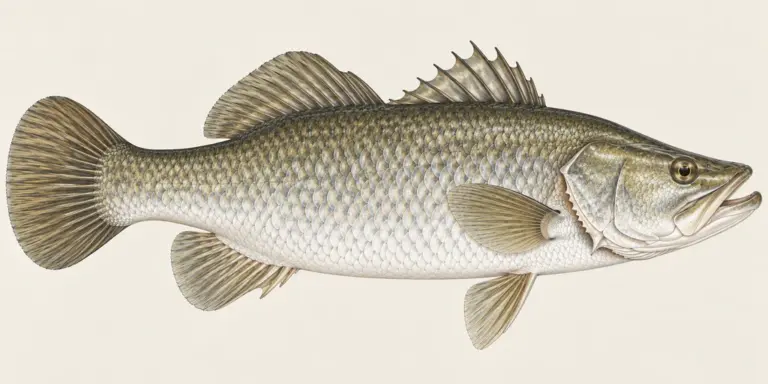
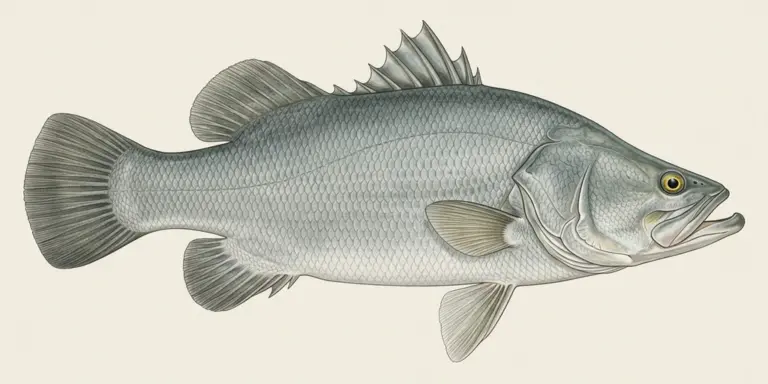
AI-generated illustrations.
Where it holds
The range runs from the eastern edge of the Persian Gulf to China, Taiwan and southern Japan and south to Papua New Guinea and northern Australia. In Australia the stock assessment distinguishes several stocks in Western Australia, the Northern Territory and Queensland.
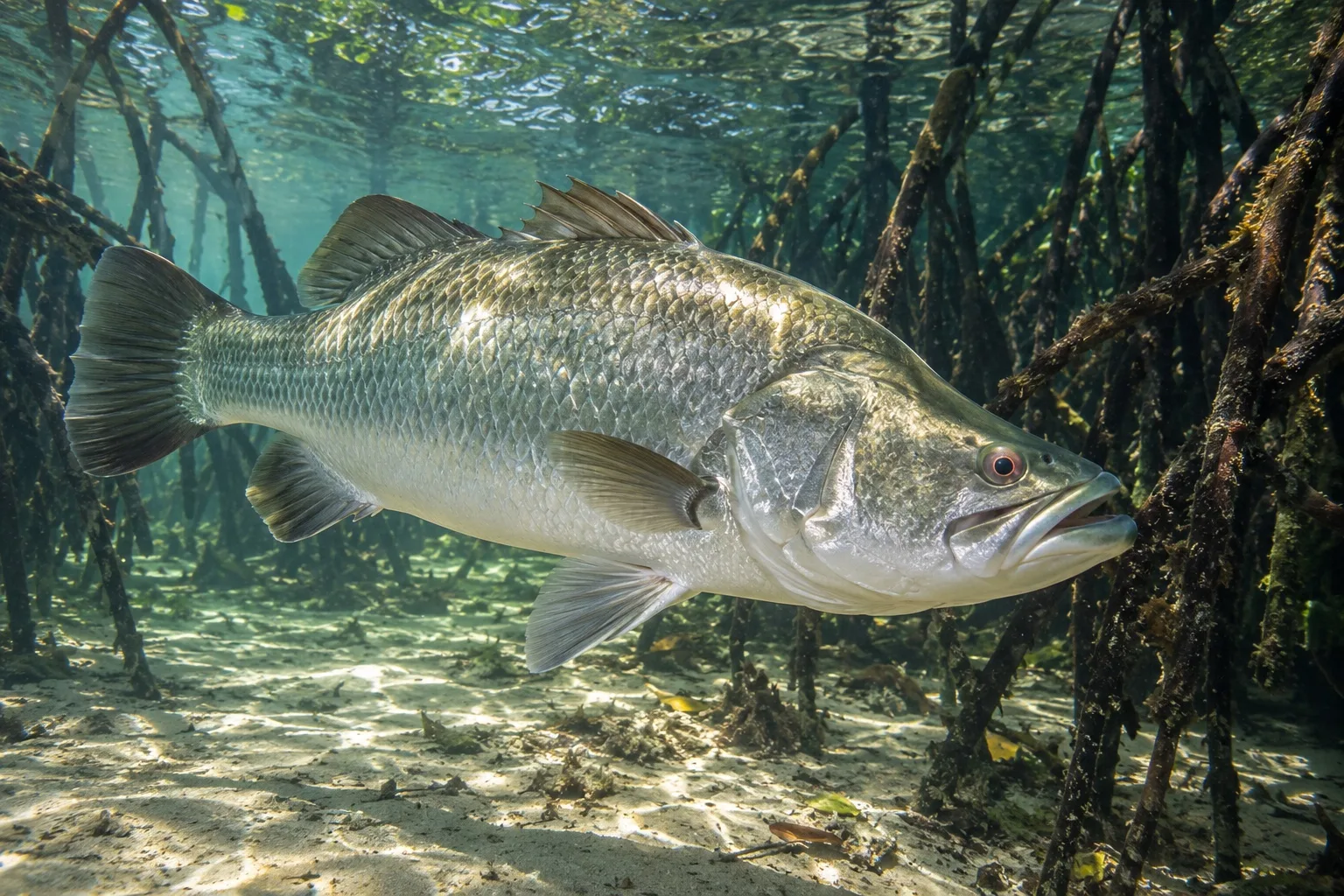
The barramundi lives in coastal waters, estuaries and lagoons, in clear to murky water. Larvae and young juveniles grow up in brackish, seasonally flooded swamps at the river mouths, and older juveniles move into the upper reaches of rivers. It prefers to hold close to cover: undercut banks, sunken wood and overhanging vegetation. How good a year class turns out depends strongly on rainfall; wet years bring more juveniles.
Holding spots in the picture
Choose the time of day: the picture shows where the species holds. We do not show German seasons for travel fish; the bars give the chance of a catch for each month. Tap a fish or a spot in the list to bring it closer. The picture is schematic and AI-generated, and every water is different.
Chance of a catch per month according to the catch calendar
- J
- F
- M
- A
- M
- J
- J
- A
- S
- O
- N
- D
Spawning season
In the river
Undercut bank, overhanging branches, timber
Barramundi are found here all year round.
In rivers, barramundi hold up near cover: under undercut banks, by sunken timber and under trees hanging over the water. Older juveniles move right up into the upper reaches, and at the start of the wet season mature males drop downstream to the estuaries.
On the coast
Seagrass, gravel and stones in the shallows
Barramundi are found here all year round.
On the coast it lives in estuaries, lagoons and inshore water, clear or murky. To spawn, the fish gather in the river mouths and on the tidal flats in front of them, in groups around full and new moon on a rising tide.
Depth: FishBase gives a depth of 10 to 40 metres.
Size comparison: AI-generated drawing, schematic.
How it lives and spawns
The barramundi eats fish and crustaceans, and juveniles also eat insects. It is a protandrous hermaphrodite: most fish mature first as males, spawn for one or several seasons as males and then become females. Small fish are therefore almost always males and large ones mostly females. In Queensland males mature at two to five years and females at five to ten years.
At the start of the wet season maturing males migrate downstream out of fresh water and spawn with the females in the estuaries and on the tidal flats in front of them. Spawning takes place in groups around full and new moon, mainly at the start of the flood tide, which carries the eggs into the estuary. Brackish water is needed for the eggs to develop. By some estimates a female can produce up to 2.3 million eggs per kilogram of body weight.
When and where the season is
In Queensland the barramundi spawns from October to February. Two closed seasons protect it then: on the east coast from 1 November to 31 January, in the Gulf of Carpentaria already from 7 October to 31 January. During this time you may neither keep it there nor target it for catch and release, because even the stress of being caught can prevent spawning. A few reservoirs that the authority lists individually are exempt. As of October 2026; the official version is held by the Queensland fisheries authority. In the other months the slot limit protects part of the fish.
How the season works out in the Northern Territory and Western Australia depends on the water and on access in the wet and dry seasons. Before the trip, check which closed seasons and closed areas apply to your water.
What you catch it with
Step by step: Fishing for barramundi: tips on bait, rig and tackle – season, spots, bait, tackle and rules on one page.
Recreational anglers catch the barramundi with rod and handline. It is considered a good fighter that avoids solid nets and is best caught with rod and line and with lures. In Australia reservoirs are stocked with barramundi, and catch and release is particularly common there. In Queensland some of these reservoirs are exempt from the closed season; in all other waters releasing during the closed season is no way out: you may not target it then.
Slim fish-shaped crankbaits catch well, cast or trolled. Work them slowly and erratically, because the barramundi often follows a lure for a long time before it strikes. Around sunken wood soft plastics and bladeless vibration lures also bring bites, at times poppers on the surface too.
Fish at the cover it uses: at undercut banks, sunken wood and overhanging trees. According to the Australian stock assessment around 90 per cent of released barramundi survive.
In Kakadu National Park the traditional owners ask visitors to fish sustainably, for example by releasing fish, and to fish only in the areas open to visitors.
Keep back from the bank: Saltwater crocodiles live in all waters of Kakadu National Park. The park authority advises keeping at least five metres from the water’s edge when bank fishing and never going into the water.
Mind the preopercle: The serrated preopercle with its strong spine can cut. Do not grip the fish by the gill covers.
Suitable lures
Lures worked close to cover such as undercut banks, sunken wood and overhanging trees.
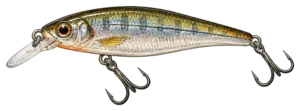
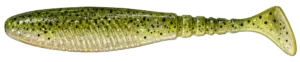
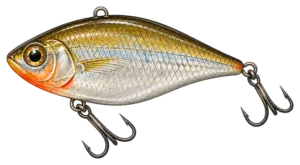
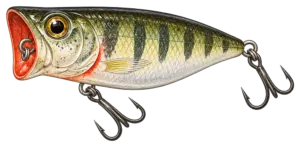
AI-generated illustrations. A click opens the lure’s page.
Observe the closed season in Queensland; keep back from the bank in crocodile waters.
Rules, licences and safety
Catch rules are set by the states and territories. Queensland uses a slot limit to protect both small males and large females and limits the number of fish per person and per boat. Seasonal and area closures come on top of that. In Western Australia you need a licence if you fish from a motorised boat. In Kakadu National Park the same catch limits apply as on the Mary River and Daly River.
Only the current rules of the responsible authority are binding, in Queensland those of the Queensland Government (Queensland Government). The stocks in Australia are mostly regarded as sustainably fished: of nine assessed stocks, seven are classed as sustainable.
A note on safety: saltwater crocodiles also stay around boat ramps and fishing spots and snatch hooked fish. These notes do not replace advice from the park authority on the spot.
Frequently asked questions (FAQ)
Is it true that barramundi change sex?
Yes. Most barramundi are males first and later become females. Large fish are therefore mostly females.
When is the closed season for barramundi in Queensland?
On the east coast from 1 November to 31 January, in the Gulf of Carpentaria from 7 October to 31 January (as of October 2026). Targeted catch and release is then also banned; only a few reservoirs are exempt.
How big does a barramundi get?
FishBase gives up to 200 centimetres and 60 kilograms. The Australian stock assessment gives 150 centimetres and 35 years.
Sources
The rating of catch chances is an editorial assessment. The facts come from these sources, and the text is worded in our own words. The illustration is an original design by Angel Momente in the style of a natural history plate (AI-generated, see the AI notice).
- FishBase: Lates calcarifer, Barramundi
- Status of Australian Fish Stocks (FRDC/Australian Government): Barramundi 2023
- Queensland Government: Size and possession limits in tidal waters
- Parks Australia: Kakadu National Park, Fishing & boating
- Wikipedia (en): Barramundi
- Recfishwest: Scott’s Species – Barramundi
- Queensland Department of Primary Industries: Closed seasons in tidal waters (Barramundi Ostküste 1.11.–31.1., Golf von Carpentaria 7.10.–31.1., kein gezieltes Zurücksetzen)
- Queensland Department of Agriculture and Fisheries: Closed seasons, fresh waters (ausgenommene Stauseen)
Created with AI support from the sources listed. Figures only appear in the text if a source gives them. Last updated: 27 October 2026. Found a mistake? Write to us. Who is behind this site: About me.
More in the lexicon
- All fish species at a glance
- Catch calendar – month, water temperature and profile for 93 species
- Line calculator – breaking strain after the knot, drag guideline, backing
- Angling methods