
Knowledge · Tackle
Underwater camera: See the bottom, weed and fish live
If you go fishing with an underwater camera, you see stones, mussel beds, weed edges and fish as a picture rather than an echo, often including the species. How far the lens can see depends on how cloudy the water is. On some waters, a live underwater image is banned while fishing.
Cable, line, stand: three designs
The designs differ mainly in whether you see the picture straight away or only afterwards. A review by fisheries researchers, including the Berlin-based Leibniz-Institut für Gewässerökologie und Binnenfischerei (IGB), describes three basic types (Cooke and others, 2021):
- Cable camera with monitor: The camera hangs on a cable below the boat, jetty or ice hole, and the picture runs live to a screen above the water. For ice fishing, such devices are advertised as letting you watch the fish and bring your bait to the right depth.
- Line camera: A small camera sits on the line just in front of the lure and films it from the front. There is no live picture. You download the footage after fishing and see how fish reacted to the lure.
- Action cam: A waterproof compact camera stands on a frame or on a pole in the water. According to the study, specialist carp anglers use this to watch when fish visit a swim they have baited beforehand.
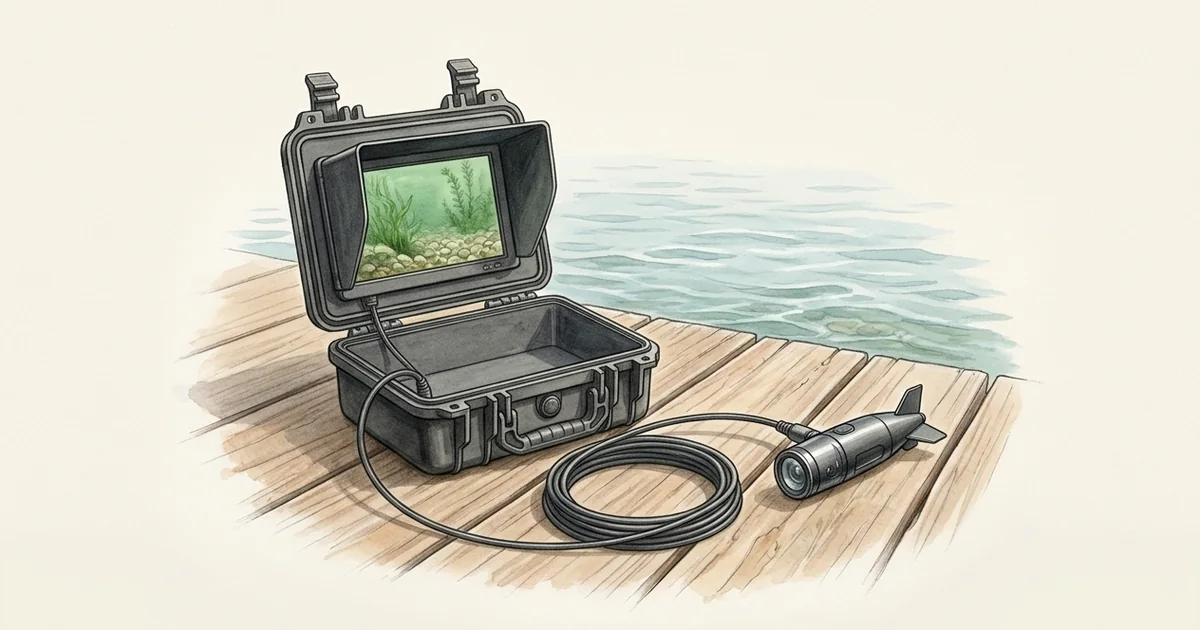
According to Blinker, many of these cameras are waterproof to a few metres even without an extra housing, and considerably deeper with a protective housing. What the protection rating on the housing does and does not tell you is explained under Catch photo equipment.
Radio and Wi-Fi under water
Some models send their picture to a smartphone via Wi-Fi or an app, writes Blinker. But radio signals travel badly through water. Water absorbs electromagnetic waves, especially high-frequency ones, far more strongly than sound, which is why devices under water usually communicate acoustically (Nature Communications, 2022). For a live picture from the depths, a cable to the surface is therefore usually needed.
What the picture shows
An echo sounder reports echoes, not species. According to Cooke and colleagues, cameras on the other hand provide details on the size, species and location of a fish that devices using indirect detection struggle to deliver. Blinker sees the greatest benefit not just in filming fish but in looking at the water itself: current edges, mussel beds, weed edges, sunken trees and hard bottom become visible.
Then there is behaviour at the lure. Whether a perch grabs it immediately, follows hesitantly or turns away just before it, you only see under water. On video you can also check how a plug runs in the current and as it sinks. According to Blinker, clubs and water wardens use cameras to record the bottom, plant growth and stocked fish.
The researchers state the limit straight away: for mapping a water and searching for fish, the camera is no cure-all. That leads to a division of labour. You search with a map and echo sounder and take a closer look with the camera. Why fish hold along edges and in weed is explained in Fishing on a lake.
At the ice hole
When ice fishing, the cable camera hangs through the hole and the monitor stands next to it. You can see whether fish are under the hole and at what depth. How big an ice hole may be is set by the water regulations; drilling is explained under Ice auger. What frost does to the camera battery is covered under Batteries and power banks.
Which design for which use
The assignment follows from the features above, not from product tests.
| If you … | then | What to watch for |
|---|---|---|
| want to see fish and bait live at the ice hole | Cable camera with monitor | hole size as set by the water regulations |
| want to check weed, stones and mussels from a boat or jetty | Cable camera with monitor | measure the visibility depth first |
| want to see how fish follow your lure | Line camera on the line | no live picture, review later |
| want to watch a baited swim for hours | Action cam on a stand | battery and memory for the whole time |
| are searching a large area or cloudy, dark water | Echo sounder instead of a camera | sound reaches further there than light |
| fish a water where live images are banned | no camera while fishing | Fishing permit (Erlaubnisschein) and water regulations |
On the second-to-last row: the Thünen-Institut names as an advantage of acoustic cameras that they also work in darkness and in cloudy water (Thünen-Institut für Seefischerei). The line camera also hangs on your line. How much breaking strain is left after the knot is worked out by the Line calculator.
Visibility, turbidity and infrared
How far a camera can see depends on the water. Hydrology measures turbidity as visibility depth. A white disc 25 cm in diameter is lowered until it just disappears in daylight (Lexikon der Geowissenschaften). The Bayerisches Landesamt für Umwelt gives usually more than six metres for nutrient-poor lakes and mostly less than two for nutrient-rich ones. In nutrient-rich lakes, algae often bloom after the spring turnover and the water turns greenish to yellowish brown. Strong wind can also make it cloudy, writes the Landesanglerverband Brandenburg. More on this under Waters and fish behaviour.
Check the visibility depth yourself
- Cut out a white, round disc about 25 cm in diameter and tie it at its centre to a cord with markings every 50 cm.
- In daylight, lower it vertically into the water from a jetty or boat.
- Note the depth at which you can only just no longer make out the disc. That is the visibility depth.
- Write down the date, weather and value. After a few measurements you will know when your water is clear enough for the camera.
Light and infrared
Water filters colours to different degrees. In tests of an underwater camera by the French marine institute Ifremer, the long-wave colours from orange to infrared were absorbed much more strongly at a distance of 1 to 3 m, while green and blue suffered less (Pelletier and others, 2021). This gives underwater images a green cast (Wikipedia, supplementary).
For infrared lights on cameras this means a short range. The Thünen-Institut für Ostseefischerei films cod at fish traps with a home-built infrared system, at night as well. With powerful infrared LEDs the picture reached about 2 m, much further in daylight (Hermann and others, 2020). The reason for infrared: white light in dark water can distort fish behaviour, and according to the Thünen researchers many fish cannot see infrared. But it is not completely invisible to every species. A study by the Universität Hohenheim counts carp among the species for which perception of near infrared has been demonstrated.
Rules: water regulations, authority, group fishing
Whether a camera is allowed while fishing is not set out in any single set of rules. Fisheries law is state law, and on top of that come the regulations of the water managers. According to the IGB, club committees usually regulate new technology themselves through their water regulations, often by gut feeling and without accompanying research. Two official examples, retrieved in November 2026:
- Middle Franconia: § 5 (prohibited equipment) of the Bezirksfischereiverordnung reads, after the amendment of 26 March 2026, which according to the official gazette takes effect on 1 January 2026: “Fishing using devices or systems that, by means of real-time sonar technology […] or real-time display of underwater activity (e.g. live footage by drones, cameras etc.), enable the location, observation or tracking of fish or fish movements is prohibited.” Exceptions require the written consent of the district’s fisheries advisory service (Mittelfränkisches Amtsblatt Nr. 4/2026).
- Lower Austria: In § 12(5), the NÖ Fischereigesetz 2001 lists “artificial light sources” and the “echo sounder” among the prohibited devices and means of capture. The paragraph does not mention cameras. Whether a camera with lights falls under it is for the fisheries authority to answer (RIS).
Many newer bans target live sonar and are tailored to echo sounder transducers; examples are given under Echo sounder. Middle Franconia, by contrast, names cameras explicitly.
Before using it for the first time: read the water regulations and your fishing permit. If they say nothing about cameras or live images, ask the water manager or the fisheries authority before you film while fishing.
Group fishing and angling competitions
Events with scoring are covered by separate state rules. In Bavaria, under § 13 of the implementing regulation to the fisheries act, group fishing events with a final scoring of the catches are only permitted “as part of traditional events and to fulfil the duty of stock management” (AVBayFiG). The other states each have their own rules, as an overview by the Deutscher Angelfischerverband from 2018 shows. Which equipment is allowed at a stock-management fishing event is set by the event rules and the water regulations.
People and location in the picture
A camera on a boat or jetty can easily capture bathers or other anglers too. Publishing is governed by § 22 of the Kunsturhebergesetz (Art Copyright Act): “Images may only be distributed or publicly displayed with the consent of the person depicted.” In Art. 2(2), the General Data Protection Regulation (GDPR) excludes processing “by a natural person in the course of a purely personal or household activity”. According to Recital 18, this could also include the use of social networks if it is done without any connection to a professional or commercial activity (EUR-Lex). This page does not decide whether a particular video falls under this. Your state’s data protection authority can advise you. The simplest approach is to keep strangers out of the picture.
Footage can also easily give away your spot. According to Cooke and colleagues, many cameras and phones automatically save the location of the recording, and recognisable landmarks in the picture add to this. More on sharing catch photos is under Catch photo equipment.
Fairness: the arguments for and against
Whether cameras fit with fair angling is disputed. The review with IGB involvement weighs it up:
- For: If you see on the live picture that a fish is taking the bait, you can strike immediately. That can prevent deeply swallowed hooks. Underwater images are an alternative to the catch photo, for which the fish has to come out into the air. And many anglers simply enjoy seeing fish, even if they do not catch more.
- Against: The camera can make fishing more efficient and allow you to select particular species and sizes. That removes some of the chance that otherwise plays a part in angling. Because of the high image resolution, the authors consider cameras a technology that could change angling more than the usual fish finders.
On balance, the authors see only a limited risk that cameras harm most stocks through higher catches. Reliable figures on how widespread they are and how they affect catches are lacking. Rules would be needed most where cameras are attached directly to fish, for animal welfare reasons. There is a similar debate about live sonar, see Echo sounder.
Common mistakes
- Setting off when the water is cloudy. After an algal bloom or a stormy day, the monitor often shows nothing but suspended particles. Measure the visibility depth first or take the echo sounder straight away.
- Expecting a lot from infrared. In the Thünen-Institut’s system, the infrared picture reached about 2 m despite powerful LEDs, and the researchers speak of short-range observation. And near infrared is not completely invisible to carp.
- Expecting a Wi-Fi live picture from the depths. Radio travels badly through water. For a live picture from the depths you usually need a cable to the surface.
- Filming without checking the water regulations. Middle Franconia bans fishing with live underwater images, other regulations ban live sonar.
- Sharing videos without checking them. Recognisable people, landmarks and saved location data should be removed from the footage first.
Frequently asked questions
Can I use an underwater camera while fishing?
There is no single answer. What counts is state law, local regulations, the water regulations and your fishing permit; in Middle Franconia, for example, there is a ban. If in doubt, ask the water manager or the fisheries authority.
Does the camera replace the echo sounder?
No. The camera only sees a small part of the water, and hardly anything in cloudy water. The echo sounder searches the area, and the camera then shows what is at the spot.
Can fish see the camera’s infrared light?
According to the Thünen-Institut, many fish cannot see infrared. For some species, including carp, perception of near infrared has been demonstrated, however.
Why is the camera picture greenish under water?
Water absorbs red and orange within just a few metres, while green and blue travel further. In nutrient-rich lakes, algae also colour the water greenish to yellowish brown.
Related
- Echo sounder: cone, display types and live sonar bans
- Water thermometer: measure temperature and find fish
- Ice fishing: tackle, bait and rules at the ice hole
- Ice auger: drilling holes without weakening the ice
- Batteries and power banks: charge, store and use them in the cold
- Catch photo equipment: protection rating, tripod and consent
- Polarised sunglasses: see below the surface without technology
- Line calculator: breaking strain after the knot
Sources
- Cooke, Arlinghaus und andere: Technological innovations in the recreational fishing sector, Reviews in Fish Biology and Fisheries 2021 (Bauformen, Grenzen, Für und Wider, Ortsdaten) und IGB: Angeln 4.0, Pressemitteilung vom 29. April 2021 (Gewässerordnungen der Vereine)
- Blinker: Unterwasserkamera beim Angeln (Dichtheit, WLAN, Gewässeranalyse)
- Zhao und andere: Underwater wireless communication, Nature Communications 2022 (Funk unter Wasser)
- Thünen-Institut für Seefischerei: Nach Fischen hören (PDF) (akustische Kamera bei Dunkelheit und Trübung) und Hermann, Chladek, Stepputtis, Thünen-Institut für Ostseefischerei: iFO, HardwareX 2020 (Reichweite von Infrarot, Wirkung von weißem Licht)
- Pelletier und andere, Ifremer: KOSMOS, an open source underwater video lander, Sensors 2021 (Farbverlust auf 1 bis 3 m), Shcherbakov und andere, Universität Hohenheim: Sensitivity Differences in Fish Offer Near-Infrared Vision as an Adaptable Evolutionary Trait, PLOS One 2013 (Infrarot beim Karpfen) und Wikipedia: Unterwasserfotografie (Farbverlust, nur ergänzend)
- Spektrum Akademischer Verlag, Lexikon der Geowissenschaften: Sichttiefe (Messung mit weißer Scheibe), Bayerisches Landesamt für Umwelt: Ökosystem See (Sichttiefe nach Nährstoffgehalt, Algenblüte) und Landesanglerverband Brandenburg: Beeinflusst das Wetter den Fangerfolg? (Trübung durch Wind)
- Regierung von Mittelfranken: Mittelfränkisches Amtsblatt Nr. 4/2026 (Bezirksfischereiverordnung, § 5) und RIS: NÖ Fischereigesetz 2001, § 12 (verbotene Vorrichtungen)
- Bayern.Recht: AVBayFiG, § 13 Gemeinschaftsfischen und Deutscher Angelfischerverband: Angelfischereiliche Veranstaltungen in den Fischereigesetzen, Stand 2018 (PDF) (Regeln für Gemeinschaftsfischen)
- Bundesministerium der Justiz: Kunsturhebergesetz, § 22 und EUR-Lex: Datenschutz-Grundverordnung, Art. 2 und Erwägungsgrund 18 (Bildnisse, persönliche Tätigkeiten)
Text AI-assisted, drawings AI-generated. Sources opened and checked in November 2026, no graphics taken from the sources.
All information is for guidance only, without guarantee. Whether you may film at the water is set by the water regulations, your fishing permit and the responsible authorities; this text is not a substitute for legal advice.