
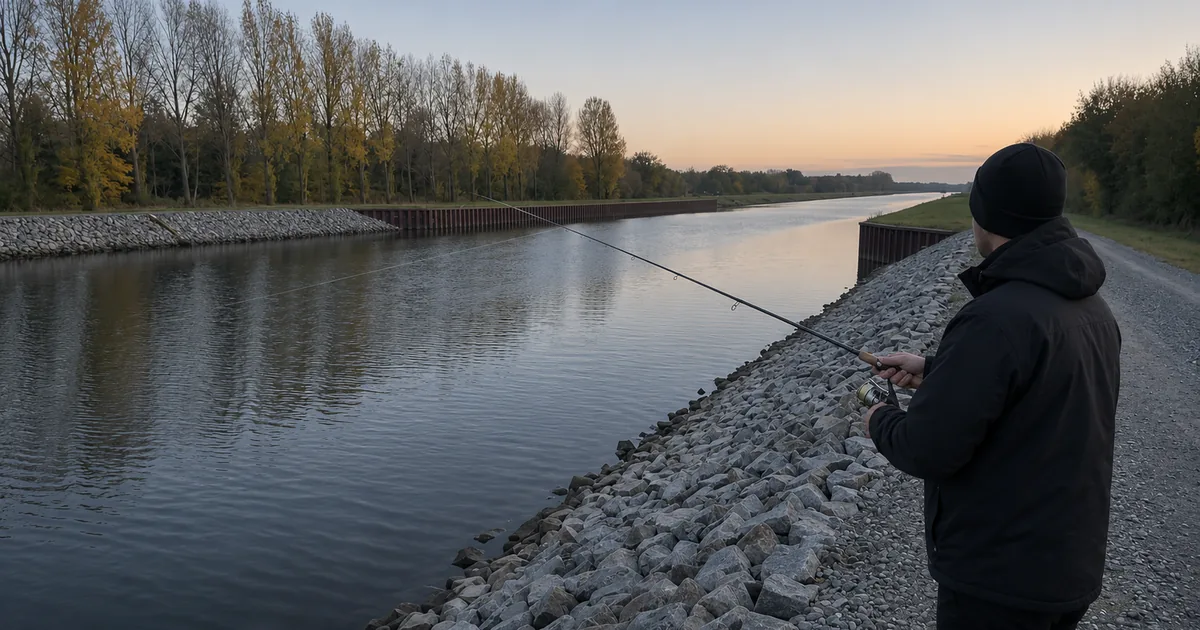
At a glance
- Spots
- Changes in the bank, foot of the rock armouring, sheet piling, landing stages and light
- Autumn
- Small fish look for calm basins, the canal cools evenly
- Time of day
- Dusk and the first hours of darkness, from 25 October one hour earlier
- Baits and lures
- Soft plastic on a light jig head, dead baitfish on the bottom without resistance
- Read first
- Fishing permit (Erlaubnisschein), closed stretches and signs of the waterways administration
What autumn changes in the canal
In the fishing calendar zander are rated Peak season from September to December. On a canal one feature works in their favour that this water keeps all year round: it is murky. Ships constantly stir up clay and silt from the bed. The Wasserstraßen- und Schifffahrtsamt Mittellandkanal/Elbe-Seitenkanal writes that this is why you can only see a few centimetres deep in rivers and canals.
The reason is given in a study of the fish fauna of the Dortmund-Ems-Kanal, published by the Landesfischereiverband Westfalen und Lippe. With its eyes adapted to darkness, the zander catches fish even in pitch darkness, and in murky water it gets closer to them. In very murky waters it is therefore often the dominant predator.
When the water cools in autumn, in a canal it does so without layers. Stratification into warm surface water and cold deep water, as lakes form it, did not occur on the Dortmund-Ems-Kanal because of the shipping traffic. So I do not look for the zander at a particular depth, but at the few places where the canal looks different from the stretch next to it. There are not many: according to the same study, dead wood and similar obstacles are removed immediately because they endanger shipping.
Where I divide up the uniform stretch
The banks of a canal usually consist of rock armouring, that is a sloping bank of large armour stones, or of sheet piling, a vertical wall of steel. Every change from stones to wall or the other way round is a starting point for me.
At the foot of the rock armouring the slope ends, and beyond it the flat bed with the navigation channel begins (fig. 1). I cast to this edge first. A pointer comes from a telemetry study in which researchers tracked zander fitted with transmitters in the Elbe in the Czech Republic. By day the fish stayed in the deep water of the main river channel, at dusk they moved shallower. A river is not a canal, but this is how I carry it over: by day deep at the edge, in the evening up the slope.
At the sheet piling I look for the zander directly under my feet. I walk slowly along the wall and let the soft plastic down vertically beside it. Every few seconds I lift it with a short jerk of no more than 20 centimetres and let it sink back to the bottom, then I walk on a few steps.
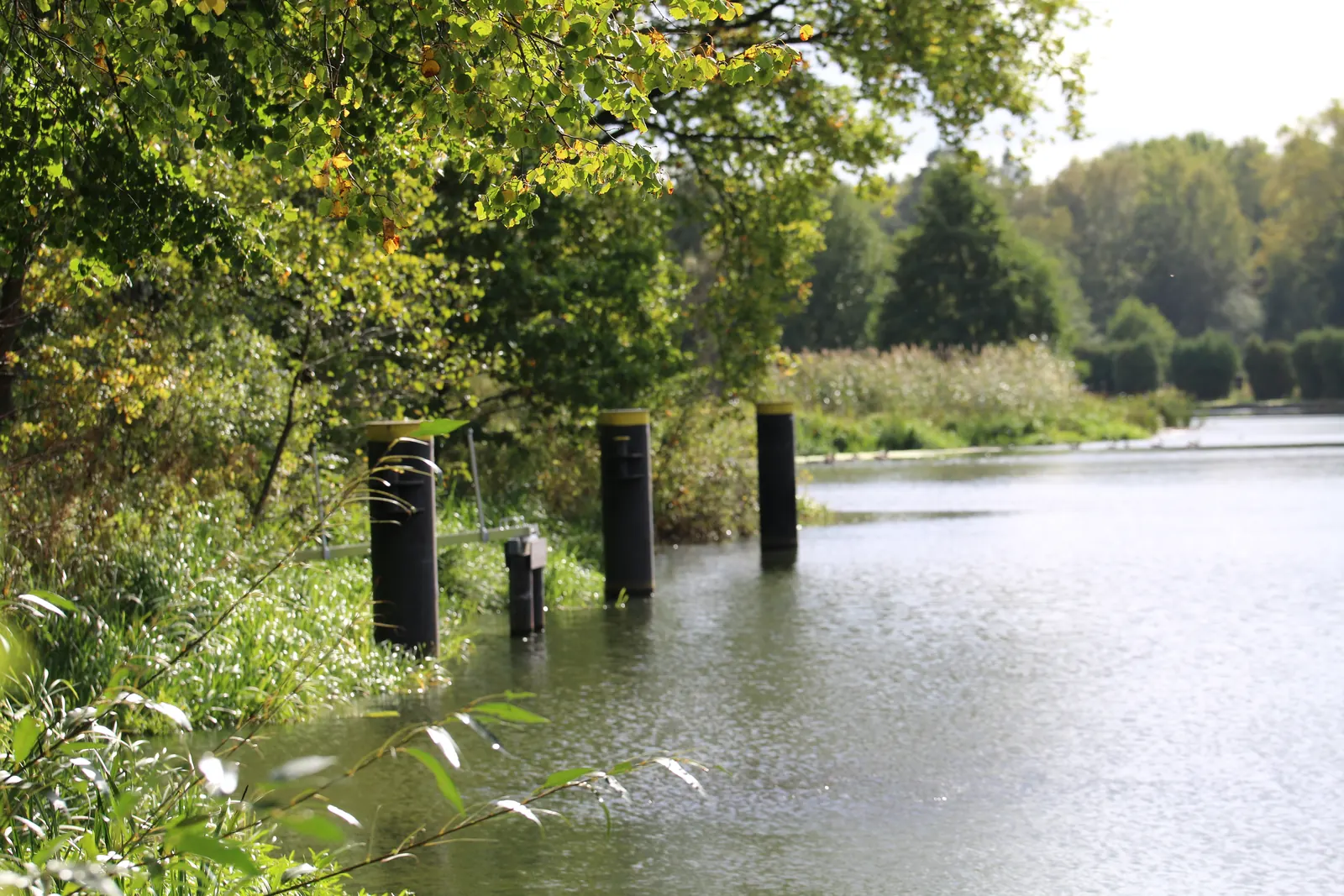
Anything that interrupts the bank line gets a few targeted casts: landing stages, small bays, piles in the water, bridge piers. Where other canals join, I read the fishing permit (Erlaubnisschein) first. On the Mittellandkanal, for example, according to the Anglerverband Niedersachsen, the mouths of the branch canals may only be fished with an annual permit, not with a day or weekly ticket (as of October 2026).
After dark, lit spots come into play: bridges, landing stages and harbour entrances under street lamps. Small fish gather under the light, and the zander hunt from the darkness next to it. I cast a crankbait into the shadow and reel it into the light. My head torch points at the ground at my spot, never at the water.
Harbour and turning basins in autumn
Calm zones are rare in a canal with shipping. On the Dortmund-Ems-Kanal, according to the Landesfischereiverband’s study, fish find them in old channels (Alte Fahrten), that is quieter side sections next to today’s navigation route, and in separate harbour basins. Both can serve them as winter holding areas.
So the colder it gets, the more time I spend at harbour entrances and at the edges of basins where fishing is allowed. Whether a basin is worth it, I judge by the small fish. If in the evening I see shoals at the surface or small fish along the wall, I stay; otherwise I go back to the canal stretch.
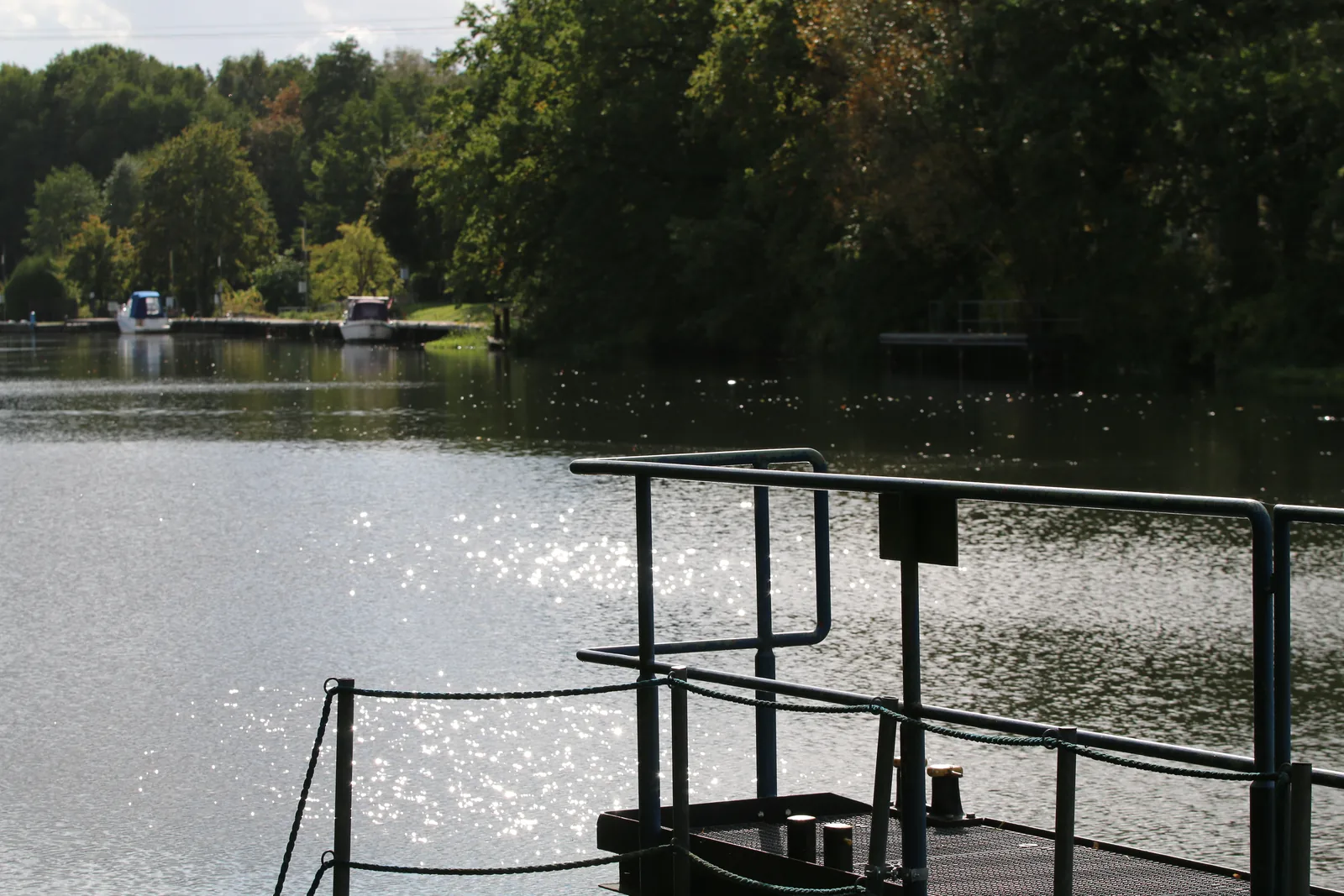
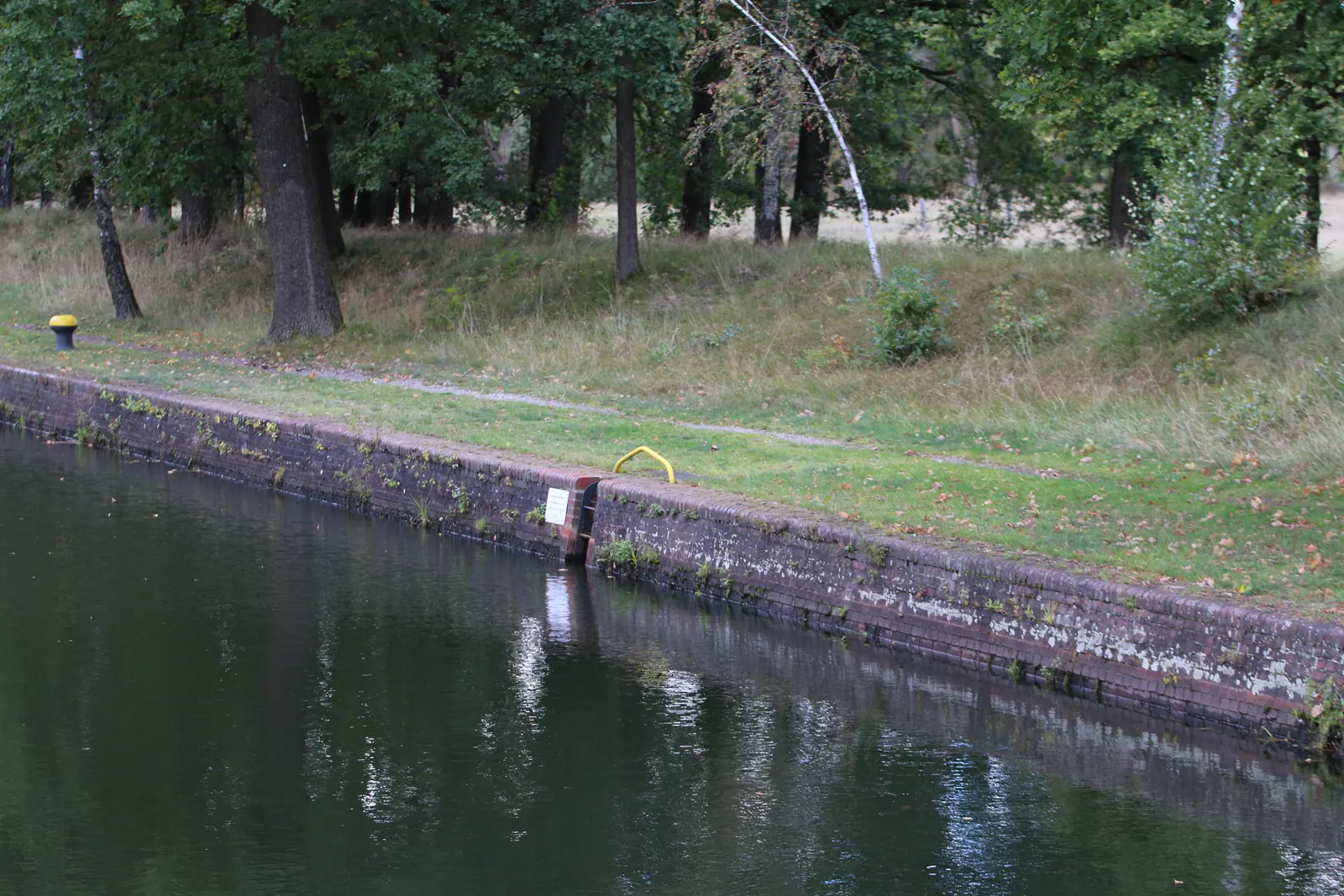
Not every basin is open to anglers. Whether I may cast in a turning basin is stated in the fishing permit (Erlaubnisschein). The Wasserstraßen-Betriebsanlagenverordnung counts federally owned refuge harbours among the installations that may not be entered outside their purpose.
Dusk after the clocks go back
Under the Sommerzeitverordnung, summer time ends on the last Sunday in October. In 2026 that is 25 October; at 3 a.m. the clocks are put back to 2 a.m. After that it gets dark one hour earlier by the clock, and I plan my evenings at the canal correspondingly earlier.
Dusk is what I rely on most with zander. In the Elbe study the tagged fish moved most at dusk and least at night. The researchers interpret their night-time spots near the bank as rest rather than hunting. This fits an analysis in which the Leibniz-Institut für Gewässerökologie und Binnenfischerei (IGB) was involved: larger, older zander tended to settle down to rest earlier at night than smaller ones. So I fish from the last hour before sunset into the first hours of darkness, and not right through to midnight.
From my own experience
- I fish for zander on the Mittellandkanal, and my spot there is the sheet piling.
- I set off at sunset and stay one to two hours.
Soft plastic and baitfish from the bank
My main method is the soft plastic on a jig head. I use the lightest head that still reliably reaches the bottom and work it with reel-lift jigging (Faulenzen): the rod stays still, I lift the lure off the bottom with one or two turns of the handle and let it sink again. I choose lure size and tackle as described under Zander fishing, and I thread the lure on following the jig head rig.
Between the stones of the slope a jig head easily gets stuck. So I cast out at an angle, let the lure drop onto the bed in front of the edge and at the end lift it briskly over the stones. If it still snags, I walk a little way along the bank and pull from a different angle instead of yanking the rod.
For a session at dusk I put out a dead baitfish on a bottom rig. Small, slim fish of seven to twelve centimetres fit the zander’s prey range well. When it bites it should feel no resistance, so I use a light lead on a side arm and fish with the bail arm open. Whether and when baitfish are allowed is regulated by the state and the lessee. On the Mittellandkanal, for example, the Anglerverband Niedersachsen bans baitfish and fish strips for part of the spring.
Rules and safety on the waterway
Where I may fish on the canal is stated in the lessee’s fishing permit (Erlaubnisschein); the fishing licence (Fischereischein) is required by the state. The closed season (Schonzeit) and minimum size (Mindestmaß) for zander are set by your federal state (Bundesland), and the lessee can be stricter. On the Mittellandkanal the Anglerverband Niedersachsen sets a harvest slot for zander, that is a lower and an upper limit for fish that may be taken.
For federal banks and installations the Wasserstraßen-Betriebsanlagenverordnung applies; I have summarised its rules at weir and lock complexes under Fishing at locks and weirs. On a canal two things matter. Dams, groynes and training walls may not be entered outside their purpose either. In addition, the administration may close individual banks and service roads to pedestrians if the condition of the waterway is at risk.
As of October 2026: this post does not name any stretch where you may fish. Before I cast on a new section of canal, I read the water rules and the fishing permit (Erlaubnisschein) and look out for closure signs. Whether night fishing is allowed is regulated by the state and the lessee.
At the sheet piling I stand on a vertical steel edge above deep water. The Wasserstraßen- und Schifffahrtsamt Mittellandkanal/Elbe-Seitenkanal describes what a moving ship sets off. The bow wave first draws the water away from the bank, then it comes back with great force. Near moving ships the suction of the propeller can pull a person under water. So I step back before every ship, do not go to the edge alone in the dark and, on arriving, note the nearest ladder. This text does not replace medical advice or training in water rescue.
Frequently asked questions
When do zander bite on a canal in autumn?
I rely on dusk and the first hours after it. In a telemetry study on the Elbe, zander were most active at dusk. Since the clocks went back at the end of October, it begins one hour earlier by the clock.
Where do zander sit on a canal?
By day I look for them deep at the foot of the rock armouring and right at the sheet piling, plus at spots that interrupt the bank line, such as landing stages, bridges and harbour entrances. In late autumn calm basins with small fish come into play.
May I fish in the harbour and at the sheet piling?
That is stated in the lessee’s fishing permit (Erlaubnisschein) and on the signs on site. Under the Wasserstraßen-Betriebsanlagenverordnung, federally owned refuge harbours and other operating installations may not be entered outside their purpose. If I am unsure, I ask the lessee.
Related
- Zander: features, way of life and spawning time in profile
- Zander fishing: tackle, lures and retrieve step by step
- Fishing on a canal: canal profiles, ship waves and fish species
- Fishing at locks and weirs: rules, signs and dangers at weir and lock complexes
- Fishing spots in autumn: jetties, harbours and drop-offs with the spinning rod
- Jig head rig: threading the soft plastic on correctly
- Night fishing: light, choice of swim and bite indication after sunset
- Fishing calendar: season and spawning time of native species
Sources
- Landesfischereiverband Westfalen und Lippe, Niepagenkemper: Untersuchungen zur Fischfauna des Dortmund-Ems-Kanals (Schriftenreihe Band 4, 2004) (Trübung, Zanderauge, Hafenbecken, Schichtung)
- Wasserstraßen- und Schifffahrtsamt Mittellandkanal/Elbe-Seitenkanal: Fragen und Antworten (Sichttiefe, Bugwelle, Sog)
- Výzkumný ústav živočišné výroby, Horký, Slavík, Bartoš: A telemetry study on the diurnal distribution and activity of adult pikeperch in a riverine environment (Hydrobiologia 614, 2008), Kurzfassung (Tagesgang besenderter Zander in der Elbe)
- Leibniz-Institut für Gewässerökologie und Binnenfischerei: Eulen und Lerchen unter den Fischen (Pressemitteilung vom 8. Dezember 2025) (Ruhezeit großer Zander)
- Bundesministerium der Justiz: Verordnung über die Einführung der mitteleuropäischen Sommerzeit ab dem Jahr 2002, § 2 (Ende der Sommerzeit)
- Bundesministerium der Justiz: Wasserstraßen-Betriebsanlagenverordnung, § 2 (Schutzhäfen, Dämme, Sperrungen)
- Anglerverband Niedersachsen: Mittellandkanal und Stichkanäle (Mündungen, Entnahmefenster, Köderfische)
- Blinker: Angeln auf Zander, der Weg zum Traumfisch (Uferwechsel, Spundwand, Anleger)
- Blinker: Zanderangeln bei Nacht, fünf Tipps (Licht und Schatten, Kopflampe)
- Fisch & Fang: So fängt man Zander mit Köfi (Häfen, Köderfischgröße, Montage)
Text AI-assisted, title image and drawing AI-generated, photos in the text: Iwan Belokurov. Sources opened and checked in October 2026; no graphic was taken from the sources.
All information is indicative and without guarantee. The studies come from individual waters and cannot be transferred to every canal; closed season (Schonzeit), minimum size (Mindestmaß) and night fishing are regulated by state law.