
Knowledge · Tackle
Camping table and camp layout: Keeping order on a night session
Keeping fishing, sleeping and cooking cleanly apart at your fishing camp saves you searching, stumbling and sparks near the tent wall at night. More important than any piece of furniture is the ground: level, out of hollows, away from the edge of the bank and not under dead branches. You decide what goes where in daylight.
Choose your spot in daylight
Take a close look at an unfamiliar spot while it is still light, advises an article on night sessions in Fisch & Fang. In the dark you see less, and distances look different than by day. The author clears medium-sized stones and branches out of the way, because at night you have to find every step between bedchair and rods blind. Settle four questions before you set up:
- Is the ground level? For a campsite the Deutscher Alpenverein (DAV) names a level area without roots. Avoid hollows, dips and channels through which water could run off.
- How far is the edge? At clay and gravel pits, banks can slip, warns the DLRG. So the tent, bedchair and stove do not belong at the crumbling edge, even if the view is best there.
- What is hanging over you? Dead branches on large trees endanger people much like falling dead trunks, says an occupational safety article on the forestry portal waldwissen.net. In August 2026, Luxembourg’s nature administration warned that after long drought and heat even trees that look healthy can shed branches or fall. It advises looking for open areas away from trees for breaks and avoiding forests during storms and strong winds and afterwards. Under the Bundeswaldgesetz (Federal Forest Act), anyone entering the forest does so at their own risk, especially with regard to typical forest hazards (§ 14 para. 1).
- Is the camp exposed? According to the VDE, tents do not belong on high ground, at the edge of a forest, right next to masts or under solitary trees. It gives at least three metres‘ distance from neighbouring tents, and in a thunderstorm you seek shelter in a nearby building or car. When to pack up is covered under Thunderstorms and weather.
On a river, checking the water level is part of it. The Federal Waterways and Shipping Administration publishes daily water levels for the federal waterways on Pegelonline. Gauges of the federal states and official flood warnings are brought together on the Länderübergreifende Hochwasserportal, the cross-state flood portal run jointly by the federal states.
Four zones from the water to the cooking spot
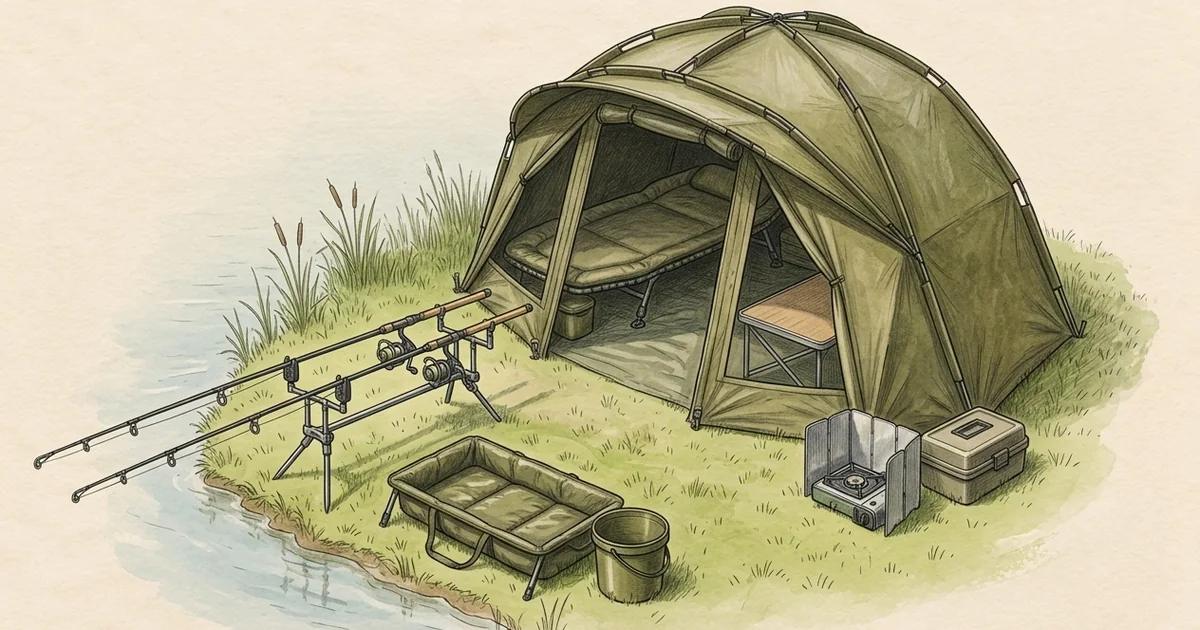
Each activity gets its own area, and the paths between them stay clear (Fig. 1).
| Zone | What goes there | What matters |
|---|---|---|
| Water’s edge | Rods on a rod pod or banksticks, landing net | within reach, nothing in front of it to trip over |
| Unhooking area | Unhooking mat, filled bucket, scales, weigh sling | everything right next to the mat, no searching at night |
| Sleeping area | Tent or umbrella, bedchair, table, lamp | Entrance facing the rods, back to the wind |
| Cooking and food | Stove, water, box with lid, rubbish bag | stable footing, away from anything flammable, downwind |
According to Fisch & Fang, scales, tape measure, a wet weigh sling and a filled bucket always belong near the unhooking mat. According to another article in the magazine, the tent should ideally stand with its back to the wind and its entrance facing the rods (Fisch & Fang). If the wind is coming off the water, you cannot have both. Pitching and guying out are explained in Fishing tent. Some federal states explicitly regulate how close to your rods you must stay; examples of supervision rules are given in Night fishing and weather shelter.
Table, organiser and groundsheet
Order on a night session above all means that every item lies in the same place at every new spot. That is how the Fisch-&-Fang author describes it. A bag system helps, he says, and everything around the bedchair and tent should always be put down in a similar way. Next to the head end of his bedchair stands a groundbait bucket as a “bedside table”: on it lies what he needs all the time: phone, boilie needle, stops and a small box for hooks and swivels.
A small camping table at the head end does the same job with more surface. On the bank, stability matters more than weight: individually adjustable legs level out sloping ground, and wide feet sink less into soft ground. A light-coloured surface helps in the dark. The author puts small items on a white cloth or in a shallow white bucket; both can still be seen without a lamp. Ready-tied hooklengths in a wallet save him tying them by torchlight; more on this under Rig box and rig board.
In winter a groundsheet under the tent makes a big difference, writes the British Angling Times. In a second article it advises sliding the dry unhooking mat under the bedchair as an insulating layer against the cold ground (Angling Times). The tip expressly does not apply to wet mats.
Tent floor and water rules: The water rules (Gewässerordnung) of the Landesanglerverband Brandenburg generally allow a weather shelter on the association’s waters, provided, among other things, it has no waterproof floor (tent floor) (No. 6.3, 2019 edition). This is a rule of the association for its own waters, not a state regulation. The text does not say whether a loose sheet underneath counts as a floor. Ask the association or the fishery manager before your session.
Light and markers for the night
The head torch needs a fixed place. The Fisch-&-Fang author hangs it above the bedchair in the struts of the umbrella; on waters with lots of bites he even wears it round his neck while asleep. With a head torch you have both hands free, which according to Blinker is much more practical than your phone’s light. Spare batteries for torch, bite indicators and camera belong in the kit. Since his head torch once fell into the water, the author always takes a second light; a small pocket torch is enough.
The Angling Times asks anglers to keep lighting to a minimum and not to shine it into other people’s tents on the far bank. The Fisch-&-Fang author uses the red light of his torch and reports from experience that fish in front of the landing net stay calmer than under glaring white light. Which lamp suits which purpose is covered under Head torch and Lantern and tent lamp.
What you cannot clear away, you mark. The author marks trip hazards such as a pole sticking out of the ground with a white cloth or a glow stick, because simply remembering the spot almost never works in the rush after a bite. On the landing net, a triangle of three glow sticks helps you find it straight away in the dark (Blinker). In the morning you collect every light again; notes on the luminous liquid and disposal are given under Glow sticks.
Cooking spot, windbreak and food
For a barbecue, the Berliner Feuerwehr (Berlin fire brigade) calls for a stable base, distance from flammable materials and attention to the wind direction so that no sparks or embers are blown about. For the camp plan this means: the cooking spot stands beside the tent on the downwind side, not between tent and rods where your path runs at night. The sources checked give no fixed number of metres. According to the same fire brigade, gas and charcoal barbecues never belong in enclosed spaces, because carbon monoxide forms and can poison you. So stove, barbecue and heater also stay outside the tent. Symptoms and the emergency number are under Fishing tent, types and fuels under Camping stove at the fishing spot.
If the open bank offers no shelter at all, the DAV says you can build a windbreak from stones, branches or twigs. At the stove, the windshield stands on the side the wind is coming from, as in Fig. 1.
Food attracts animals to your spot. Raccoons are omnivores, active mainly at dusk and at night, and happily make do with leftovers from bins, while foxes search specifically for edible waste, writes the Landkreis Oberhavel (Oberhavel district). The Landesjagdverband Berlin advises storing rubbish and waste out of reach and warns that animals used to being fed can become bold and aggressive. So overnight, food, bait and rubbish go into a sturdy box with a lid or into the car, not left open on the table. For your catch and drinks, a cool box is a good choice.
Checklist for setting up and packing down
Set up while it is light
- Walk the spot: ground level, no hollow, distance from the edge, no dry branches above you.
- On a river, check the nearest gauge. The author in Fisch & Fang clears driftwood from the bank so there are no snags during the fight.
- Rods, landing net and unhooking mat to the water’s edge, fill the bucket, put the scales and weigh sling next to it.
- Decide on the path to the bedchair and clear it, moving stones and branches aside.
- Tent or umbrella with its back to the wind, entrance facing the rods, pegs and guy lines tight.
- Table or bucket at the head end, hang up the lamp, spare light and batteries within reach.
- Cooking spot downwind beside the tent, food and rubbish bags into the box.
- Mark trip hazards with a cloth or glow stick, three glow sticks on the landing net.
Pack down without a trace
- Collect all glow sticks, including the markers and those on the landing net.
- Pack up rubbish, line offcuts and leftover groundbait; tip nothing into the water.
- Count the pegs so that none is left in the ground.
- Finally, search the ground around the bedchair, table and rod pod.
- Put back stones and branches you moved. The Angling Times gives leaving the spot as you found it as a rule for every kind of fishing.
Why cigarette ends, rubber bits and leftover groundbait harm the bank, and which containers belong in your bag, is explained in Leaving your fishing spot clean. What else comes along for a night is listed in the Night session packing list.
Legal pointer: Whether you may fish at night, pitch a tent, sleep in it or cook is governed by your federal state’s (Bundesland) fisheries, nature conservation and forest law, plus the water rules (Gewässerordnung) and your fishing permit (Erlaubnisschein). An overview is given in Night fishing and weather shelter, Camping and staying overnight at the fishing spot and Fires, barbecues and stoves on the bank. If in doubt, ask the club or the lower nature conservation authority (Untere Naturschutzbehörde).
Common mistakes
- Pitching camp under a tree with dry branches. Dead branches can break suddenly, after a drought even on trees that look healthy.
- Moving the tent up to the crumbling edge of the gravel pit. Banks can slip there. Only rods, landing net and the unhooking area belong by the water.
- Putting the cooking spot in the path or on the windward side of the tent. Sparks and embers drift with the wind, and at night you walk past it in the dark.
- Leaving food and rubbish open on the table. Raccoons and foxes are out at night and find every scrap.
- Marking trip hazards only in your head. After a bite the spot is forgotten. Put a cloth or glow stick on it.
Frequently asked questions
How far from the tent should the cooking spot be?
The sources checked give no fixed number of metres. For a barbecue, the Berlin fire brigade calls for a stable base, distance from flammable materials and attention to the wind direction. So place the stove so that the wind carries sparks away from the tent, and never inside it.
Do I need a camping table on a session?
Not necessarily; a bucket at the head end can hold the small items too. A table gives more surface. What matters is a level footing on a soft bank and a light-coloured surface.
Where should food go overnight?
Into a sturdy box with a lid or into the car. The Landesjagdverband Berlin advises storing waste out of reach of wildlife, because animals used to being fed can become bold.
Am I allowed to stay overnight at the fishing spot?
That is governed by your federal state (Bundesland), the water rules (Gewässerordnung) and your fishing permit (Erlaubnisschein). Examples from official texts are given under Camping and staying overnight at the fishing spot and Night fishing and weather shelter.
Related
- Night session packing list: what comes along for one or two nights by the water
- Fishing tent and carp bivvy: designs, orientation and carbon monoxide in the tent
- Camping stove at the fishing spot: gas, meths, solid fuel and wood
- Lantern and tent lamp: light at your spot without dazzling
- Glow sticks: bite detection, luminous liquid and disposal
- Night fishing: feeding times, bite detection and light colour
- Leaving your fishing spot clean: rubbish, leftover groundbait and toilet
- Line calculator: line breaking strain for your session
Sources
- Fisch & Fang: Nachtangeln auf Karpfen, 2018 (Platz bei Tageslicht, feste Ablageplätze, Eimer als Ablage, weißes Tuch, Kopflampe, Ersatzlicht, Markierungen, Rotlicht, Abhakplatz)
- Fisch & Fang: So fange ich!, 2014 (Zelt mit Rückseite zum Wind, Eingang zu den Ruten, Treibgut)
- Blinker: Immer in der Tacklebox: kleine Helfer, große Wirkung, 2026 (Stirnlampe, Knicklichter am Kescher), und Kescher am besten gummiert (Dreieck aus Knicklichtern am Kescher)
- Angling Times: The best winter carp fishing edges (Bodenplane), Winter fishing warning: how to keep your bivvy safe and warm (Abhakmatte unter der Liege) und The Ten Commandments of carp fishing (wenig Licht, Platz sauber verlassen)
- Deutscher Alpenverein: Materialkunde Zelte (ebener Lagerplatz, Mulden und Senken meiden, Windschutz)
- DLRG: Gefahren in Seen, Teichen und Kiesgruben (abrutschende Ufer)
- waldwissen.net: Besondere Gefahren infolge Totholz, nach Schweizerische Zeitschrift für Forstwesen 2009 (tote Äste und Stämme)
- Regierung Luxemburg, Naturverwaltung: Vorsicht im Wald: erhöhte Gefahren nach anhaltender Trockenheit und Hitze, 21.08.2026 (Äste, Pausen abseits von Bäumen, Sturm)
- Bundesministerium der Justiz: Bundeswaldgesetz § 14 (Betreten auf eigene Gefahr)
- VDE Ausschuss Blitzschutz und Blitzforschung: Blitzschutz beim Zelten und Campen (exponierte Stellen, Abstand zu Nachbarzelten)
- Berliner Feuerwehr: Grillen (fester Stand, Abstand zu Brennbarem, Windrichtung, Funken, Kohlenmonoxid in geschlossenen Räumen)
- Landkreis Oberhavel: Merkblatt zu Wildtieren in bewohnten Gebieten (PDF) (Waschbär und Fuchs fressen Abfälle) und Landesjagdverband Berlin: Nachbar Waschbär, 2013 (PDF) (Abfälle unzugänglich, futterzahme Tiere)
- Wasserstraßen- und Schifffahrtsverwaltung des Bundes: Pegelonline (Wasserstände der Bundeswasserstraßen) und Länderübergreifendes Hochwasserportal: Hinweise zum Internetangebot (Pegel der Länder, Warnungen)
- Landesanglerverband Brandenburg: Gewässerordnung, Ausgabe 2019 (Nr. 6.3, Zeltboden beim Wetterschutz)
Text AI-assisted, drawings AI-generated. Sources opened and checked in November 2026, no graphics taken from the sources.
All information is a guide only, without guarantee. Whether you may camp, stay overnight and cook on the bank is decided by state law, the water rules (Gewässerordnung) and your fishing permit (Erlaubnisschein); this text is no substitute for legal advice, information from the authority or medical advice.