
Knowledge · Fishing methods
Casting with a fixed-spool reel
When casting with a fixed-spool reel, your index finger holds the line until the rod has released its power at the front, and then slows the line again just before the bait lands. If you only cast for distance and never stop the line, you will often have a tangled hooklength in the water: the bait is lying there, but it won’t catch anything.
Grip, bail arm and the drop below the tip
The fixed-spool reel hangs below the rod, under your casting hand (Fischereiverein Löningen). Before the cast come three steps:
- Reel the bait up. The New York State environmental agency (DEC) recommends 15 to 30 centimetres between rod tip and float for beginners.
- Grip. Your hand holds the handle at the reel seat, with the reel foot between two fingers and the line lying over your index finger. That finger must reach the spool rim, because you will use it to slow the line later.
- Open the bail arm fully. If it snaps back during the cast, that is exactly the mishap the Bavarian exam questions tell you to avoid.
A long drop between tip and bait loads the rod more softly and slowly, a short one harder and faster, explains the British magazine Sea Angler. For heavy surf leads it gives half the rod length as a starting value, and the same length for every cast.
The overhead cast in four steps
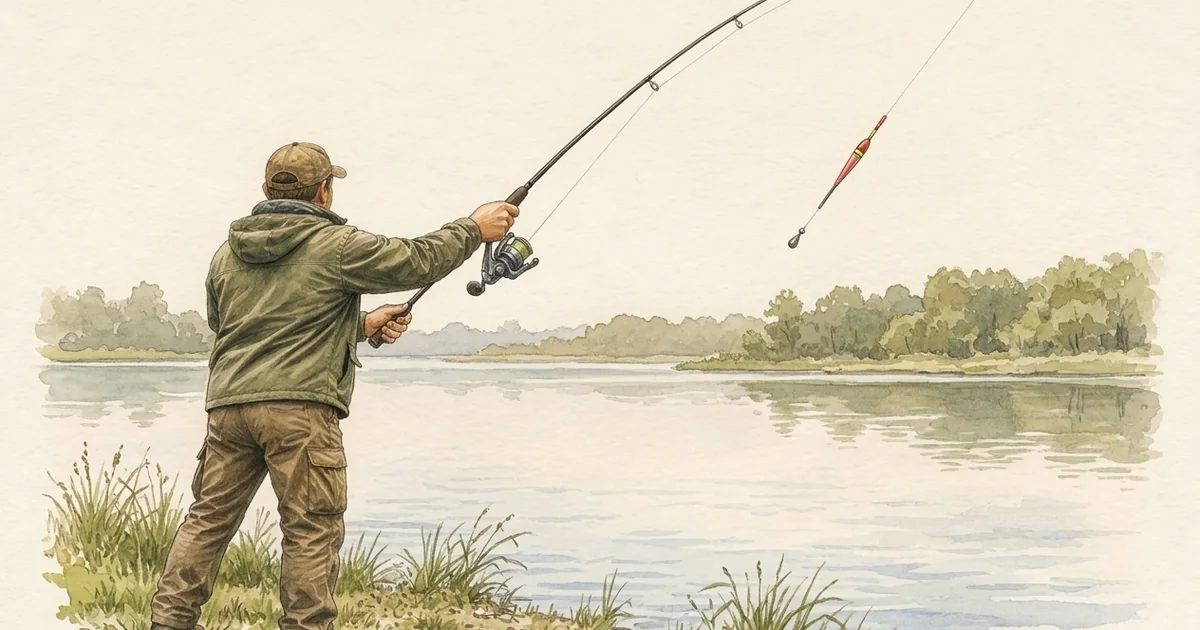
Before you cast, look behind you. The DEC beginner’s guide requires this so that nobody is standing behind you, and advises watching out for trees and bushes as well. Then comes the cast (Fig. 1):
- Swing back: The rod goes up smoothly and back over your shoulder. The DEC works from the wrist here, not with the whole arm.
- Accelerate: First the movement backwards, then forcefully forwards, writes Blinker. What you want is a flowing movement that loads the blank, not a yank on the rod.
- Release the line: Your index finger lets go while the rod moves forward in front of you. For its push-button reel the DEC gives roughly the ten o’clock position, with the rod still pointing diagonally upwards.
- Rod follows through: The rod keeps pointing in the direction of the cast until the bait drops, and your index finger is ready to slow the line.
Sources differ on when to let go. For a feeder cast with a swing tip, one Blinker author releases only at about three o’clock, almost horizontal, and holds the rod there until the rig lands. Releasing with the rod upright, he says, makes the cast jerky, the tip springs back and the rig tangles.
Underarm and side casts for tight spots
Under overhanging branches the rod stays low. With an underarm cast, a trout angler in Blinker puts a small crankbait under a bush by the water. In Texas-rig fishing for pike, pitching, which is also an underarm cast, counts as one of the basic casts (Blinker).
For a side cast you move the rod flat beside your body. One Blinker author works his way towards trees like this, because a first cast into the branches scares the fish away.
- Clear behind you, distance needed: overhead cast.
- Branches above you, target close: underarm cast.
- Trees behind you, room to the side: side cast; check beside you first.
Aiming and feathering
At the end of the cast you slow the bait down so that everything straightens out and enters the water without tangling. Ideally this happens just before it hits the water, writes Blinker. You aim with the same brake: if the bait is flying too far, you stop it short of reeds and trees. Without feathering, a treble on a lure easily catches in the leader, and with long float and ledger rigs the hooklength wraps around the main line (Fig. 2).
You brake at the spool. Blinker considers these methods practical:
- Index finger of the rod hand stretched to the spool rim: this works one-handed. With small hands or very large reels, the finger won’t reach.
- Palm or reeling hand against the side of the spool: the way out when your index finger can’t reach the rim.
- Don’t flip the bail arm over: that is an emergency stop. The bait springs back and, at worst, the line breaks.
Once the bait is in the water, close the bail arm by hand. If you close it by turning the handle, parts under the rotor suffer in the long run (Blinker). When reeling in, keep loose line slightly taut between thumb and index finger so that, according to the DEC, no loops form. Blinker lets a ledger rig with a Tyrolean stick (Tiroler Hölzl) sink on a taut line so that it reaches the bottom without tangling.
Rigs left lying: A ledger rig often stays out for a long time before you reel it in again. If it was cast without feathering, according to Blinker a tangled rig may be lying in the water the whole time, unable to catch anything. Feathering is therefore particularly worthwhile in bottom fishing.
Safety when casting
- Look behind and to the side: before every cast, even if nobody was there a moment ago. A Blinker article on surf fishing calls a fast-flying 180-gram lead a deadly weapon and warns about people walking by.
- Look up: The Bavarian angling exam (Fischerprüfung) requires you to keep your rod away from overhead power lines and to stop fishing in a thunderstorm. When you swing back, the rod reaches far above your head. Distances and what to do in an emergency are under Power lines and fishing rods.
- Wear glasses: Where baits are constantly flying through the air, a hook can end up in an eye. According to Blinker, polarised sunglasses also protect against stray baits and hooks.
- Protect your fingers: If you cast a braided shock leader, you need a casting glove or finger guard, according to Rute & Rolle; otherwise the thin line cuts into your index finger.
Note: What to do if a hook is in your skin or eye is explained under Hook injuries and first aid. This section does not replace medical advice.
What determines casting distance
- Rod length: A longer rod is a bigger lever. For long casts when spinning, Blinker gives 2,70 to 3,00 metres. More on choosing one under Spinning rod.
- Casting weight: This means the weight of the whole rig you cast (Blinker). If the bait is outside the range, the rod doesn’t load properly and the cast is shorter. If it is heavier, the rod may break.
- Line diameter: If braid has the same breaking strain as a monofilament line, it is thinner and suppler and creates less friction in the air and in the rings. The comparison is shown under Fishing line.
- Spool filling: Blinker recommends filling the spool to 1 to 2 millimetres below the rim. With too little line, according to Rute & Rolle, friction increases as the line comes off; with too much, bird’s nests are likely. How to get it right is explained under How to spool a reel properly.
- Release angle and bait shape: Blinker usually considers about 40 to 45 degrees the best angle. Compact baits fly further.
Common faults: cause and remedy
In the Saxon exam questions, a bird’s nest (Perücke) is line that has tangled during the cast. This table leads from the fault to the cause:
| Fault | Possible cause | Remedy |
|---|---|---|
| Bird’s nest in the cast | Spool too full | fill only to 1 to 2 mm below the rim |
| Loops after the cast | slack line reeled in without tension | keep the line slightly taut when reeling in |
| Hooklength wrapped around the main line | not feathered, released with the rod upright | brake just before landing, cast smoothly, use an anti-tangle tube on the bottom |
| Line breaks during the cast | bail arm snaps shut (emergency stop), weak knot, chafed line, damaged rings | open the bail arm fully, test the knot, cut back the line, check the rings |
| Bait in a tree or the reeds | braked too late | get your finger to the spool earlier |
According to the Saxon questions, the stiff tube on an anti-tangle lead keeps the hook rig apart. The same questions require a knot test before every fishing session and advise cutting off chafed line. Damaged rings damage the line (Bavaria), and chipped beads on a Texas rig nick the leader until it breaks during the cast (Blinker). According to Blinker, braid should go onto the spool much tighter than mono. For heavy leads on a thin main line there is the shock leader.
Once you have a bird’s nest on a fixed-spool reel, it is best to cut it off and retie, advises a Blinker article on line twist. The tangle is not left at the water, because it endangers birds and other animals, according to the Bavarian exam questions. How to dispose of line scraps is explained under Disposing of fishing line and hooks.
Frequently asked questions
How far should the bait hang below the tip before the cast?
For beginners the DEC gives 15 to 30 centimetres down to the float; for surf casting Sea Angler gives half the rod length.
May I close the bail arm by turning the handle?
Better not; in the long run, parts under the rotor can be damaged. Close the bail arm by hand.
Can I cast any weight with any rod?
No. Above the casting weight the rod may break; below it the rod doesn’t load and the cast stays short.
What do I do with a bird’s nest?
Cut it off and retie; take the scraps home with you.
Related
- Fixed-spool reel: design and bail arm
- How to spool a reel properly: fill level without twist
- Shock leader: for heavy leads
- Power lines and fishing rods: distances
- Spinning: after the cast
- Float rig: the rig from Fig. 2
- Knots: connections that survive the cast
Sources
- Blinker: Beim Werfen immer etwas abbremsen (Abstoppen, Verwicklungen)
- Blinker: Hohe Wurfweite (Weite, Bewegung)
- Blinker: Angelrolle, mehr als nur ein Schnurspeicher (Füllhöhe), Angelschnur aufspulen (Geflecht straff), Schnurdrall vermeiden (Perücke abschneiden), 9 Profitipps zur Rollenpflege (Bügel von Hand)
- Blinker: Angeln mit der Schwingspitze (Loslassen, ruckartiger Wurf), Forellen angeln mit Mini-Wobbler (Unterhandwurf), Forellenangeln im Waldsee (seitliche Würfe), Hechtangeln mit dem Texas-Rig (Pitching, Vorfach reißt)
- Blinker: Alles Wichtige für deinen Einstieg (Wurfgewicht), Tiroler Hölzl Montage (gespannte Schnur), Brandungsangeln (fliegendes Blei), Polarisationsbrille (Augenschutz)
- Bayerische Landesanstalt für Landwirtschaft: Prüfungsfragen zur Staatlichen Fischerprüfung 2023/2024 (Bügel, Ringe, Freileitungen, Schnurreste)
- Landesamt für Umwelt, Landwirtschaft und Geologie Sachsen: Prüfungsfragen Gerätekunde, Stand 06/2025 (Perücke, Knotenprobe, Wurfgewicht)
- Fischereiverein Löningen: Gerätekunde zur Fischerprüfung (Rolle unter der Wurfhand)
- New York State Department of Environmental Conservation: Fishing Basics (Abstand, Wurfablauf, Schnur spannen)
- Sea Angler: How to improve your casting skills (Länge unter der Spitze), How to beach cast, part 1 (gleiche Länge)
- Rute & Rolle: Brandungsangeln, 10 Tipps für mehr Meter (Fingerschutz)
Text AI-assisted, drawings AI-generated. Sources opened and checked in November 2026, no graphics taken from the sources.
All figures are guide values without guarantee; the safety section does not replace medical advice.