
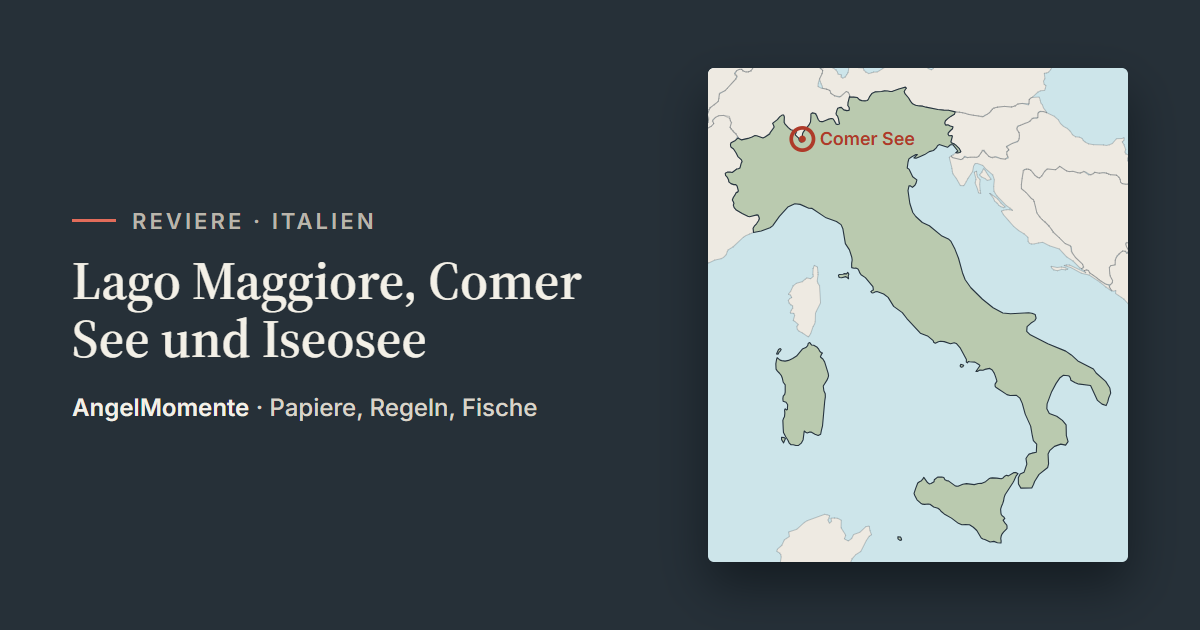
Waters · Italy
Fishing on Lake Maggiore, Lake Como and Lake Iseo
On Lake Maggiore, Lake Como and Lake Iseo you fish three of Italy’s great pre-Alpine lakes. Lake Como and Lake Iseo are regulated by Lombardy, Lake Maggiore by a commission staffed jointly by Italy and Switzerland. Here the German fishing licence is replaced by the type B licence (licenza di tipo B), a proof of payment that you can also get online as a guest.
- Papers
- Lombardy type B licence, plus catch log and association card depending on the lake
As of October 2026
At a glance
- Papers
- Lombardy type B licence, plus catch log and association card depending on the lake
| Fish | Minimum size | Closed season | Catch limit | Note |
|---|---|---|---|---|
| Whitefish (coregone) | 30 cm | 1.11.–31.1. | 8 per day | Maggiore: Bondella 25 cm; Como 30 cm, 1.11.–31.1., 10; Iseo 30 cm, 1.11.–15.1., 10 |
| Perch | 18 cm | 15.3.–31.5. | 25 per day | Como 16 cm, 15.3.–31.5., 30; Iseo 16 cm, 1.4.–15.5. |
| Pike | 45 cm | 15.3.–31.5. | 2 per day | Como 60 cm, 1.2.–15.4., 1; Iseo 60 cm, 1.3.–30.4., 2 |
| Zander | 40 cm | 15.3.–31.5. | 2 per day | Como 40 cm, 1.4.–31.5., 2 |
| European lake trout | 40 cm | 26.9.–20.12. | 3 per day | Maggiore together with char; Como 40 cm, 1.12.–15.1.; Iseo 30 cm, 1.12.–20.1. |
| Agone (twaite shad) | 20 cm | protected all year round | – | Fishing ban in the Italian part of Maggiore; Como and Iseo 15 cm, 15.5.–15.6. |
| Wels catfish | – | none | – | do not return at any of the three lakes, kill |
| Eel | – | protected all year round | – | Maggiore and Como protected, Iseo fishing ban 2026 |
Main values: Italian part of Lake Maggiore (commission and orders); Lake Como (district 5) and Lake Iseo (district 14) in the note. As of October 2026. The regulation and your fishing permit (Erlaubnisschein) take precedence.
Location and waters Lake Maggiore, Lake Como and Lake Iseo with rule booklets
Lake Maggiore (Verbano) covers 212 km² and is up to 370 m deep. Around 80 per cent of its area lies in Italy, spread over the provinces of Varese, Novara and Verbano-Cusio-Ossola; the rest belongs to Switzerland (Commissione italo-svizzera per la pesca).
Lake Como (Lario) measures 146 km² and, at 410 m, is the deepest lake in Italy. Its three arms meet off Bellagio, and the Adda flows in and out again. Lake Iseo (Sebino) covers 62 km² and lies between Bergamo and Brescia. The Oglio comes down from the Val Camonica and leaves the lake at Sarnico. In the middle lies Monte Isola, the largest lake island in southern and central Europe.
For Lake Como and Lake Iseo, the Lombardy region publishes a rule booklet (prontuario) for each fishing district, currently the 2026 edition: district 5 for Lake Como, district 14 for Lake Iseo. On Lake Maggiore, the rules of the Italian-Swiss commission apply on both Italian shores.
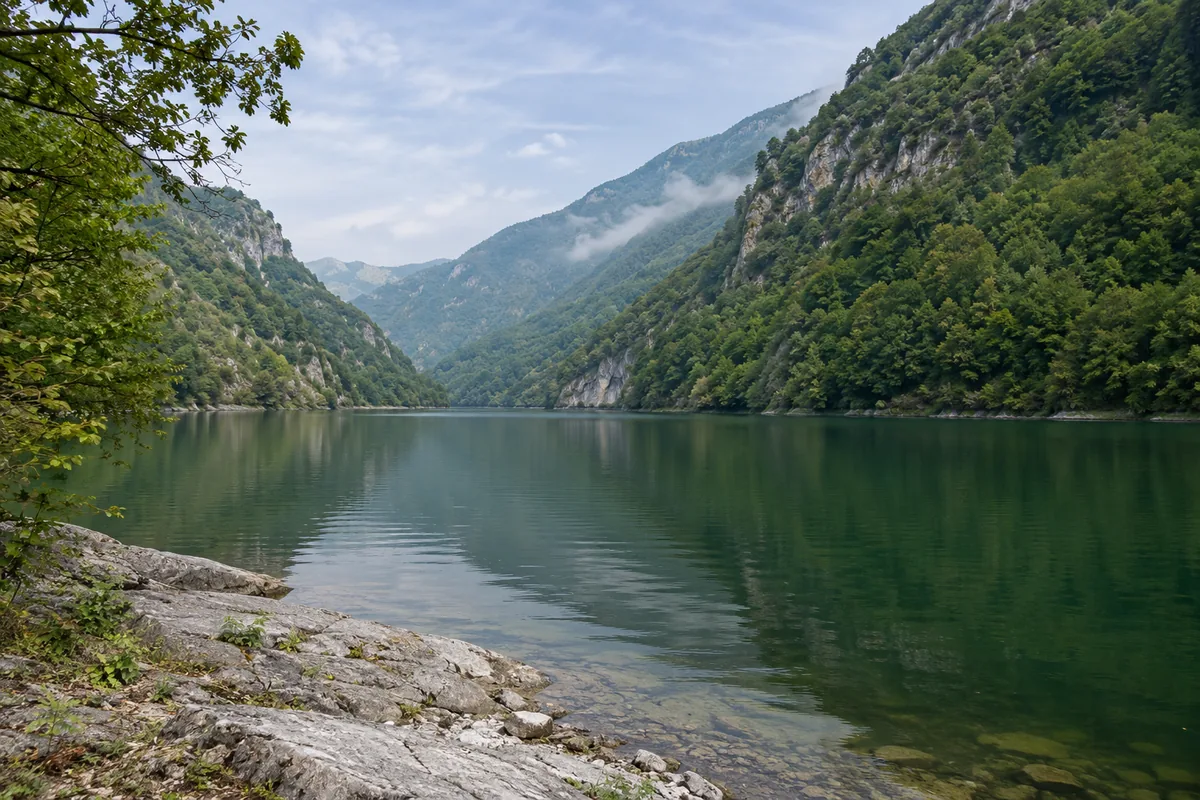
Fish and best time Whitefish, perch, zander, pike and lake trout
- Lake Maggiore: Whitefish (coregone, in the encyclopedia whitefish) made up more than half of the professional fishers’ catch in 2015. Add to that perch, zander, pike and lake trout. The wels catfish is spreading fast.
- Lake Como: According to a 2015 survey by Lombardy, perch, agone (the lake form of the twaite shad) and the whitefish species bondella are common, lake trout and zander moderately common.
- Lake Iseo: The most common fish is the rudd, followed by agone and the introduced roach. Perch is moderately common, pike less so.
The catch calendar shows which species bites when.
Papers and permit Lombardy type B licence, type D licence and FIPSAS card
The Lombardy type B licence is only the receipt for the regional fee of 23 euros. It is valid for twelve months from payment throughout Italy. As a foreigner you pay through the region’s PagoPA portal in the English version, where you do not need an Italian tax number. You carry the receipt and your ID while fishing. The exemption for under-18s and over-65s applies only to residents of Italy.
- Piedmont shore: Piedmont recognises licences from other regions, so the Lombardy type B licence is valid there too. Alternatively, foreigners can get the type D licence for three months.
- Swiss part: Under the agreement you need the licence of the state in which you fish. For the Swiss waters in the north, the canton’s patent applies, see Ticino.
- Lake Como: From the bank you also need the membership card of the FIPSAS angling federation and the catch log (tesserino segnapesci) of the water manager; from a boat you also pay an annual contribution to FIPSAS.
- Lake Maggiore: Throughout the Italian part you keep the catch log issued by the FIPSAS sections of Novara, Varese and Verbano-Cusio-Ossola. On the Lombardy shore, the FIPSAS card is required in the federation’s waters, and from a boat a contribution to the federation. Off Ranco and Angera, the municipalities issue the permit.
- Lake Iseo: The type B licence is enough here. In marked private fishing rights (diritti esclusivi) you need the owner’s permission.
Basics: Fishing licence and angling exam and Fishing permit and water card.
Special rules Closed seasons, rods, trolling and daily limits
- Lake Maggiore, closed seasons: They start and end at 12 noon. For pike, zander and perch the Italian commissioner has extended them, and in the Italian part his order applies. Grayling and bleak (alborella) are fully protected, and you kill every wels catfish immediately.
- Lake Maggiore, tackle and boat: At most two rods with ten baits in total. When trolling, six rods and 25 baits per boat are allowed. During the trout closed season, baits under 18 cm are banned, and during the pike closed season baits over 18 cm. From a boat you fish only from one hour before sunrise to one hour after sunset, from the bank also at night. Live sonar must not be on board.
- Lake Como: Once you reach the daily limit for pike or salmonids, you stop for the day. On any trout, pike, whitefish, perch, char, grayling and wels catfish you keep, you cut off the lower lobe of the tail fin before you carry on fishing. You do not return wels catfish or other non-native species.
- Lake Como, boat: Trolling is banned during the trout closed season, and the tirlindana (a trolling line with up to ten baits) during the perch closed season. During the zander closed season you may neither spin nor fish with deadbait from a boat within 100 m of the shore. At night you fish only from the bank, except in a few zones from 15 June to 30 September until midnight, where you return everything except wels catfish.
- Lake Iseo: Night fishing only from the bank for carp and wels catfish, with at most three rods. From 15 to 30 June you may keep agone only on Wednesdays, Saturdays and Sundays. The boat may be at anchor or under way.
As of October 2026. Lombardy updates its rule booklets regularly, and the Italian commissioner for Lake Maggiore changes closed seasons and catch limits by order. The Lombardy fisheries act with the district rules and the regulation of the Italian-Swiss commission, including its orders, take precedence.
Related
- Fishing on lakes, Fishing in Italy, Lake Garda, South Tyrol and Ticino
- Whitefish, perch, pike, lake trout and zander in the fish encyclopedia
- Closed season and minimum size explained and Stunning and killing a fish
- Boats and life jackets and Fishing from a cutter and boat
Sources
- Commissione italo-svizzera per la pesca: Regolamento di applicazione (gültig ab 1. Januar 2026), Anordnungen des italienischen Kommissars (Stand 15. März 2026), Abkommen über die Fischerei in den italienisch-schweizerischen Gewässern, Lago Maggiore und Fangbericht Lago Maggiore 2015
- Regione Lombardia: Esercizio della pesca mit den Regelheften Bezirk 5 (Verbano, Lario, Ceresio) und Bezirk 14 (Sebino) 2026 sowie dem Programma triennale della pesca (D.g.r. X/6133 vom 23. Januar 2017), Licenze di pesca A e B
- Regione Piemonte: Legge regionale 29 dicembre 2006, n. 37 und Licenza di pesca
- ARPA Lombardia: Stato delle acque superficiali, Laghi 2014 bis 2019
Guide without guarantee, as of October 2026. The regulation and orders of the Italian-Swiss fisheries commission for Lake Maggiore, the Lombardy fisheries act with the rules of districts 5 and 14, and the Piedmont fisheries act take precedence.