
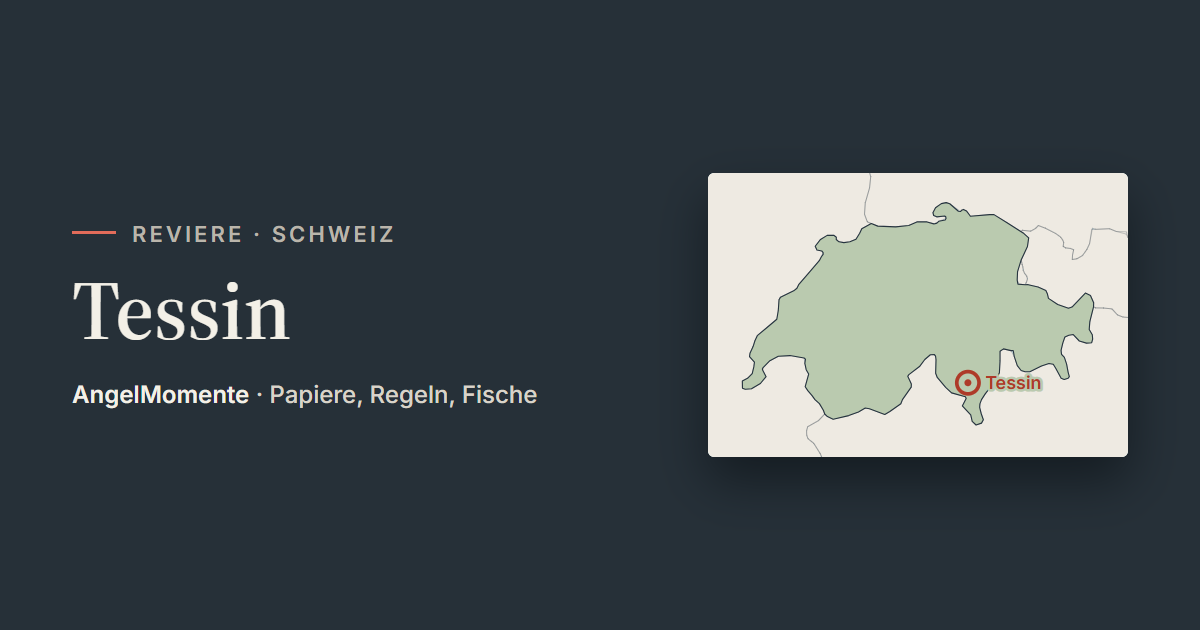
Destinations · Switzerland
Fishing in Ticino
In Ticino, Switzerland shares Lake Maggiore and Lake Lugano with Italy, along with the Ticino, Maggia and Verzasca rivers and a good ninety mountain lakes and reservoirs. With a short-term permit from the canton (Kurzpatent) you can fish the Swiss part of both lakes and the rivers, and you do not need a proof of competence (Sachkundenachweis) for it.
- Papers
- Canton permit, bank fishing too; short-term permit T without SaNa
- Season
- Lakes by species closed season; rivers 15.3. to the last Sunday in September
As of October 2026
At a glance
- Papers
- Canton permit, bank fishing too; short-term permit T without SaNa
- Licence and permit
- Season
- Lakes by species closed season; rivers 15.3. to the last Sunday in September
- Fishing seasons
- Lakes from the bank at any time, from a boat by monthly times
| Fish | Minimum size | Closed season | Catch limit | Note |
|---|---|---|---|---|
| Pike | 45 cm | 15.3.–30.4. | 2 per day | |
| Perch (pesce persico) | 18 cm | 1.4.–31.5. | 50 per day | |
| Zander | 40 cm | 1.4.–31.5. | 5 a day | plus temporary protected zones |
| Trout (lakes) | 40 cm | 26.9.–20.12. | 5 a day | with chars; rivers: brown trout 26 cm |
| Alpine char | 25 cm | 15.11.–24.1. | – | counts towards the 5 trout and chars |
| Whitefish | 30 cm | 1.11.–31.1. | 15 salmonids | Bondella 25 cm; Lake Lugano 15.11.–24.1. |
| Agone | 20 cm | 15.5.–15.6. | – | Eating fish from Lake Maggiore is limited |
| Wels catfish | – | none | – | must be killed |
| Grayling | – | protected all year round | – | Lake Maggiore; rivers only with permit D3 |
| Eel | – | protected all year round | – |
Values for the Swiss part of Lake Maggiore (Annex 1 RALCSP), deviations on Lake Lugano in the note. Italian law applies in the Italian part. As of October 2026. The regulation and your fishing permit (Erlaubnisschein) are what counts.
Location and waters Lake Maggiore, Lake Lugano and mountain lakes
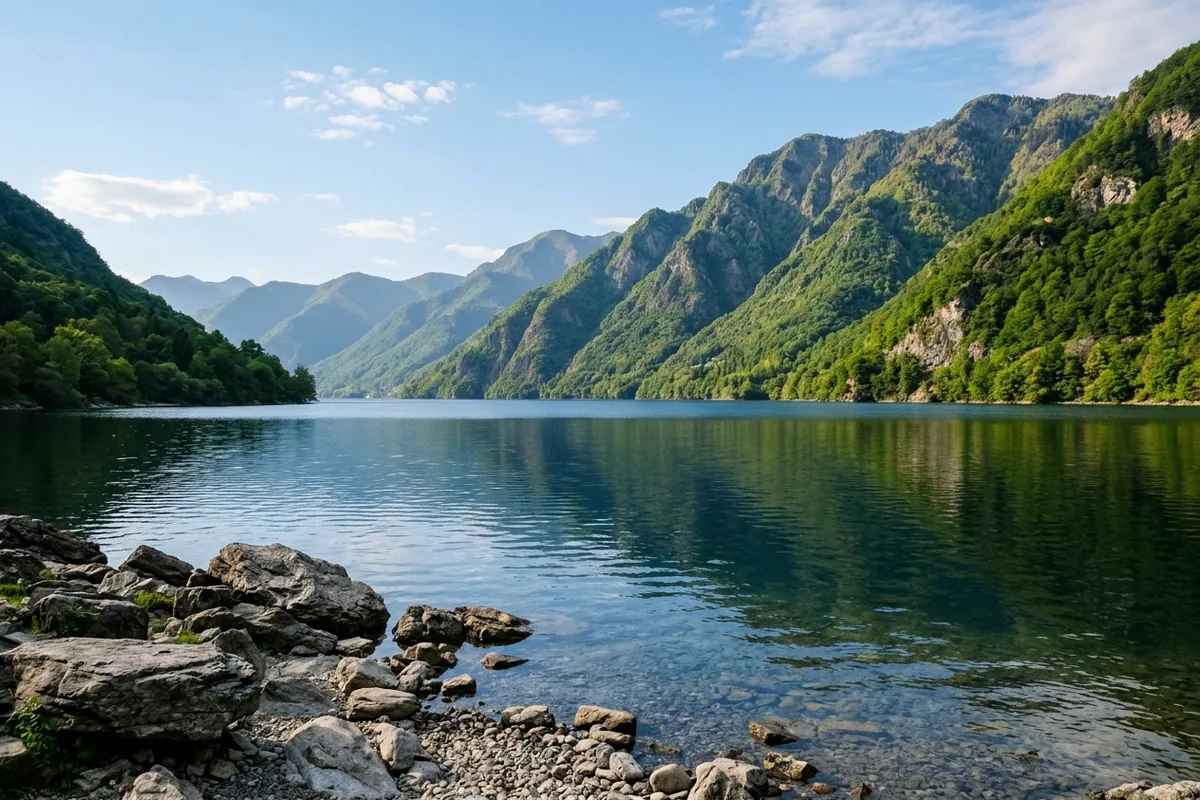
- Lake Maggiore (Verbano): 212,5 km², about 80 per cent of the lake surface lies in Italy. Lake Lugano drains into it via the Tresa.
- Lake Lugano (Ceresio): 48,9 km² on the border with Lombardy. The Melide causeway separates the north basin, up to 288 metres deep, from the south basin, at most 89 metres deep.
- Mountain lakes and reservoirs: 93 numbered waters, 83 of them above 1200 metres.
The 1986 fishing convention between Switzerland and Italy applies to both lakes and the Tresa. You need the licence of the state on whose territory you fish. The Ticino permit therefore applies only in the Swiss part; for the Italian part you need an Italian licence.
Fish and best time Pike, perch, zander, trout and char
What recreational anglers took in 2024, according to the canton’s catch statistics:
- Lake Maggiore: pike comes first, then perch, trout, agone, wels catfish and whitefish. Pike and perch make up a good half of the catch.
- Lake Lugano: Perch and zander make up three quarters of the catch.
- Rivers and mountain lakes: mainly trout and char. Grayling is allowed only with the additional permit D3 on top of the annual permit, in October and November on sections of the Ticino and Moesa.
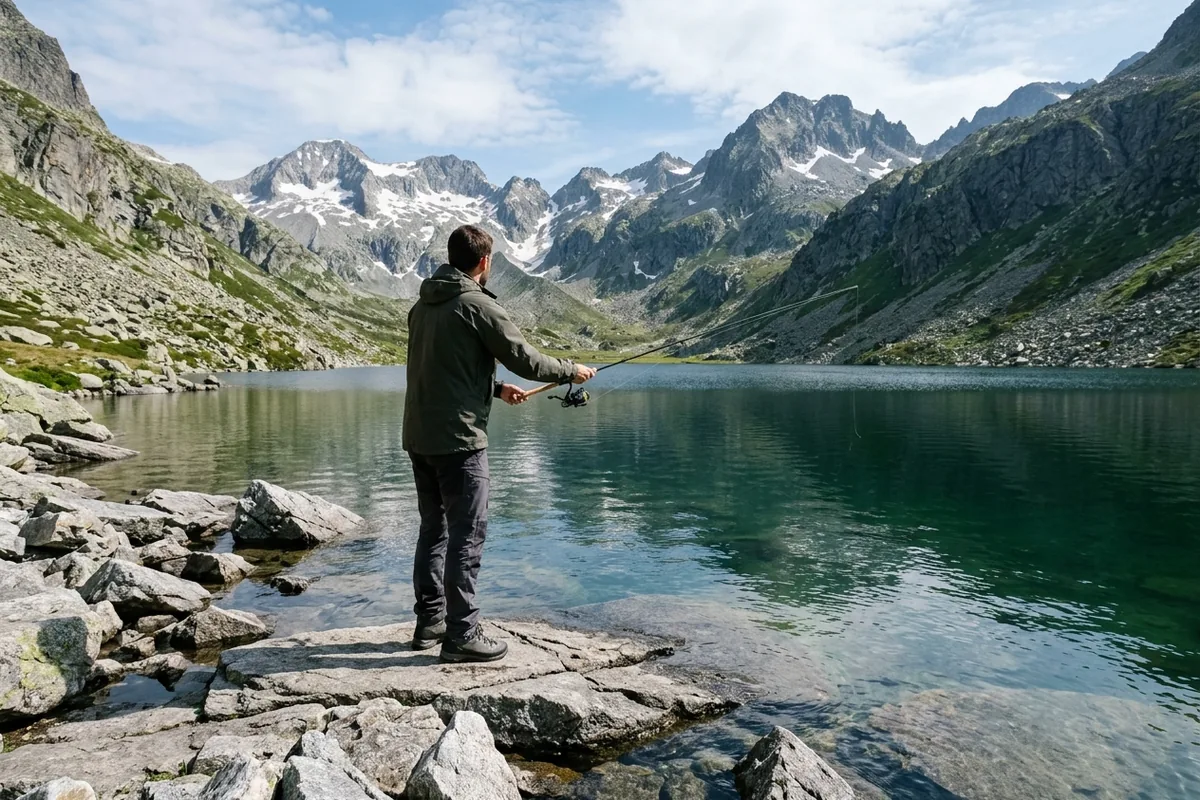
On the lakes the season follows the closed seasons of the species in the “At a glance” box. Rivers and lower mountain lakes are open from 15 March to the last Sunday in September, with short-term permit T1 only from 1 April. Above 1200 metres the season starts on the first Sunday in June and ends on the second Sunday in October. The catch calendar shows when each species bites.
Agone from Lake Maggiore accumulate pollutants. Children, teenagers and women of childbearing age should not eat them; everyone else should eat no more than 120 grams a week. Agone from Lake Lugano are considered safe.
Papers and permit Short-term permit T for 2 or 7 days, annual permit D
There is no German-style fishing licence (Angelschein) in Ticino. In all public waters you need the canton’s fishing permit (patente di pesca), including for bank fishing on the two large lakes.
- Short-term permit T: valid for 2 or 7 consecutive days. T1 is valid in all public waters, on the lakes also from a boat; T2 only from the bank of the two lakes.
- Annual permit D: from age 14 and only with a proof of competence (Sachkundenachweis, SaNa). You do not need one for the short-term permits.
- Issue: Short-term permits are available digitally via the cantonal Pesca TI app, at every municipal office in the canton and at the tourist offices on the canton’s list.
- Children: up to 8 years under the supervision of an adult with a permit, from 9 to 13 without a permit with their parents‘ consent and their own catch record book.
Always carry your permit, catch record book and ID. Enter any fish you keep before you leave your fishing spot, and from a boat before you land. More on this under Fishing licence and angling exam.
Special rules Closed seasons from 12 noon, killing non-native species, tackle
On Lake Maggiore and Lake Lugano, the annexes to the Ticino fisheries regulation apply. Minimum sizes, closed seasons and daily limits are in the box; closed seasons begin and end at 12 noon. Eel, bleak and pigo are protected in both lakes, and in Lake Maggiore grayling too. You may not catch native crayfish anywhere in the canton.
- Killing: You must kill wels catfish, largemouth bass, brown bullhead, ruffe and some other non-native species when you catch them (stunning and killing fish).
- Tackle on the lakes: Per person two rods with no more than ten lures in total; when trolling, six rods and 25 lures per boat. Live sonar is banned while fishing and on board. From the bank you may fish around the clock, from a boat only at the monthly times in the regulation.
- Barbs and bait fish: On the lakes the regulation allows barbed hooks on the rod and trolling tackle and live bait fish. Federal law allows both only with a proof of competence. With a short-term permit you therefore fish without barbs and without live bait fish.
- Rivers and mountain lakes: one rod and no groundbaiting, in rivers no barbs and no live bait fish. The brown trout must be 26 cm in rivers, 30 cm in the Ticino below Personico. You may keep six trout and char a day on rivers, three in the 30-cm sections, and 80 in the season. The marble trout is protected in running waters.
Closed all year round are the mouths of the Maggia, Ticino and Verzasca, zone A of the Bolle di Magadino and, in Lake Lugano, the mouths of the Cassarate, Laveggio, Magliasina and Vedeggio as well as the arches of the Melide causeway. During the zander closed season from 1 April to 31 May, zones around the Brissago Islands and in the Gulf of Locarno are added, and in Lake Lugano in the bays of Lugano, Agno and Capolago. These temporary zones are not marked on the ground. The exact boundaries are given in the protected zones decree, which you can find via the canton’s legal basis.
As of October 2026. The Ticino fisheries act, the regulation with its annexes, the 2025 to 2030 protected zones decree and federal law are what counts. Italian rules apply in the Italian part of the lakes.
Safety
Rain makes the Ticino rivers rise quickly. Many gorges are used by hydropower plants, where the amount of water can increase without warning. Follow the power plants‘ warning signs and do not camp on islands in the riverbed. Almost everyone who drowned in Ticino in 2025 was alone at the water. Emergency numbers: police 117 or 112, ambulance 144, Rega 1414. More under Bank and waders and Thunderstorms and weather.
Related
- Lake fishing and river fishing
- The Italian part of the lakes: Northern Italian lakes
- Fishing in Switzerland, neighbouring Graubünden with the Moesa, Lake Geneva and the Switzerland water atlas
- Closed season and minimum size explained
- In the fish lexicon: pike, perch, zander, lake trout, whitefish and grayling
Sources
- Konvention zwischen der Schweiz und Italien über die Fischerei in den schweizerisch-italienischen Gewässern (SR 0.923.51)
- Legge cantonale sulla pesca (LCSP) und Regolamento di applicazione (RALCSP) mit Anhängen 1 bis 3
- Decreto esecutivo concernente le zone di protezione pesca 2025-2030
- Ufficio della caccia e della pesca: Estratto normative 2026, Domande frequenti, Patente digitale, Punti di rilascio patente turistica 2026 und Statistica sul pescato 2024
- Bundesrecht: Tierschutzverordnung, Art. 23 und 97, und Verordnung zum Bundesgesetz über die Fischerei, Art. 5b
- CIPAIS: Lago Maggiore und Lago di Lugano
- Acque sicure: 6 regole per i fiumi und 6 pericoli
Guide without guarantee, as of October 2026. What counts is the fishing convention with Italy, Ticino fisheries law, federal law and the conditions in your permit and catch record book.