
Knowledge – Fish
Silver carp: Features, habitat, best time and baits
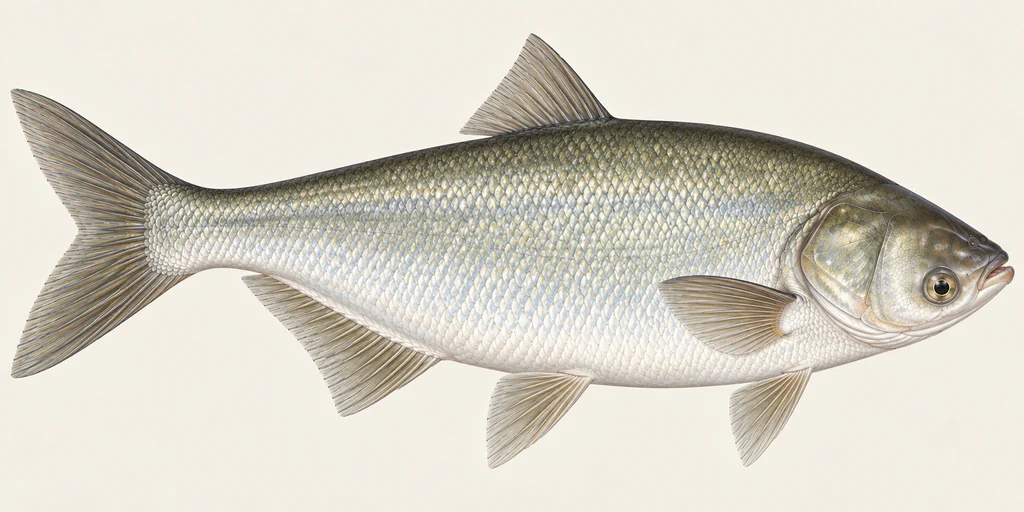
The silver carp (Hypophthalmichthys molitrix), also called tolstolob, comes from East Asia and arrived in Central Europe in the 1960s. It filters plankton out of open water and almost never takes a bait deliberately. It is mostly caught by accident when carp fishing or with a cloud of groundbait under a float.
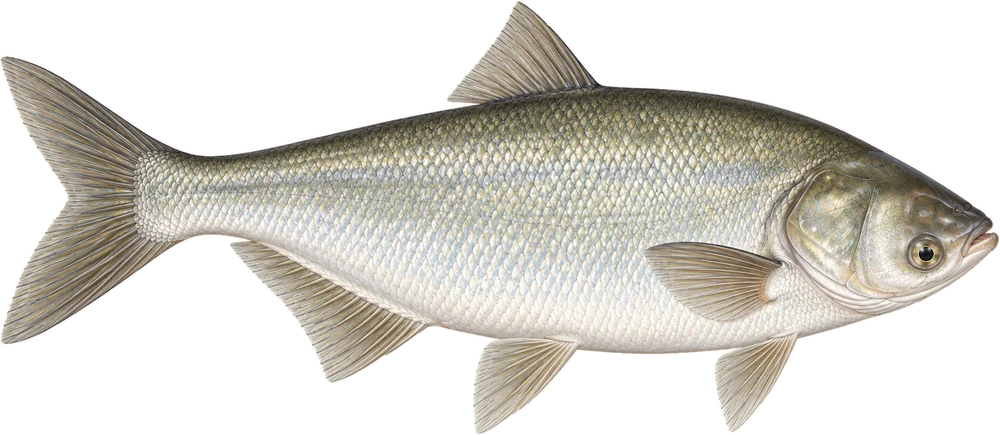
In short: The silver carp is most likely to take the hook from May to September, mostly as bycatch. Good spots on a lake: open water, the surface and weed beds; on a river: quiet bays and groyne pools. Plankton eater: the silver carp takes baits only by chance and can hardly be targeted. Non-native species; stocking and releasing are governed by state law. Step by step: Fishing for silver carp.
- Small eyes set below the middle of the head
- Large, strongly superior gape without barbels
- Sharp belly keel from the throat to the vent and a lateral line bowed downwards
Catch chances through the year
- Hardly any chance
- Possible
- Good
- Peak season
- Spawning (observe the closed season)
Editorial assessment for waters in Germany, not a measured value and no guarantee. Spawning time is not the same as the legal closed season.
Species profile and sources in the catch calendarAll species compared month by monthThe rules of your federal state
How to recognise it
The silver carp is an elongated, laterally flattened fish with small eyes set below the middle of the head. The large mouth slopes upwards and there are no barbels. The back is greenish grey, the flanks and belly shine evenly silvery and carry no spots. Along the middle of the body you count 110 to 124 conspicuously small scales.
The most reliable feature is on the belly. A sharp keel without scales runs from the chest to the vent, extending forward beyond the pelvic fins. Inside works a fine filter of fused gill rakers with 650 to 820 teeth. The mouth has no teeth.
Size figures vary. FishBase gives 120 centimetres as the maximum length and 50 kilograms as the highest published weight. The Saxon fisheries authority (Fischereibehörde) gives about one metre of body length for 50 kilograms. In ponds a silver carp weighs around one kilogram after three summers.
Most similar is the bighead carp. It is darker, looks heavier and has irregular dark spots on its flanks. Its belly keel runs only from the pelvic fins to the vent, and its gill rakers are clearly coarser with 240 to 300 teeth.
The grass carp also has low-set eyes, but a blunt snout, a dark green to greenish-black back and large scales with a dark net-like pattern. The eye position and the upward-pointing mouth alone tell the silver carp from the carp. Besides tolstolob the name silver amur (Silberamur) is also in use.
Side by side
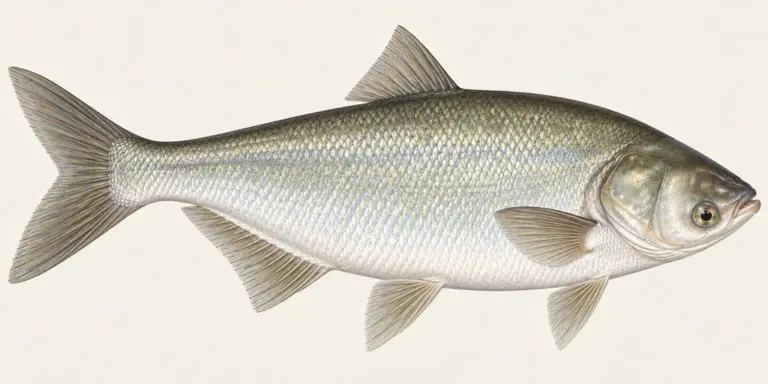
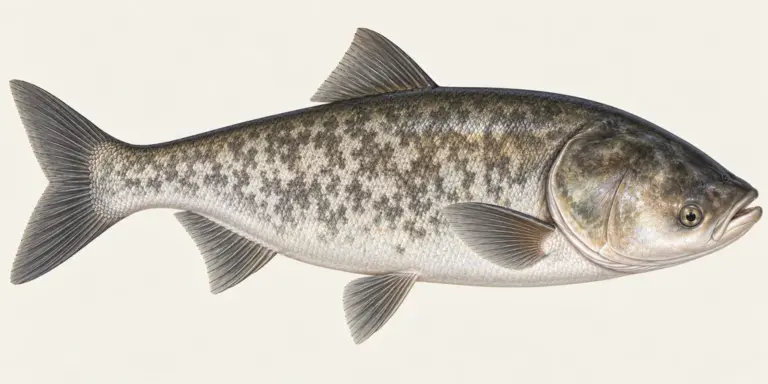
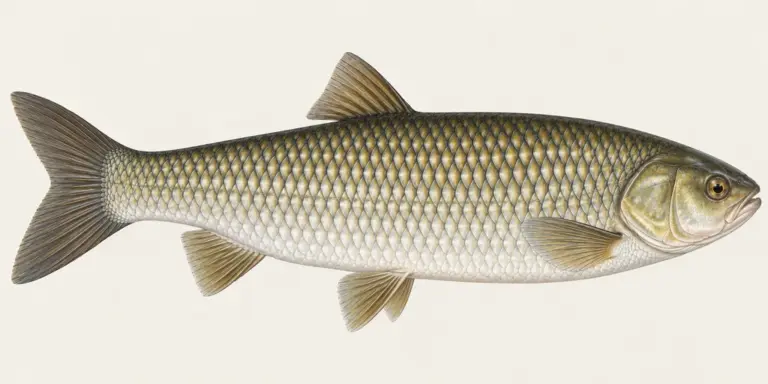
AI-generated illustrations.
Where it holds
The silver carp originally comes from several river systems of East Asia, from the Amur to the Pearl River. There the fish overwinter in the middle and lower stretches of the rivers and feed in summer in shallow, warm side waters with little current.
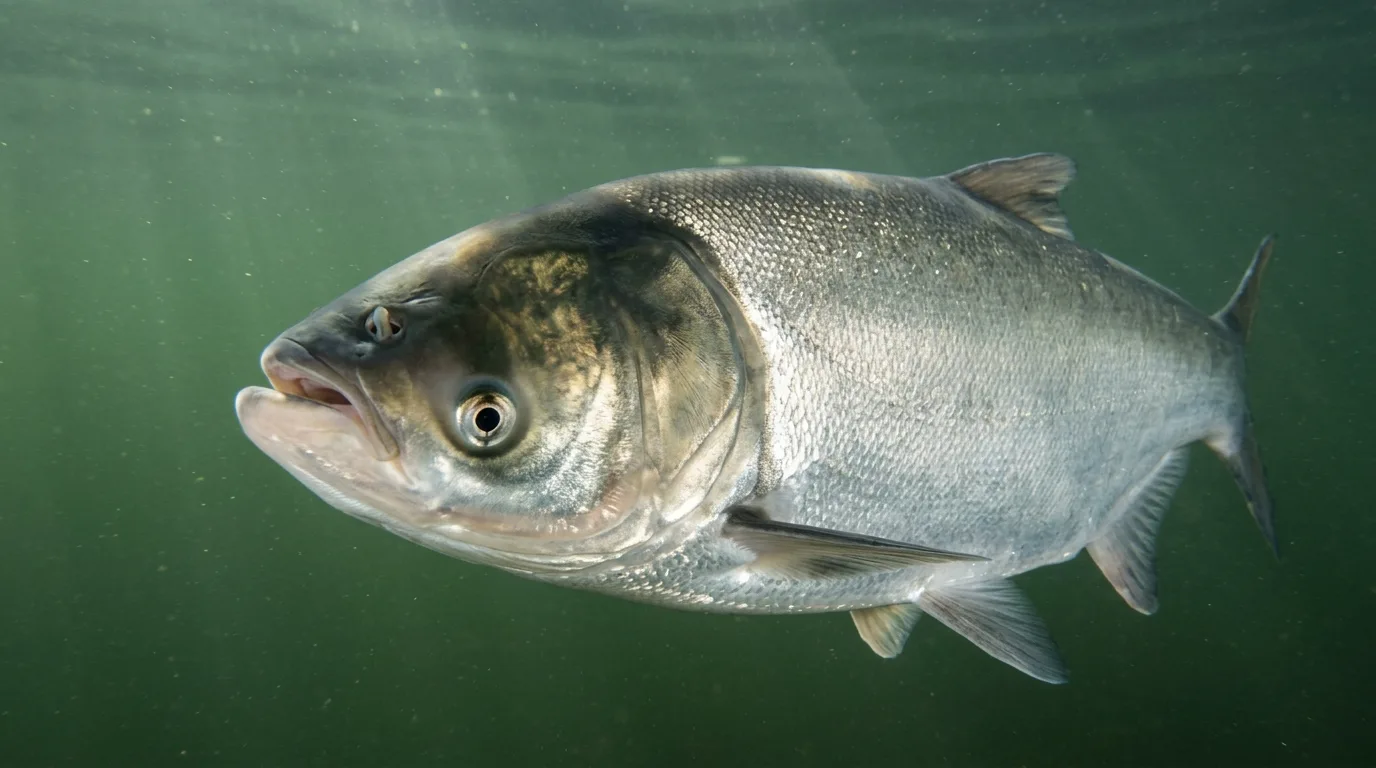
In Germany the stock goes back to stocking. The species was introduced into the Federal Republic in 1964 and into the GDR in 1965 to curb algae in nutrient-rich waters. In Saxony anglers still catch individual fish today in reservoirs, running waters and flooded opencast mine lakes, although stocking of open waters there has practically stopped since 1990.
According to Blinker, silver and bighead carp like to stay in weedy, naturally turbid water. In open water they stand just below the surface.
Holding spots in the picture
Choose the season and time of day: the picture shows where the species stands then. Spots outlined in red apply only in the chosen season. Tap a fish or a spot in the list to bring it closer. The picture is schematic and AI-generated, every water is different.
Chance of a catch in springslim
Catch chances in summerpossible
Catch chance in autumnhardly any
Catch chance in winterhardly any
- J
- F
- M
- A
- M
- J
- J
- A
- S
- O
- N
- D
Active time Silver carp are caught very irregularly spread over the day.
Active time Silver carp are caught very irregularly spread over the day.
Active time Silver carp are caught very irregularly spread over the day.
No main time Silver carp are caught very irregularly spread over the day.
In the lake
Water lilies and weed bed
Silver carp are found here all year round.
Open water
Silver carp are found here all year round.
Just below the surface
Silver carp are found here all year round.
The silver carp is a sociable open-water fish and often swims just under the surface. It likes to stay in cloudy water rich in plants and filters plant plankton there.
Spring: chances according to the catch calendar are slim in March and April, possible in May.
Summer: catch chances according to the catch calendar are possible. To feed it seeks out shallow areas above 21 °C with little current.
Autumn: catch chances according to the catch calendar are possible in September, slim in October and November. When the water temperature falls below about 13 °C it takes only the bare minimum.
Winter: catch chance according to the catch calendar hardly any.
In the river
Pools, deep spot
Silver carp are found here only in autumn and winter.
Groyne scour hole
Silver carp are found here only in spring, summer and autumn.
Calm bay with aquatic plants
Silver carp are found here only in spring, summer and autumn.
In rivers the silver carp prefers energy-saving spots in groyne fields and oxbows. It feeds in shallow, warm backwaters and on flooded areas with little current.
Spring: chances according to the catch calendar are slim in March and April, possible in May.
Summer: catch chances according to the catch calendar are possible.
Autumn: catch chances according to the catch calendar are possible in September, slim in October and November. In autumn the adult fish move to deeper spots in the main channel and no longer feed there.
Winter: catch chances according to the catch calendar are slim. It overwinters in the middle and lower river stretches.
Depth: According to FishBase it feeds in shallow water 0.5 to 1 metre deep. FishBase gives the depth range as 0 to 20 metres.
Size comparison: AI-generated drawing, schematic.
How it feeds and why it does not spawn here
The fry eat zooplankton, that is animal plankton. From a length of about five centimetres the silver carp switches to phytoplankton, plant plankton, which it sieves out of the water with finely fused gill rakers. According to the Saxon fisheries authority the filter retains particles between 4 and 80 micrometres, far finer than any bait.
It does not compete with the carp because it uses parts of the plankton that the carp does not take. The hope of lowering the overall amount of algae in lakes with silver carp did not come true, however.
It spawns only in large rivers, in strongly flowing, turbid water, above 15 °C and with a high oxygen content, and only when the water level rises quickly. In ponds the fish never spawn, and no spawning is known from reservoirs either. According to the Saxon authority even the Elbe has too little discharge. Natural recruitment is therefore not to be expected here.
Startled silver carp leap high out of the water. Noise and vibration from boat engines trigger this.
When it bites
In autumn the fish move into deep areas and do not feed in winter. That they do not stop entirely in the cold is shown by finds of full guts below 4 °C in the Missouri. Intake there is probably throttled, though.
The fishing time is the warm season, roughly from late spring to early autumn. Anglers report that bighead and silver carp can be caught very irregularly through the day. The fixed dusk phase of the carp is missing.
Rapid spring warming does not agree with the fish. In Saxon reservoirs large numbers of silver, bighead and grass carp died in the 1990s.
Today’s catch index needs JavaScript. Season and spawning time are in the catch calendar.
You will find the monthly overview of all species and the water temperature check in the catch calendar.
What you catch it with
Step by step: Fishing for silver carp: tips on bait, rigs and tackle – season, spots, baits, tackle and rules on one page.
With ordinary baits the silver carp can hardly be caught deliberately. It was long considered uncatchable, and the fish landed were mostly foul-hooked, that is hooked on the outside. That is not a proper catch. You unhook such fish at once and gently, as described on the page Landing and unhooking a fish.
More recent reports say that anglers now more often hook the fish properly in the mouth. The bait hangs on a small porcupine or wobbler float in mid-water, in the zone where the plankton feeders look for food (float rig, floats). You cast small balls of groundbait onto the float one after another, so that the bait hangs in a cloud of fine particles. The fish swim through it with their mouths open and at some point suck in the bait. A groundbait with a vanilla scent is popular. The bait has to be relatively small, such as popcorn or a bread flake.
When carp fishing, silver and bighead carp mostly take floating boilies, so-called pop-ups. They are said to fight hard when played, so the tackle can be one size stronger than for grass carp. You need a large landing net to land them, and the fish belongs on a soft unhooking mat.
Plan for it as bycatch: Anyone fishing for carp in a stocked water should choose line, rod and landing net so that an unexpectedly large silver carp can also be landed safely.
Check where the hook sits: A fish hooked in the mouth is a cleanly caught fish. Silver carp hooked on the outside you unhook at once and return carefully.
Allow for leaps: The fish reacts to engine noise with leaps. On a boat you should be prepared for an impact and protect your face and cameras.
Suitable lures
A very small bait such as a bread flake or popcorn, offered in mid-water in a cloud of groundbait.
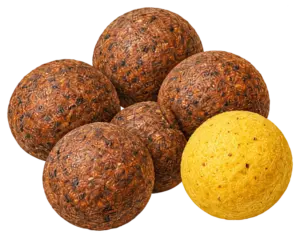
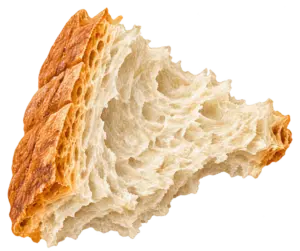
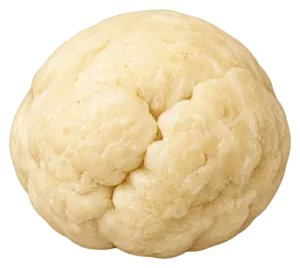
AI-generated illustrations. A click opens the lure’s page.
Rigs for these baits: running leger rig, float rig.
Plankton filter feeder: the bait is sucked in only by chance, deliberate catches are rare.
How the silver carp does in the kitchen and how to remove the bones
In China the silver carp is regarded as a tasty food fish and mostly reaches the table fresh there. Its flesh is firm, white and flaky and does not have the strong taste of darker carp meat. In Saxony pond farmers sell it live-fresh or cold smoked as “fisherman’s ham” (Fischerschinken).
The catch is the many Y-bones that lie in the fillet in two rows above and below the lateral line. A strip of dark red meat also runs along the lateral line, which you cut out. Of the whole fish only about a fifth to a quarter is left as fillet. Scoring only helps with small fish up to around one kilogram; in larger ones the bones are too long for it. There, when filleting, you cut strips between the bones without severing them and pull them out after cooking.
What you need to observe
The silver carp is non-native in Europe. According to the guideline of the Saxon fisheries authority (Fischereibehörde) it is not on the EU Union list of invasive species. The Bundesamt für Naturschutz lists it as unestablished and potentially invasive on its action list. Stocking and release of non-native fish are governed by state law and the water’s rules. In Saxony, for example, stocking open waters requires a permit from the fisheries authority.
Closed seasons (Schonzeit), minimum sizes (Mindestmaß) and harvest slots are set by the federal states (Bundesland). They differ by water and time of year. That is why we give no figures: what is binding is the fisheries regulation of your federal state and your fishing permit (Erlaubnisschein). You will find a list of links to the official sources in the catch calendar.
A fish that you may take and want to keep you stun and kill straight away in line with animal welfare (Stunning and killing fish). Protected fish, undersized fish or fish too large under a harvest slot you return gently to the water with wet hands (Releasing fish).
What closed season, minimum size and harvest slot mean and where to find them is explained on the page Closed season and minimum size explained.
Frequently asked questions (FAQ)
Why does the silver carp not bite on normal baits?
It filters tiny plankton out of the water and does not look for individual morsels of food. It sucks in a bait only by chance, most likely when it is hovering in the middle of a cloud of groundbait.
How do I tell silver carp from bighead carp?
The silver carp is evenly silvery, the bighead carp darker and spotted. In the silver carp the belly keel reaches far forward to the chest, in the bighead carp it only starts at the pelvic fins.
Does the silver carp breed here?
No. It needs large, rapidly rising rivers with a strong current to spawn. It does not spawn in ponds and reservoirs; the stocks come from stocking.
Sources
The rating of catch chances is an editorial assessment. The facts come from these sources, and the text is worded in our own words. The illustration is an original design by Angel Momente in the style of a natural history plate (AI-generated, see the AI notice).
- FishBase: Hypophthalmichthys molitrix (Nutzung)
- Sächsisches Landesamt für Umwelt, Landwirtschaft und Geologie: Leitlinien für die Nutzung von Silberkarpfen und Marmorkarpfen in Aquakultur und Fischerei
- U.S. Geological Survey: Nonindigenous Aquatic Species Database, Hypophthalmichthys molitrix
- Kolar et al. (U.S. Geological Survey): Asian Carps of the Genus Hypophthalmichthys, Biological Synopsis and Environmental Risk Assessment (Temperaturgrenzen)
- Bundesamt für Naturschutz: Gebietsfremde Fische, naturschutzfachliche Invasivitätsbewertung
- Blinker: Steckbrief Grasfische (Silber- und Marmorkarpfen: Größe, Nahrung, Fangmethode)
- Wikipedia: Silberkarpfen (Merkmale, Größe, Nahrung, Laichbedingungen)
- Spektrum Akademischer Verlag: Lexikon der Biologie, Tolstoloben
- Missouri Department of Conservation: Carp Lemonade (Missouri Conservationist, Juli 2004)
Created with AI support from the sources listed. Figures only appear in the text if a source gives them. Last updated: 27 October 2026. Found a mistake? Write to us. Who is behind this site: About me.
More in the lexicon
- All fish species at a glance
- Catch calendar – month, water temperature and profile for 93 species
- Line calculator – breaking strain after the knot, drag guideline, backing
- Angling methods