
Knowledge – Fish
Bighead carp: Features, habitat, best time and baits
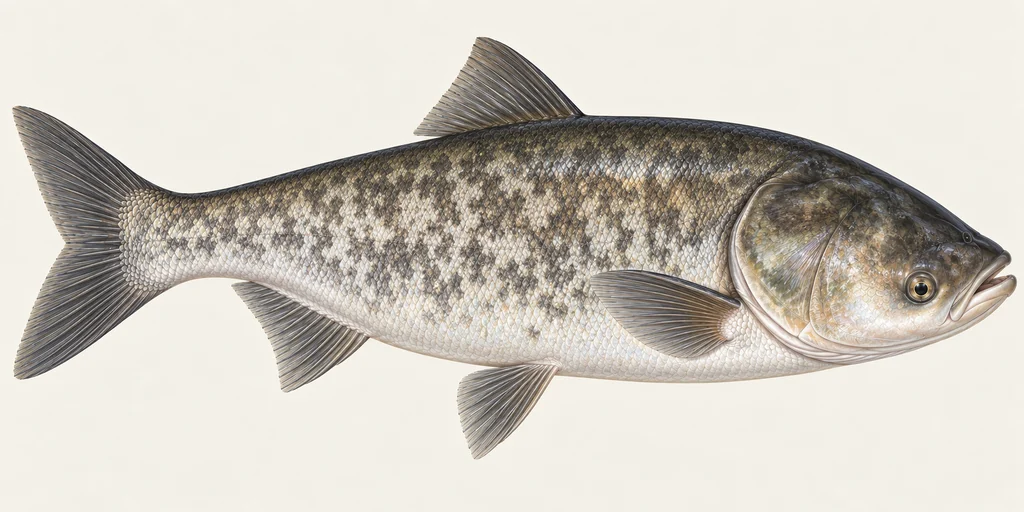
The bighead carp (Hypophthalmichthys nobilis) is a heavy open-water fish from China that came to Europe in the 1960s. It filters mainly zooplankton from the water and therefore hardly takes anglers‘ baits. In Central Europe it does not reproduce naturally; all fish come from stocking.
In short: The bighead carp is most likely to take the hook from June to September, mostly as bycatch. Good spots on a lake: open water, the surface and weed beds; on a river: quiet bays and groyne pools. Plankton eater: the bighead carp takes baits only by chance and can hardly be targeted. Non-native species; stocking and releasing are governed by state law. Step by step: Fishing for bighead carp.
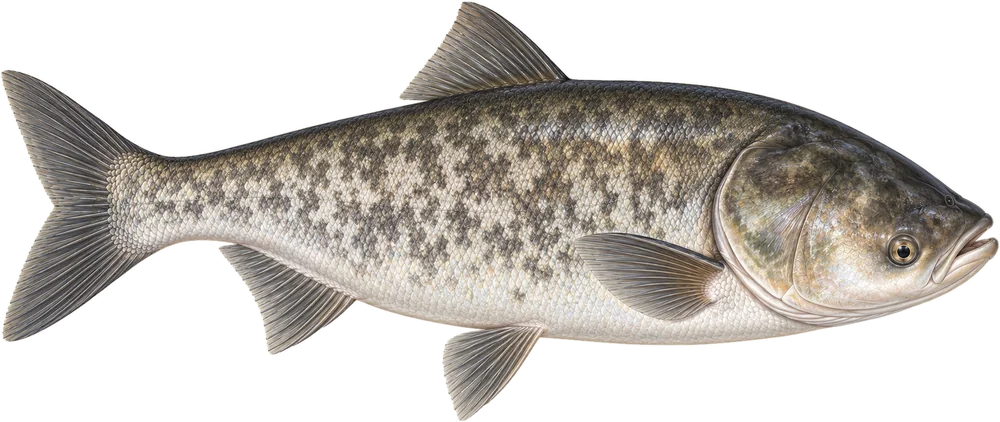
- Small eyes set below the middle of the head and a large, superior mouth
- Belly keel only between the pelvic fins and the vent
- Dark, irregular spots on the flanks
Catch chances through the year
- Hardly any chance
- Possible
- Good
- Peak season
- Spawning (observe the closed season)
Editorial assessment for waters in Germany, not a measured value and no guarantee. Spawning time is not the same as the legal closed season.
Species profile and sources in the catch calendarAll species compared month by monthThe rules of your federal state
How to recognise it
The bighead carp is a large, heavy fish with a large, scaleless head. The eyes sit far forward and low on the head and look obliquely downwards. The mouth is large and has no teeth, and the lower jaw protrudes. Barbels are absent. The body is dark grey and becomes lighter towards the belly. On the flanks there are large, irregular dark spots, which give it its name.
A smooth keel runs along the belly, reaching only from the pelvic fins to the vent. Its gill rakers with 240 to 300 teeth are clearly coarser than those of the silver carp.
Size figures differ. FishBase gives 146 centimetres and 40 kilograms as maximum values and 60 centimetres as the common length. The Saxon fisheries authority (Fischereibehörde) gives 146 centimetres and 77,5 kilograms from the literature. Blinker reckons with rather 1,50 metres at about 50 kilograms in Europe.
The bighead carp is often confused with the silver carp. The silver carp is evenly silvery and unspotted, its keel extends beyond the pelvic fins towards the chest. In the bighead carp the keel ends at the pelvic fins.
The spotted pattern, the large upward-facing mouth and the lower-set eyes tell it from the grass carp. Anyone with a fish on the hook that has conspicuously small, deep-set eyes and a large head should first check the belly keel and the colouring.
Side by side
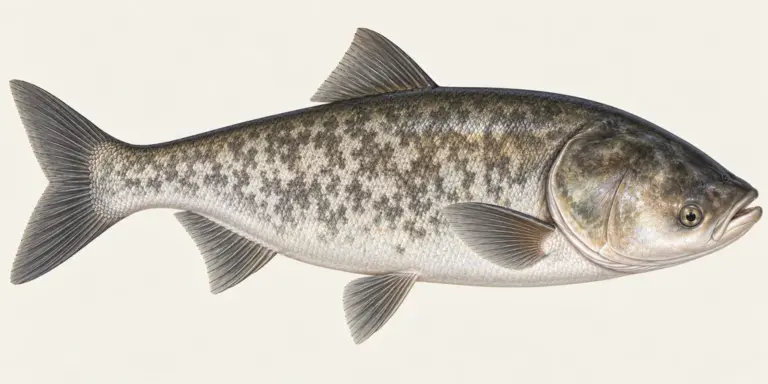
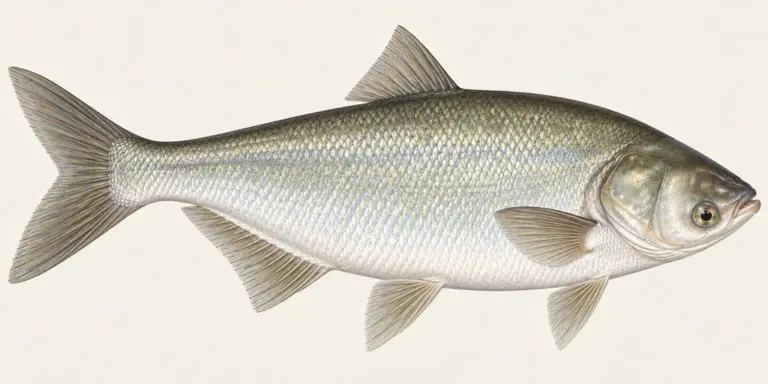
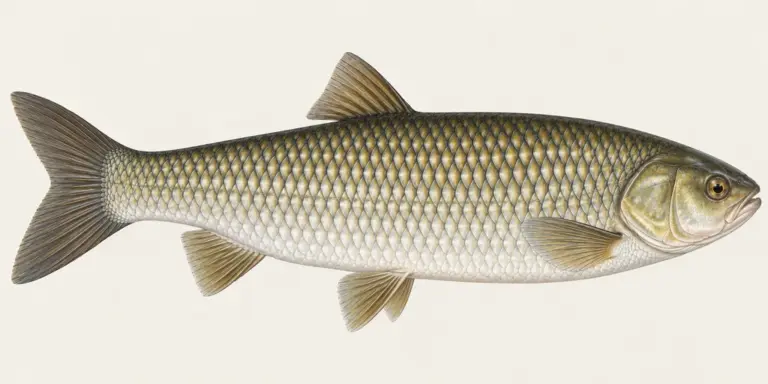
AI-generated illustrations.
Where it holds
The bighead carp comes from southern and central China. In Europe it was put into large rivers, lakes and ponds. It lives in open water and usually roams in small shoals.
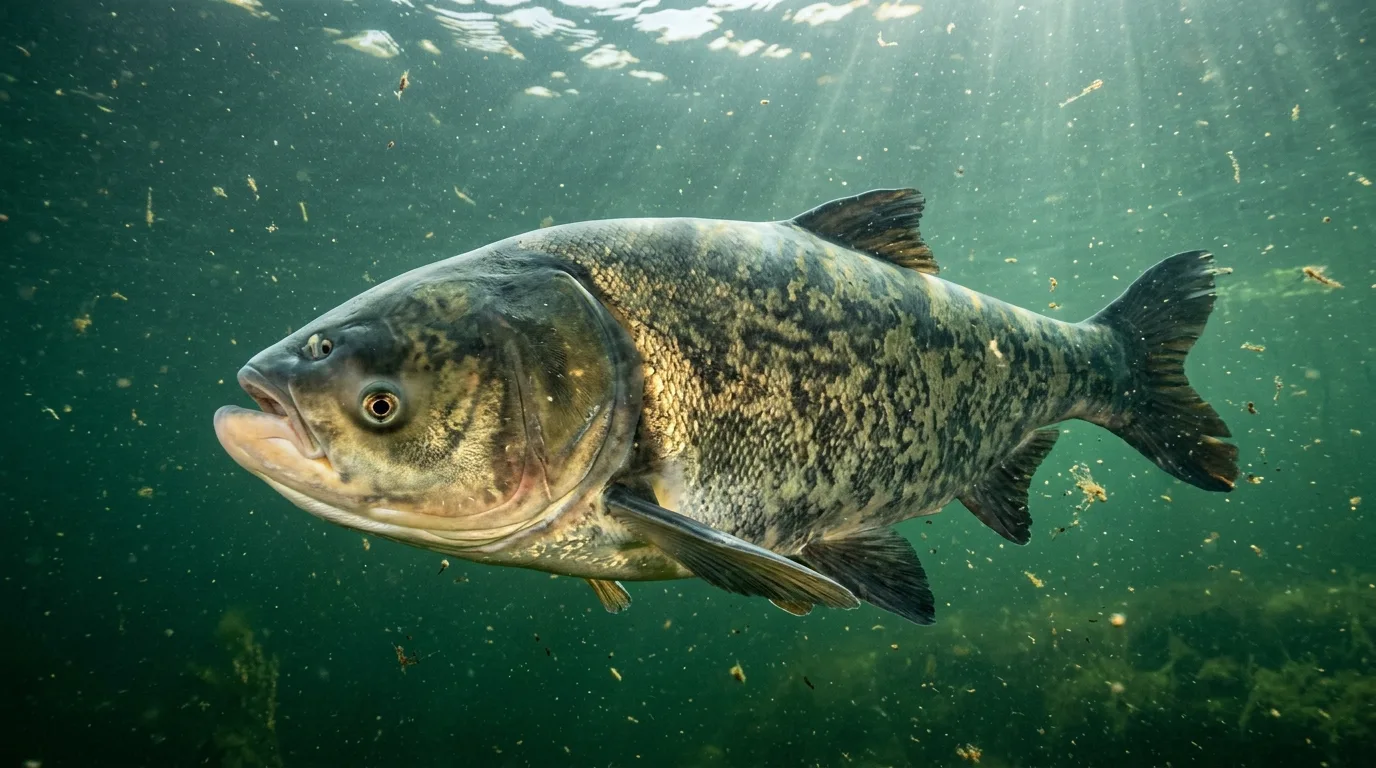
To feed it seeks out shallow, warm side waters, lakes and flooded areas with little current, according to FishBase at over 24 °C at depths of 0,5 to 1,5 metres. When the water temperature falls to about 10 °C in autumn, the fish form large shoals and migrate downstream into deeper parts of the main channel to overwinter.
According to Blinker, silver and bighead carp like to stay in weedy, naturally turbid water. In Saxony anglers still catch individual fish today in reservoirs, running waters and flooded opencast mine lakes, although stocking of open waters there has practically stopped since 1990.
Holding spots in the picture
Choose the season and time of day: the picture shows where the species stands then. Spots outlined in red apply only in the chosen season. Tap a fish or a spot in the list to bring it closer. The picture is schematic and AI-generated, every water is different.
Chance of a catch in springslim
Catch chances in summerpossible
Catch chance in autumnhardly any
Catch chance in winterhardly any
- J
- F
- M
- A
- M
- J
- J
- A
- S
- O
- N
- D
Active time Bighead carp are caught very irregularly spread over the day.
Active time Bighead carp are caught very irregularly spread over the day.
Active time Bighead carp are caught very irregularly spread over the day.
No main time Bighead carp are caught very irregularly spread over the day.
In the lake
Water lilies and weed bed
Bighead carp are found here all year round.
Open water
Bighead carp are found here all year round.
Just below the surface
Bighead carp are found here all year round.
The bighead carp is a sociable open-water fish, usually moving in small shoals. It often circles just under the surface and likes to stay in cloudy water rich in plants. There it filters zooplankton out of the water.
Spring: chance of a catch according to the catch calendar slim.
Summer: catch chances according to the catch calendar are possible. To feed it seeks out shallow areas above 24 °C with little current.
Autumn: catch chances according to the catch calendar are possible in September, slim in October and November. When the water temperature falls below about 13 °C it takes only the bare minimum.
Winter: catch chance according to the catch calendar hardly any.
In the river
Pools, deep spot
Bighead carp are found here only in autumn and winter.
Groyne scour hole
Bighead carp are found here only in spring, summer and autumn.
Calm bay with aquatic plants
Bighead carp are found here only in spring, summer and autumn.
In rivers the bighead carp prefers energy-saving spots in groyne fields and oxbows. It feeds in shallow, warm backwaters and on flooded areas with little current.
Spring: chance of a catch according to the catch calendar slim.
Summer: catch chances according to the catch calendar are possible.
Autumn: catch chances according to the catch calendar are possible in September, slim in October and November. When the temperature falls to about 10 °C, the fish move downstream in large shoals to deeper spots in the main channel.
Winter: catch chances according to the catch calendar are slim. It overwinters in deep spots in the middle and lower river stretches.
Depth: According to FishBase it feeds in shallow water 0.5 to 1.5 metres deep.
Size comparison: AI-generated drawing, schematic.
How it feeds and why it does not spawn here
The bighead carp is a filter feeder. Its gill rakers sieve mainly larger zooplankton out of open water, plus algae. It does not look for individual morsels of food. When this was noticed in the 1960s it turned out to be unsuitable for controlling water plants.
Because its filter is coarser than that of the silver carp, it takes the same zooplankton as the carp. The Saxon fisheries authority therefore rates it as a direct food competitor of the carp. Under our conditions it grows quickly and reaches roughly the piece weight of a carp in three summers.
To spawn the species needs very warm, turbid water above 18 °C, usually 22 to 30 °C, with a strong current and a rising water level. We do not have that. It never spawns in ponds, and no spawning has become known in Saxon reservoirs either. Natural recruitment is not to be expected in Central Europe.
Unlike the silver carp it rarely leaps. Occasionally it jumps a short way out of the water when spawning or when electrofished.
When it bites
Most bighead carp are caught in the warm season. Anglers report that bighead and silver carp can be caught very irregularly through the day.
In the cold season the fish stay deep and eat less. It is not entirely without catches, though: according to Fisch & Fang, bighead carp also take small fish in winter when plankton is scarce and are then regularly caught on artificial lures; the German record fish bit at the end of November. Whether such fish bit or were foul-hooked often remains open. Where warm water is discharged, for example in the warm-water plumes of power stations, grass carp bite all year round according to Blinker.
Rapid spring warming can harm the fish. In Saxon reservoirs large numbers of silver, bighead and grass carp died in the 1990s.
Today’s catch index needs JavaScript. Season and spawning time are in the catch calendar.
You will find the monthly overview of all species and the water temperature check in the catch calendar.
What you catch it with
Step by step: Fishing for bighead carp: tips on bait, rigs and tackle – season, spots, baits, tackle and rules on one page.
With ordinary baits the bighead carp can hardly be caught deliberately. It was long considered uncatchable, and the fish landed were mostly foul-hooked, that is hooked on the outside. That is not a proper catch. You unhook such fish at once and gently, as described on the page Landing and unhooking a fish.
More recent reports say that anglers now more often hook the fish properly in the mouth. The bait hangs on a small porcupine or wobbler float in mid-water, in the zone where the plankton feeders look for food (float rig, floats). You cast balls of groundbait onto the float one after another, so that the bait hangs in a cloud of fine particles. The fish swim through it with their mouths open and at some point suck in the bait. It has to be relatively small, such as popcorn or a bread flake.
When carp fishing, bighead and silver carp mostly take floating boilies, so-called pop-ups. The tackle can be one size stronger than for grass carp. You need a large, deep landing net to land them, and the fish belongs on a soft unhooking mat. The mouth has no teeth, a disgorger is enough (disgorger).
Keep expectations low: Do not plan a fishing day around bighead carp alone. See it as possible bycatch when carp fishing, especially in warm waters with old stocking.
Strong tackle, clean landing: The fish are heavy and powerful. Choose line and rod accordingly, keep a large landing net ready and check whether the hook is in the mouth.
Identifying by the belly: With an unclear fish a look at the keel helps: if it ends at the pelvic fins and the flanks are spotted, it is a bighead carp.
Suitable lures
A very small bait such as a bread flake or popcorn, offered in mid-water in a cloud of groundbait.
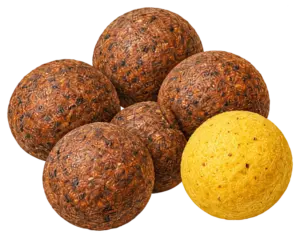
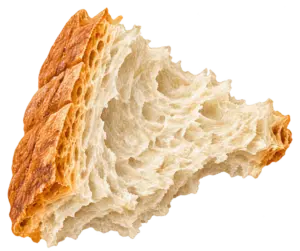
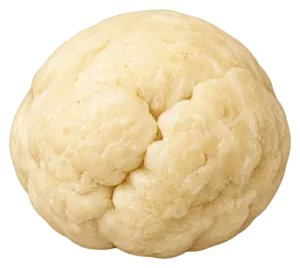
AI-generated illustrations. A click opens the lure’s page.
Rigs for these baits: running leger rig, float rig.
Plankton filter feeder: the bait is sucked in only by chance, deliberate catches are rare.
What a bighead carp brings to the plate and how to cut it up
In Saxony it is precisely the bighead carp that has become an important source of income for some pond farms. Its flesh is light and firm and tolerates almost any cooking method: it can be fried, deep-fried, grilled, baked in the oven, steamed, smoked and pickled.
Some care is worthwhile when cutting up. After filleting you pull off the skin and remove the fatty belly meat, which tastes strong. You cut off the section that lay above the ribs; it is free of bones. In the rest of the fillet the Y-bones lie diagonally lengthways. Cut it into strips with two or three bones each without severing any of them, and fry them breaded. At the table you break each strip in the middle: one half is boneless, from the other you pull out the bones whole.
What you need to observe
The bighead carp is non-native in Europe. According to the guideline of the Saxon fisheries authority (Fischereibehörde) it is not on the EU Union list of invasive species. The Bundesamt für Naturschutz lists it as unestablished and potentially invasive on its action list. Stocking and release of non-native fish are governed by state law and the water’s rules. In Saxony, for example, stocking open waters requires a permit from the fisheries authority.
Closed seasons (Schonzeit), minimum sizes (Mindestmaß) and harvest slots are set by the federal states (Bundesland). They differ by water and time of year. That is why we give no figures: what is binding is the fisheries regulation of your federal state and your fishing permit (Erlaubnisschein). You will find a list of links to the official sources in the catch calendar.
A fish that you may take and want to keep you stun and kill straight away in line with animal welfare (Stunning and killing fish). Protected fish, undersized fish or fish too large under a harvest slot you return gently to the water with wet hands (Releasing fish).
What closed season, minimum size and harvest slot mean and where to find them is explained on the page Closed season and minimum size explained.
Frequently asked questions (FAQ)
Can you target bighead carp?
Hardly. As a plankton filter feeder it takes baits only by chance. The best chance is with a small bait under a float in the middle of a cloud of groundbait.
Does the bighead carp breed in Germany?
No. It needs very warm, strongly flowing rivers with a rising water level to spawn. The stocks here come from stocking.
How do I tell bighead carp from silver carp?
The bighead carp is darker and spotted, its belly keel ends at the pelvic fins. The silver carp is plain silvery, the keel reaches far forward.
Sources
The rating of catch chances is an editorial assessment. The facts come from these sources, and the text is worded in our own words. The illustration is an original design by Angel Momente in the style of a natural history plate (AI-generated, see the AI notice).
- FishBase: Hypophthalmichthys nobilis (Temperaturbereich, Höchstalter, Nahrung, Merkmale)
- Sächsisches Landesamt für Umwelt, Landwirtschaft und Geologie: Leitlinien für die Nutzung von Silberkarpfen und Marmorkarpfen in Aquakultur und Fischerei
- U.S. Geological Survey: Nonindigenous Aquatic Species Database, Hypophthalmichthys nobilis
- Kolar et al. (U.S. Geological Survey): Asian Carps of the Genus Hypophthalmichthys, Biological Synopsis and Environmental Risk Assessment (Temperaturgrenzen)
- Bundesamt für Naturschutz: Gebietsfremde Fische, naturschutzfachliche Invasivitätsbewertung
- Blinker: Steckbrief Grasfische (Silber- und Marmorkarpfen: Größe, Nahrung, Fangmethode)
- Wikipedia: Marmorkarpfen (Herkunft, Größe, Nahrung, keine Vermehrung in Mitteleuropa)
- Fisch & Fang: Deutscher Rekord-Marmorkarpfen (Fänge in der kalten Jahreszeit, Rekordfisch im November)
- Missouri Department of Conservation: Carp Lemonade (Missouri Conservationist, Juli 2004)
Created with AI support from the sources listed. Figures only appear in the text if a source gives them. Last updated: 27 October 2026. Found a mistake? Write to us. Who is behind this site: About me.
More in the lexicon
- All fish species at a glance
- Catch calendar – month, water temperature and profile for 93 species
- Line calculator – breaking strain after the knot, drag guideline, backing
- Angling methods