
Destinations · the Netherlands
Fishing on the Rhine, Waal, IJssel and Meuse
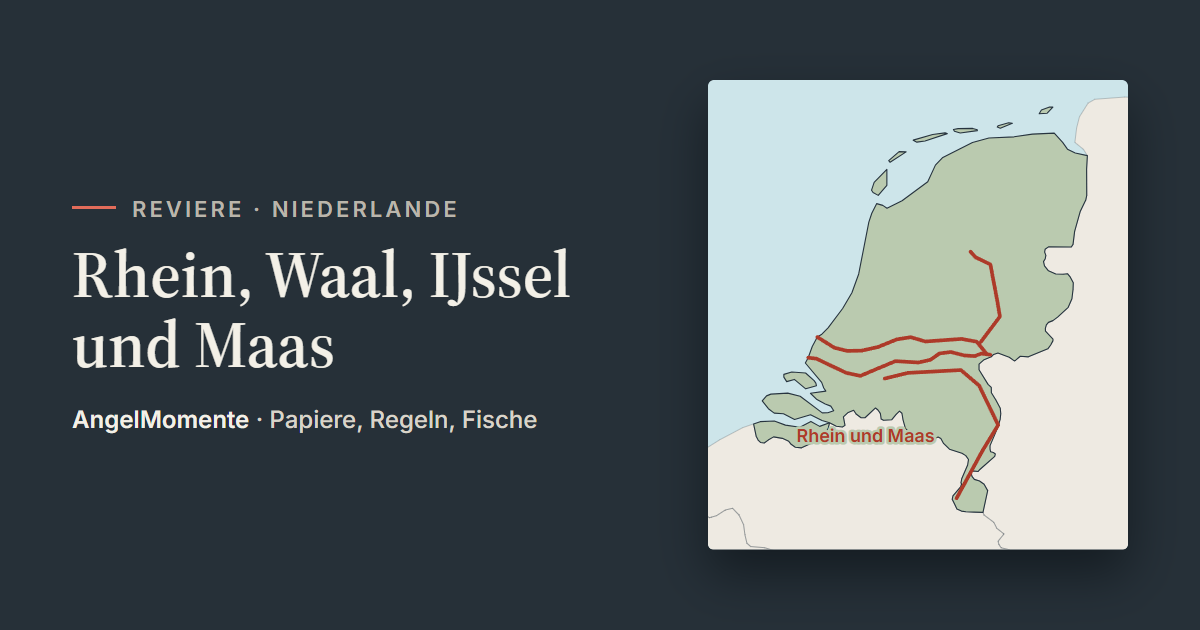
In the Netherlands the Rhine divides into the Waal, the Nederrijn with the Lek, and the IJssel, and the Maas enters the country at Eijsden. Rijkswaterstaat manages them as waterways, and only the Grensmaas is not navigable. With the fishing licence (VISpas) and the waters list you can fish many stretches of the Rhine, Waal, IJssel and Maas, but you may not even have eel in your possession there.
- Papers
- VISpas with waters list or the VISplanner app
- Season
- all year, bait ban 1.4.–31.5. (for pike, perch, zander until the last Saturday in May)
As of October 2026
At a glance
- Papers
- VISpas with waters list or the VISplanner app
- Licence and permit
- Season
- all year, bait ban 1.4.–31.5. (for pike, perch, zander until the last Saturday in May)
- Fishing seasons
- Night fishing only with a NachtVIStoestemming on stretches with a moon symbol
| Fish | Minimum size | Closed season | Catch limit | Note |
|---|---|---|---|---|
| Zander | 42 cm | 1.4.–31.5. | 2 | VISpas: 42 to 70 cm; closed season ends on the last Saturday in May |
| Pike | 45 cm | 1.3.–31.5. | 1 | VISpas: 45 to 80 cm; closed season ends on the last Saturday in May |
| Perch | 22 cm | 1.4.–31.5. | 3 | VISpas: 22 to 45 cm; closed season ends on the last Saturday in May |
| Asp | – | none | – | |
| Wels catfish | – | protected all year round | – | release immediately |
| Barbel | 30 cm | 1.4.–31.5. | – | Grensmaas: always release |
| Ide | – | 1.4.–31.5. | – | |
| Chub | 30 cm | 1.4.–31.5. | – | |
| Bream | – | none | – | |
| Eel | 28 cm | none | no keeping fish | possession ban on all the rivers named (Bijlage 16) |
Uitvoeringsregeling visserij, take limits from the VISpas conditions; no more than 15 fish in total, of which 5 over 25 cm. The waters list and VISplanner may be stricter. As of October 2026. The regulation and your fishing permit are what count.
Location and waters Rhine, Waal, Boven Merwede, IJssel, Maas and Grensmaas
The waters list and VISplanner give the rivers under their Dutch names and usually by stretch according to river kilometres. Under these names you will find your stretch:
Boven-Rijn and Pannerdensch Kanaal
At Spijk the Rhine enters the country and from there is called the Boven-Rijn. As far as Millingen the border runs down the middle of the river, and the south bank is German. At the Pannerdensche Kop it divides: two thirds of the water flow into the Waal, one third into the Pannerdensch Kanaal (Rijkswaterstaat).
Waal and Boven Merwede
The Waal is the largest arm of the Rhine and runs past Nijmegen, Tiel and Zaltbommel to Woudrichem. From there, where the Maas and Waal once joined, the river is called the Merwede (Rijkswaterstaat). The Boven Merwede is only 8.8 km long but belongs to the Antwerp–Rotterdam–Germany shipping axis, and ships run there thick and fast (Rijkswaterstaat). At Werkendam it splits into the Beneden-Merwede and Nieuwe Merwede.
The Waal appears in the waters list in many stretches by kilometre. The Boven Merwede near Gorinchem is included across its full width, with the harbours on the north bank, from about km 953,7 at the old Dalem lock to km 958. On the north bank you may put up a shelter such as an umbrella or a bivvy.
Nederrijn and Lek
The Nederrijn flows from the Pannerdensch Kanaal at Angeren to Wijk bij Duurstede, after which it is called the Lek and runs into the Nieuwe Maas at Krimpen aan de Lek (Rijkswaterstaat).
IJssel
The IJssel branches off at Westervoort and runs 127 km past Zutphen, Deventer and Kampen into the IJsselmeer. It almost always flows, and in spring, at high water, scour holes and the foreland often flood (Sportvisunie).
Grensmaas in Limburg
The Maas enters the country at Eijsden and is 196 km long here. The Grensmaas on the border with Belgium, from Maastricht to roughly Maasbracht, is not navigable, and ships use the Julianakanaal (Rijkswaterstaat). It is the only river in the country with a gravel bed (Rijkswaterstaat).
In the waters list it appears in two pieces: from the Borgharen weir to the mouth of the Geul, where the Visstand Verbetering Maas association holds the fishing rights, and from the Geul to the Belgian border at Stevensweert (border post 126). In the second piece you take no fish home; more under “Special rules”.
Maas in Limburg, Gelderland and Noord-Brabant
Below the Grensmaas the Maas is a waterway again. Seven weirs keep the navigable depth at 3 m. Between Linne and Buggenum, commercial ships use the Lateraalkanaal because the river meanders strongly there (Rijkswaterstaat).
In Limburg, the Maas appears in the waters list municipality by municipality, from Eijsden-Margraten to Gennep. In Noord-Brabant the list gives it for Land van Cuijk and Heusden by kilometre: from the Afferden weir (km 146,55) past the Grave and Lith weirs to km 226,3. Some stretches apply across the full width, others only to the Brabant or the Gelderland half. VISplanner shows which side is yours.
Bergsche Maas and Afgedamde Maas
Between 1888 and 1904 the Maas was dammed off at Andel and connected to the Amer and Hollandsch Diep by the newly dug Bergsche Maas. It is 24.5 km long and flows from Well past Heusden to beyond Geertruidenberg, where it is called the Amer (Rijkswaterstaat). The old riverbed has been called the Afgedamde Maas ever since.
Both are in the waters list, the Bergsche Maas from km 226,3 with the harbours of Heusden, Genderen, Drongelen, Hagoort and Dussen.
Hollands Diep and Biesbosch
At Werkendam the Nieuwe Merwede branches off and flows to the Hollandsch Diep (Rijkswaterstaat). The Hollands Diep begins where the Amer and Nieuwe Merwede meet (Rijkswaterstaat), with the Biesbosch between them. Waters, quiet periods and rules there have a page of their own: Biesbosch and Hollands Diep.
Fish and best time Asp, bream, ide and zander
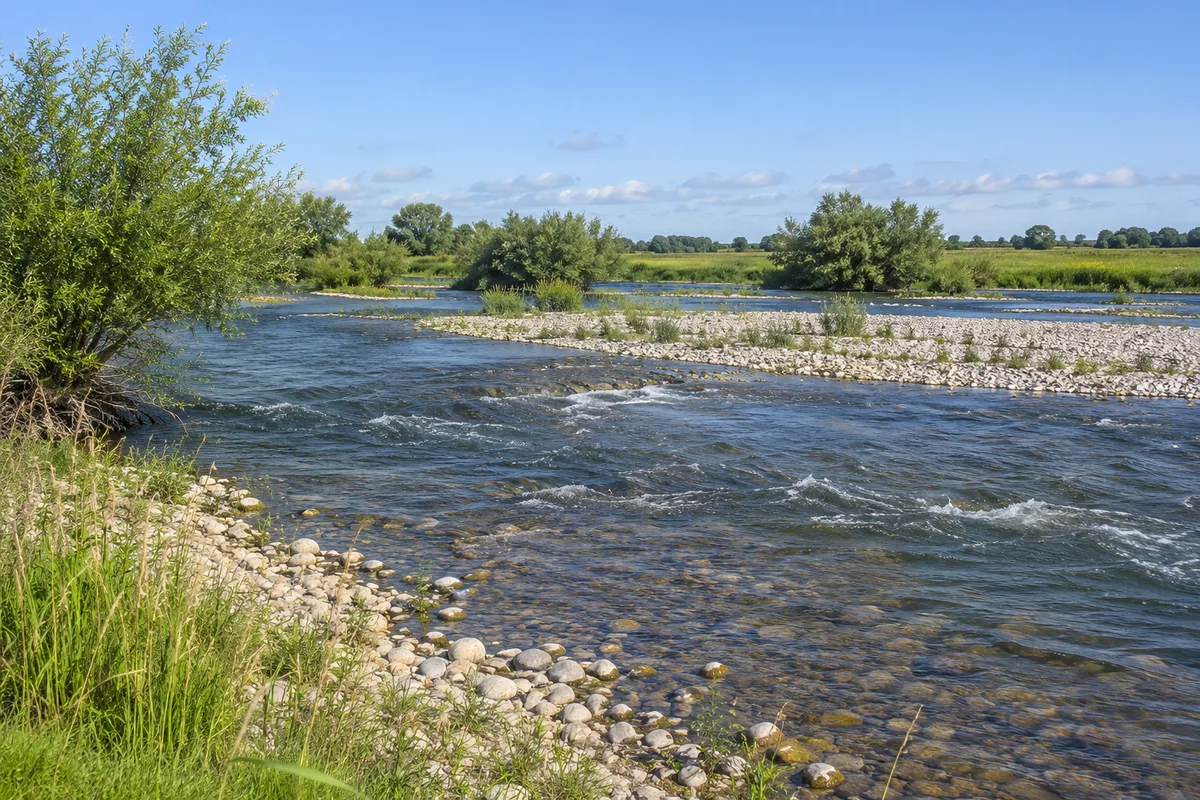
At 24 sampling sites in the Rhine delta, including in the Waal, Lek and IJssel, the International Commission for the Protection of the Rhine (IKSR) counted 41 species, more than in any other stretch of the Rhine (IKSR).
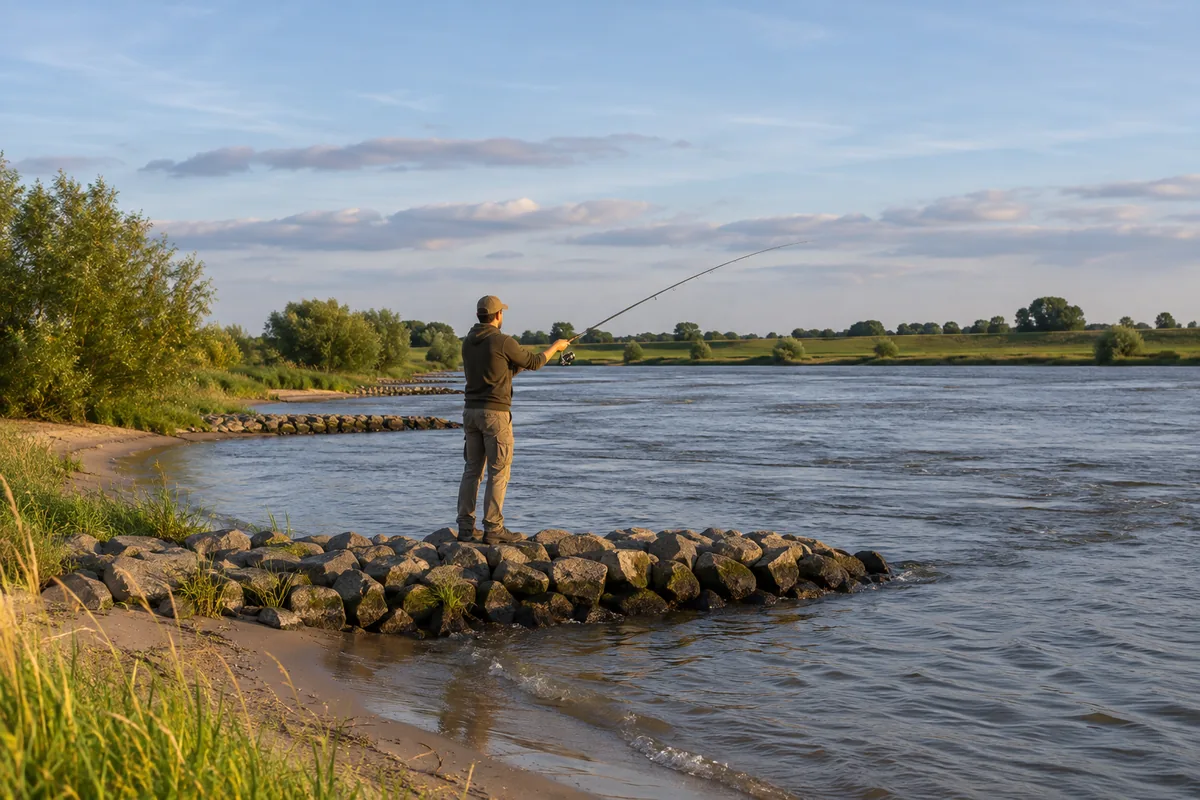
- Waal: In a survey in autumn 2023, 28 species ended up in the net, mainly bream and roach. Among the fish that like current, the vimba was followed by asp and ide (Sportvisunie).
- IJssel: On summer evenings, asp and bleak stand in the groyne fields. With the feeder, bream, ide, barbel and big roach are possible. For pike and zander the chances are best in summer, and wels catfish are increasing (Sportvisunie).
- Grensmaas: Formerly a barbel river, today barbel catches have fallen sharply. Asp and wels catfish are doing well, and zander and pike are joining them. In the warm months, asp take lures mainly early in the morning and in the evening (Sportvisunie).
What else bites when is shown by the catch calendar.
Papers and permit VISpas and waters list
- VISpas: For most inland waters you need it (Rijksoverheid). Only together with the waters list or the VISplanner app is it your written permit (Sportvisunie).
- Purchase: You order the VISpas online from the Sportvisunie, and the site is also available in German. After payment you receive a provisional VISpas by e-mail, together with the waters list (VISpas bestellen).
- Stretches: The rivers are listed by stretch according to river kilometres. Check in VISplanner whether your bank is included.
- German bank: The south bank between Spijk and Millingen belongs to Germany. What applies there is explained under Rhine in Germany.
- Belgian bank of the Grensmaas: The other bank lies in Belgium. In Flanders you need the Vlaams visverlof for public waters (Natuur en Bos).
Special rules Eel ban, weirs and baits
Closed seasons, minimum sizes and take limits are in the “At a glance” box. The wels catfish is protected all year round in the Netherlands, as are salmon, sea trout and vimba. A protected fish goes straight back into the same water (Reglement minimummaten en gesloten tijden). In addition:
- Eel: At the water and near it you may not have eel in your possession. This applies to the Boven-Rijn from Spijk, Pannerdensch Kanaal, Nederrijn, Lek, Waal, Boven-Merwede, IJssel, the Maas from Eijsden, Bergsche Maas and Afgedamde Maas (Uitvoeringsregeling visserij, Artikel 28b and Bijlage 16). Even with the VISpas every eel goes straight back, as do carp and grass carp.
- Weirs: On the Neder-Rijn, Lek and Maas, fishing is prohibited up to 75 m below a weir, as well as in the fish pass and 25 m before its upper end. If the weir is out of operation, the ban does not apply (Artikel 28c).
- Baits: From 1 April to 31 May, slaughter waste, dead baitfish, fish strips and artificial lures are prohibited, with the exception of artificial flies up to 2.5 cm (Reglement voor de binnenvisserij, Artikel 6). For pike, perch and zander, this ban ends on the last Saturday in May (Artikel 61). With the VISpas you also may not fish in this period in a way that is likely to catch zander, for example with a drop shot or a jig head with a worm.
- Catch: With the VISpas you may keep no more than 15 fish, of which no more than five over 25 cm. Two rods are allowed, a third only with a Derde Hengeltoestemming on waters with the symbol.
- Night fishing: The law does not forbid it on the Rhine, Maas and IJssel. With the VISpas, though, you need the NachtVIStoestemming, and it is valid only on stretches with the moon symbol in the list and VISplanner (Sportvisunie). Anyone aged 16 or under fishes at night only in the company of an angler aged 16 or over with the right permit.
- Grensmaas and Maastricht: From the mouth of the Geul to Stevensweert, the waters list forbids taking fish. Carp, barbel, dace, common nase, brown trout, sea trout and salmon are released immediately there. In Maastricht and Eijsden-Margraten every fish goes back alive, and keepnets and night fishing are prohibited there.
- Shipping: With the VISpas you may not fish from a belly boat where commercial shipping could be obstructed, and on no account in the shipping channel of large waterways such as the Waal.
As of October 2026. What counts are the Uitvoeringsregeling visserij and the conditions in the waters list and VISplanner for your stretch. VISplanner is always up to date.
Safety
- Suction and wash at the groynes: Even between the groynes, suction and wash from passing ships can be very strong. In the groyne field, current, eddies and differences in depth make the water dangerous (Rijkswaterstaat). When a ship passes, the water in the groyne field first draws back and then surges up again, so keep away from the water’s edge.
- Ships: A large ship can neither brake at once nor swerve at short notice. Inland ships often have a blind spot of more than 350 m (Rijkswaterstaat). For a motor boat that travels faster than 20 km/h or is longer than 15 m, you need a boating licence. More under Boats and life jackets.
- Gauge: On the Grensmaas the water can rise by two metres in a few hours (Sportvisunie). You will find current water levels on Waterinfo.
- Emergency: 112. More under Bank and waders.
Related
- Fishing a river and Fishing in the Netherlands
- Downstream: Biesbosch and Hollands Diep, upstream: the Rhine in Germany
- Species in the rivers: zander, asp, barbel, ide, wels catfish
- Feeder fishing, Night fishing and Closed season and minimum size explained
Sources
- Uitvoeringsregeling visserij (Fassung vom 11.07.2026): Artikel 5b, 5c, 28b, 28c, 61 und Bijlage 16
- Reglement voor de binnenvisserij 1985 (Artikel 6 und 7) und Reglement minimummaten en gesloten tijden 1985
- Rijkswaterstaat: Vaarwegenoverzicht (Boven-Rijn, Waal, Boven- und Beneden-Merwede, Nederrijn, Lek, IJssel, Maas, Bergsche Maas, Nieuwe Merwede, Hollandsch Diep), Veilig zwemmen, Veilig varen und Grensmaas (08.05.2024)
- IKSR: Fische im Rhein 2018/2019, Bericht Nr. 279 (2021)
- Sportvisunie: Gezamenlijke Lijst van Nederlandse VISwateren 2026 bis 2028 mit den Bedingungen des VISpas, VISpas (deutsch), Lijsten van VISwateren, NachtVIS- und Derde Hengeltoestemming und Beiträge zu Waal, IJssel und Grensmaas
- Rijksoverheid: VISpas und Agentschap voor Natuur en Bos: Visverlof
Guide without guarantee, as of October 2026. What counts are the Dutch regulations, the conditions of the VISpas and of the waters list for your stretch and, on the Belgian bank, the Flemish rules in their current versions.