
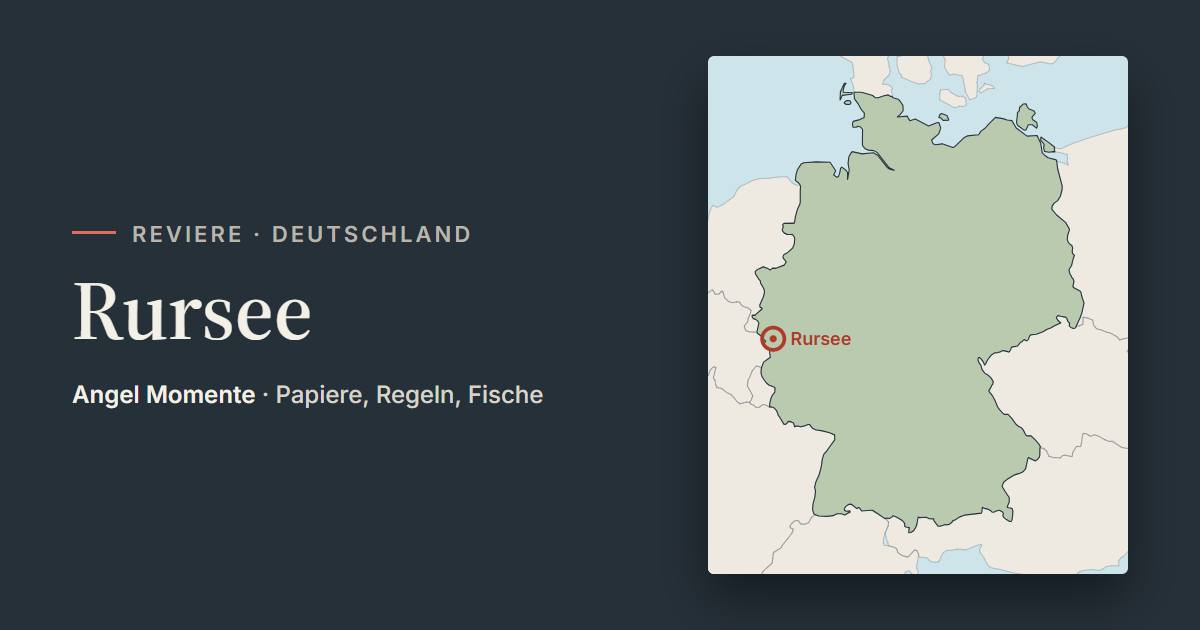
Waters · Germany
Fishing at the Rursee
The Rursee in the northern Eifel is the main lake of the Rurtalsperre Schwammenauel; above it lies the Obersee, a drinking water reservoir. The fishing permit (Erlaubnisschein) for both is issued by the Fischerei-Pächtergemeinschaft Rursee. Its minimum sizes for pike and zander are above those under state law, and there are fixed daily limits as well.
- Papers
- Fishing licence and fishing permit from the FPG Rursee
- Fishing seasons
- Boats on the main lake only from 1 hour before sunrise to 1 hour after sunset
As of October 2026
At a glance
- Papers
- Fishing licence and fishing permit from the FPG Rursee
- Licence and permit
- Fishing seasons
- Boats on the main lake only from 1 hour before sunrise to 1 hour after sunset
| Fish | Minimum size | Closed season | Catch limit | Note |
|---|---|---|---|---|
| Pike | 55 cm | 15.2.–30.4. | 2 a day together with zander | no predator fishing during the pike closed season |
| Zander | 50 cm | 1.4.–31.5. | 2 a day together with pike | |
| Perch | – | none | – | predator fishing banned from 15.2. to 30.4. |
| Large whitefish (Große Maräne) | 28 cm | 15.10.–15.1. | 12 a day | hegene rig with no more than 5 nymphs |
| European lake trout | 50 cm | 20.10.–15.3. | 5 together with carp and tench | brown trout 25 cm |
| Carp | 35 cm | none | 5 together with trout and tench | |
| Eel | 50 cm | none | 4 a day | |
| Wels catfish | – | none | – | every wels catfish must be kept |
| Bream | 25 cm | none | – | silver bream also 25 cm |
| Roach | 18 cm | none | – |
Angling conditions of the FPG Rursee from 1 January 2026 for the Rurtalsperre and Obersee; no more than 20 fish a day in total. For species not listed the state fisheries regulation of NRW (Landesfischereiverordnung) applies. As of October 2026. What counts are the regulation and your fishing permit (Erlaubnisschein).
Location and waters Rurtalsperre Schwammenauel and Obersee near Heimbach
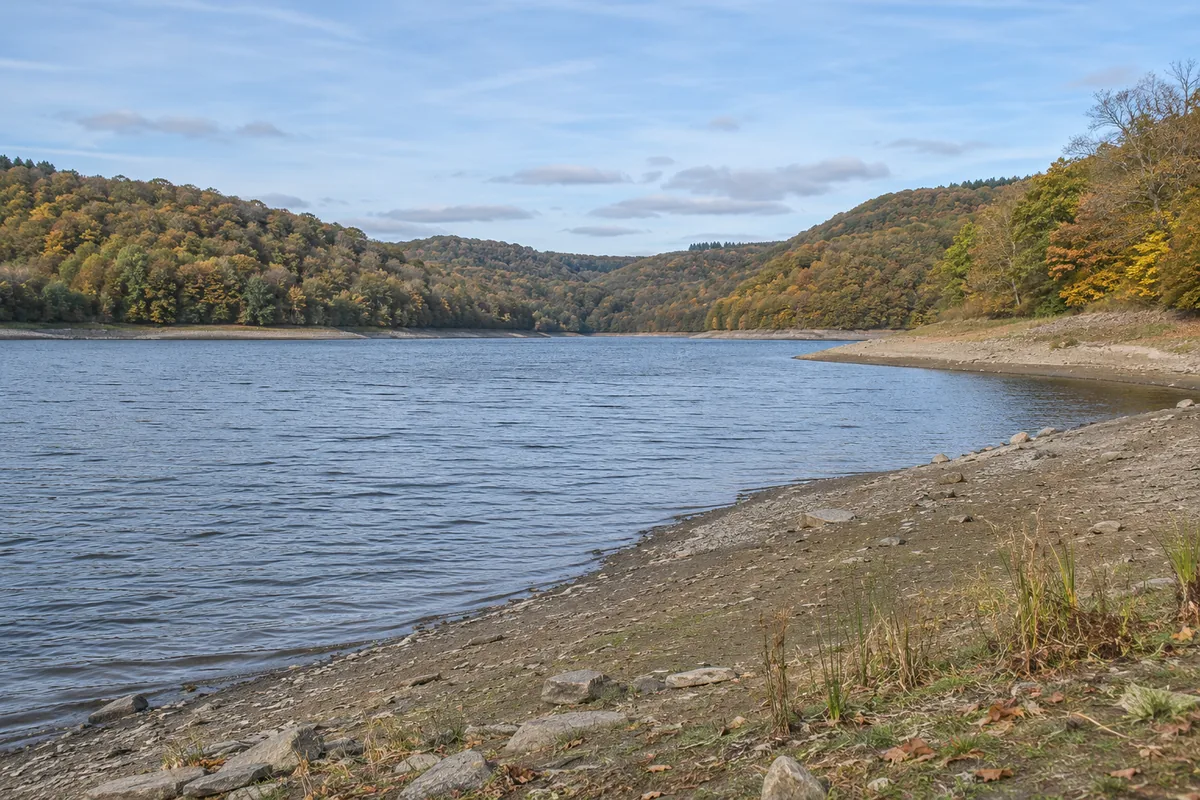
The dam stands in the Rur valley above Heimbach in the Düren district (Kreis). It was built in two stages, from 1934 to 1938 and from 1955 to 1959. Since then the reservoir has held 202,6 million cubic metres at full capacity, which makes it the second-largest reservoir in Germany. Its basin stretches 24 km through the valley, and the water surface measures 7,83 km². In winter the Wasserverband Eifel-Rur keeps more space free for floods than in summer (WVER: Die Rurtalsperre).
The Paulushofdamm impounds the Obersee as a pre-dam. Its water level stays almost constant, and it supplies the greater Aachen area with drinking water. The leaseholders‘ association has leased the fishing rights from Einruhr to Schwammenauel, including the Obersee, since 1959 (FPG Rursee: Gewässer).
Fish and best time Pike, zander, perch, whitefish and wels catfish
The leaseholders‘ association sets minimum sizes and closed seasons for these species (Angelbedingungen der FPG Rursee):
- Predators: pike, zander, perch and wels catfish.
- Salmonids and whitefish: lake trout, brown trout and the common whitefish (Große Maräne), which you will find in the lexicon under whitefish.
- Coarse fish: carp, tench, bream, silver bream, roach, ide and eel.
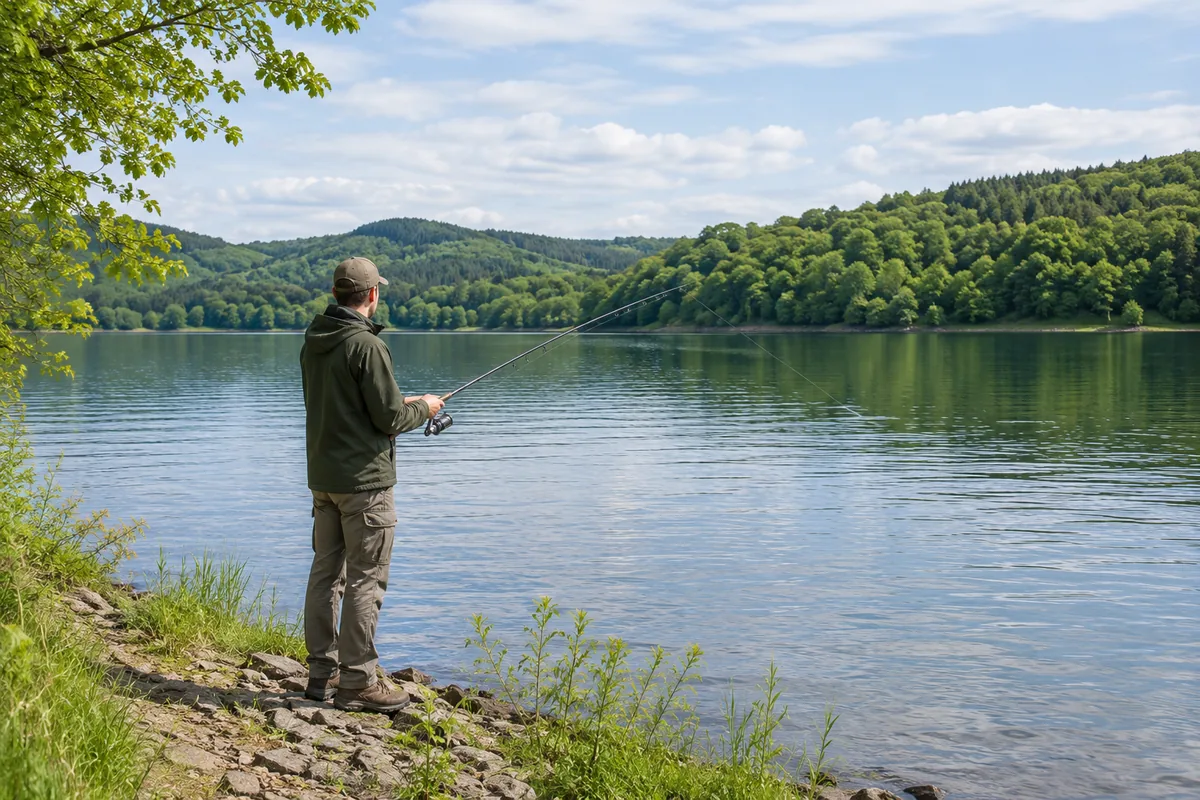
The lake has little structure, and the fluctuating water level makes spawning difficult. That is why the leaseholders‘ association stocks fish every year. Predator fishing only starts again in May, because as long as pike are protected, predator fishing stops completely. Zander even stay protected until the end of May. For whitefish the closed season begins in mid-October. When which species bites is shown in the catch calendar; how to read a reservoir is explained under Fishing on the reservoir.
Papers and permit Fishing licence and fishing permit from the FPG Rursee
- Fishing licence (Fischereischein): Without it there is no fishing permit. In North Rhine-Westphalia it has been valid for life since July 2026, only with the fishing levy (Fischereiabgabe) paid, and you may also show it electronically (Landesfischereigesetz, §§ 31 und 35). Guests from abroad can get an annual fishing licence without an exam if they prove their knowledge in another way. More under Fishing in North Rhine-Westphalia.
- Fishing permit (Fischereierlaubnisschein): It is available as a day, 3-day, week and annual permit. It is valid for the main lake and the Obersee. You can buy it at the leaseholders‘ association’s outlets around the lake and in the region. Only the person named on both documents may fish.
- Children: Until their tenth birthday a child may fish with one of the adult’s two rods. Dealing with and killing the catch remains the adult’s job. From 10 to 15, young people may fish under state law only when accompanied by a fishing licence holder. More under Fishing with children.
- Catch record: You enter every fish you keep and return the record to the leaseholders‘ association, even if you have caught nothing.
Basics: Fishing licence and angling exam and Fishing permit and water card.
Special rules Two rods, catch limit, protected areas and boats
- Tackle: two rods, each with one bait or a hegene rig with no more than five nymphs. You keep rods that are set out in view at all times.
- Predators: Use a steel or fluorocarbon leader of at least 40 cm. With dead baitfish steel is mandatory. Live baitfish, the baitfish drop net (Köderfischsenke) and baitfish brought from other waters or bought in shops are banned, as are gobies as bait.
- Catch limit: no more than 20 fish a day. Of these, only two may be pike or zander, four may be eels, twelve whitefish and five trout, carp and tench combined. Once a group is full, you stop fishing specifically for those species. You keep every wels catfish.
- Banned: live sonar; even the transducer must not be on board. The same goes for competitions and selling your catch.
- Protected areas: Between 20 October and 15 March a 50 m strip reaching out into the lake is closed at the stream mouths, as is the inflow of the Rur into the Obersee. A 50 m ring stays clear around the passenger boat landings. In the two diving bays there is no fishing while diving is going on.
- Obersee: Because it supplies drinking water, groundbaiting is banned. You may only fish from a boat here using the leaseholders‘ association’s rowing boats. The Eifel National Park borders the Urft arm: from the bank you may fish there all year round, except on the peninsula in front of the Urft dam and within 50 m of it. The main lake is not part of the national park.
- Boats on the main lake: From 1 April to 15 November every boat needs a badge from the Wasserverband. For winter there are only 150. Combustion engines are banned. An electric motor needs its own motor badge, even if it is only carried, and oars or paddles stay on board. When trolling you fly a red flag and keep out of the shipping channels (Freizeitordnung des WVER).
- On the bank: Parking on the bank, camping, campfires and barbecues are not allowed at the reservoir.
The minimum sizes in the box come from the angling conditions. For pike and zander they are above the values of the state fisheries regulation (Landesfischereiverordnung); for species not listed the regulation applies. Return protected or undersized fish immediately and carefully.
As of October 2026. The leaseholders‘ association’s angling conditions have applied since 1 January 2026, and the Wasserverband’s leisure rules (Freizeitordnung) date from 6 November 2025. Annual and five-year fishing licences issued before 1 July 2026 remain valid until their expiry date. Read the angling conditions in full before your first cast.
Safety
The water level in the main lake changes constantly and can drop very low in dry periods. Rocks, mounds of earth, tree stumps and scrub then lie just below the surface along the bank. You walk on the bank to fish at your own risk. Dam structures, embankments and gauges are off limits away from the paths (Freizeitordnung des WVER). More under Bank and waders.
You do not go out on the main lake at night. From one hour after sunset to one hour before sunrise it is closed to boats, as it is when visibility is below 100 m or there is ice. Keep 10 m away from floating barriers. More under Boat and life jacket and Walking on ice.
Related
- Fishing in North Rhine-Westphalia and Möhnesee
- Pike, zander and whitefish in the fish lexicon
- Spinning and Closed season and minimum size explained
Sources
- Fischerei-Pächtergemeinschaft Rursee: Richtlinien für die Ausübung des Fischens in der Rurtalsperre Schwammenauel einschließlich des Obersees (gültig ab 01.01.2026), Gewässer, Karten kaufen und Legal notice (Impressum)
- Wasserverband Eifel-Rur: Die Rurtalsperre und Freizeitordnung für den Hauptsee der Rurtalsperre (06.11.2025)
- Landesfischereigesetz Nordrhein-Westfalen (Fassung ab 1. Juli 2026) und Landesfischereiverordnung NRW (Fassung ab 3. Juli 2026)
- Landesregierung NRW: Nordrhein-Westfalen führt digitalen Fischereischein ein (29. Januar 2026)
Guide without guarantee, as of October 2026. What counts are the state fisheries act (Landesfischereigesetz) and the state fisheries regulation (Landesfischereiverordnung) of North Rhine-Westphalia, the angling conditions of the Fischerei-Pächtergemeinschaft Rursee and the leisure rules (Freizeitordnung) of the Wasserverband Eifel-Rur.